
Passive-Aggressive. Pros, Cons & Strategies
The passive-aggressive:
- Doesn’t speakup, same as the passive
- Craves control and respect as much as the aggressive
The result is a mix:
- Capitulation out of fear
- Followed by unexpressed anger
- Followed by undercover aggression and sabotage to win, or to exact revenge
Traits & Behaviors
- Negative interpretations
- Covert aggression
- Sneaky behavior. Ie: “forget” to CC you when reporting a win to the boss
- Attacks you anonymously
- Fake smiles
- Execute poorly when they lacked the courage to say “no”
- Ambiguous to avoid commitment
- Communicate with “hints”. Ie.: they only clean half the house to say “do the other half”
- Get angry at something else in your presence
- Talk behind your back
- Murmur their attacks
🔎 Example
Him: (fighting his own irritation, moving towards aggression) Ma’am! I answered your question
Her: I’m sorry sir?
Him: (back to passive, forces a smile) Ma’am, I answered your question. I answered. I’m cooperating here, and there is no… (mutters)
Her: Sir, you have no call in getting snippy with me, I’m just doing my job here <— “Just doing” is unneededly defensive, but good attitude
Him: (retreats further)
Avoiding The “Too Nice Passive-Aggressive”
Sometimes people behave passive-aggressive because they over-deny feelings of anger and enmity.
They can deny it both internally, to themselves, and externally, hiding them from public view.
In this interview for example:
Rossi: It sounds to me a bit strange, because in reality, we don’t have any problem (and then refuses to shake hands with the man he “has no problem with”)
A great example to show that power and assertiveness, are not the same.
Rossi is high-power in the video above, but lacks assertiveness and falls into the passive-aggressive trap.
Marquez plays it Machiavellian to look friendly and candid, as if to say “I’d love to be friends, I’m good, it’s him who doesn’t want”.
That contrast makes Rossi seem unjustifiably angry and vindictive.
So, what was a better alternative for Rossi?
Think about it please.
And later you will see a similar situation, but with an assertive approach.
The Use-Cases of Passive Aggression
The general rule:
1. Display Your Disapproval When You Can’t Afford Direct Talk
Direct talk isn’t always possible.
And it’s not always in your best interest.
Then covert aggression is sometimes better than pretending all is fine.
Here is a good example:
Trump: (Calls Comey to go to him, and adds a one) He’s become more famous than me
Comey: (Shakes his head. Then shakes Trump’s hand while looking at him as little as possible)
Trump wanted Comey to submit.
And to send a message that he was in charge, and Comey had to toe the line.
However, assertiveness in that situation was difficult for Comey.
So passive-aggression was perfect for Comey.
2. To negotiate status
🔁 Same as for aggression.
And same as for aggression, we generally advice not to.
3. Make it “less of a big deal” and smoother
Assertiveness frames things as a big deal.
A little power move is more appropriate for smaller stuff.
Or when you want to save time.
🔎 Example
A receptionist called my room and asked to pay because “their boss was getting angry at them for unpaid stays”.
As a long-term and returning guest, I didn’t appreciate it.
But I also didn’t want to make it a big deal.
So when I later stopped to pay I said:
Me: Hey guys, so your boss was getting angry or something
(after paying)
Me: Alright, paid now, so your boss can calm down and be happy <—- 📣 Sub-communication 🟰 “the boss was being an idiot”
Recptionist: (Apologizes) <—- she got the message
Me: If you need me to pay in advance, just let me know <—- covert reminder that I had the option to pay after
There was little assertiveness here.
But it was quicker, smoother, and higher power.
4. To prepare the ground for later assertiveness
Early assertiveness can make you look over-reactive or thin-skin.
- And it’s often too high an investment.
- Especially in text messages.
Let’s see an example:
Case Study: Relationship Management
I thought my girlfriend could eat better for her benefit.
I was encouraging her to have less carbs/friend food and more vegetables.
I jokingly remind her so:
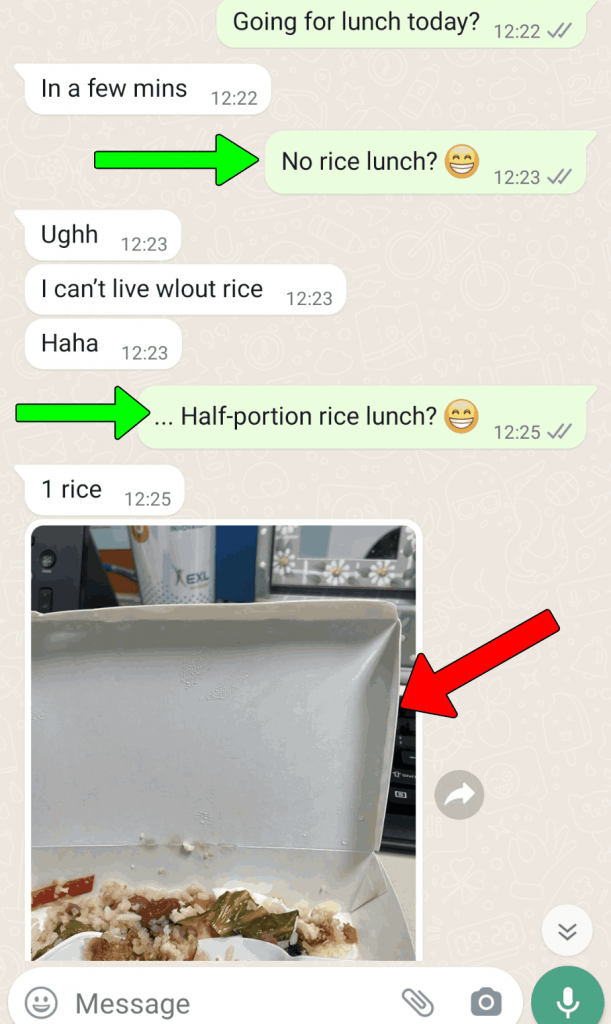
Me: going for lunch today?
Her: in a few mins
Me: No rice lunch? :D <—- Power-protecting nudge
Her: Ugh, I can’t live without rice <—- Rejects it
Me: half-rice lunch <—- I compromise
Her: 1 rice <—- She does NOT compromise
Her: (sends a picture of a meal mostly out of rice)
My approach can be overbearing for some.
But I’m also caring for her well-being.
When she snubs me this way, I feel it’s disrespectful and lose-lose.
I give her one chance to show a better attitude:
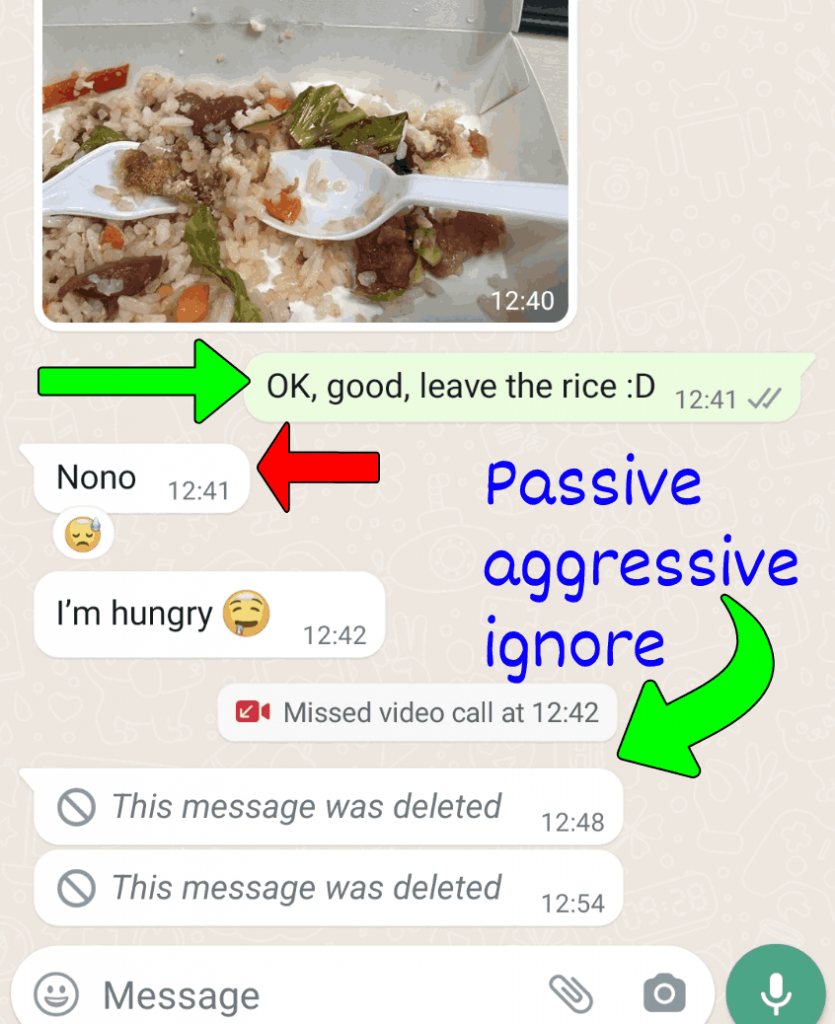
Me: OK, good, leave the rice :D <—- 3rd chance to cooperate
Her: Nono, I’m hungry <—- At this point it feels rude. And a power showdown
Me: (stops replying, does not pick-up her call, and puts a “disappointed reaction” to her “nono”) <—- Passive aggressive, no direct talk
My analysis is this:
- Power: defiant behavior, negates any influence
- Emotional: devaluing my care for her
- Quality: low quality behavior, both towards herself, and the relationship
HOWEVER,
Assertiveness would be out of place:
- Uncalibrated because I never clearly requested that she’d cut out white carbs
- Too high investment
- Too abrupt going from joking/chatting to serious
- Too “grave” on text
- Ineffective, and take too long. She may not have understood I cared. Or pretend that she didn’t understand
And I would also come across as lower-value as it would seem like I’m overreacting, thin-skinned and over-concerned about power only (instead of concerned about power, for sure, but also concerned for her well-being and our relationship).
So, I let it sit, ignore her, and stop replying.
You can already see it’s effective: she deleted messages.
My emoji and withdrawal made her emotional and reflective.
She probably worried about the state of the relationship, about my feelings.
That’s all great: the perfect set up for assertiveness in person.
And look what happens next:
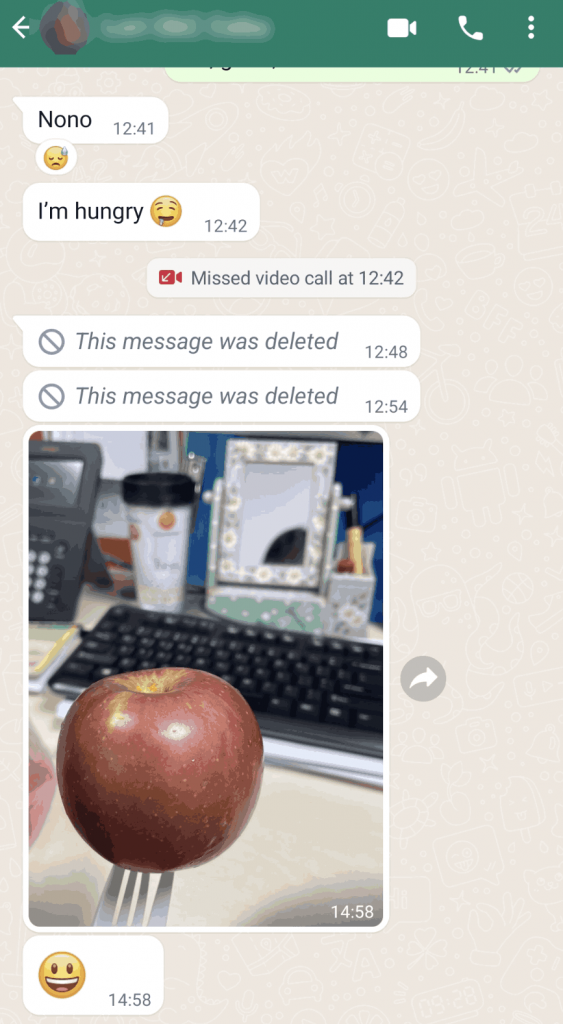
Her: (recalls and delets previous messages)
Her: (sends a picture of an apple, displaying the eating behavior that I encouraged)
Bingo!
She sub-communicates both self-care, and respect for my wishes.
Assertiveness may not even be necessary this time.
But it’s a good precedent in case this behavior repeats.