
How To Start A Social Circle In 10 Steps
This is the funnel infographic we use at Seduction University:

Obviously, dating is not the exact same thing as making friends and building social circles.
But there is a lot in common.
Starting from the fact that you can see friendship-making as a focused effort with higher initial investment during the lead-generation phase, and a longer and lower intensity period during the relationship phase in which you’ll be enjoying the fruits of your work.
And you can repeat that process any time and anywhere you need new friends.
The backbone process looks like this:
1. Start The Process: Go Out, Socialize, Organize (Get Leads)
- Join Meetup events
- Join clubs
- Talk to strangers, basically, yes, you can “cold approach” same-sex individuals or opposite-sex people for friendships. I’ve done it more than once, and it always worked well.
To make it easier:- People with a striking resemblance: for example, dressing similarly to you, or having similar body shape
- People at your favorite place, or ordering your favorite food
- Other foreigners or ex-pats if you are one yourself
- People doing similar activities as you, for example, if you’re in line for a massage, or if you see him approaching women and that’s something you’re also doing, have done, or would like doing
Or, better yet…
2. Start Your Own Event (Even Better!)
Same as for dating for men:
Socializing higher power is better than lower power.
And a great high-power position to be in is that of the host.
Organizing events is easier than most people think because there often are many people wanted to socialize and make new friends but do not take the first step.
I remember one year in Berlin, there was a girl who wanted to go to the lake but didn’t know anyone and couldn’t find any group for it.
She organized one herself… And more than a hundred people signed up!
In my travels, I organized several events, and even in smaller cities at least a handful of folks showed up.
3. Socialize & Exchange Contacts
The first meeting is more “social” than “friends”.
Yes, it’s certainly possible to already go from strangers to friends in the first meetup, but if it’s a group meetup, we’re still top of the funnel.
And you better approach with a “let’s socialize” mindset, rather than “let’s make a great friend”.
This may not yet be the time for very deep conversation or for vulnerability.
As much as you’d want for a date, you want to put your best foot forward without looking like you’re trying to impress.
If that sounds Machiavellian, it’s really not: it’s just how high-quality people are.
You want to make a good impression, but you don’t want (and ideally don’t even like) to brag or show off.
I recommend here you go for the baseline of high-warmth and high-power, and slightly higher energy than average -and higher than you’d be in a 1:1 meeting-.
Plant the seeds of 1:1 friendships with “on the side 1:1s”
If you stop at socialization only, all you’ve had is a night out of socialization.
Not bad, but we’re aiming for more stable friendships and social circles here.
To also make friends, think of it as a social event and a “speed dating” event at the same time.
You want to have a string of 1:1, interspersed with larger group-level fun.
To get to the next step, you need to:
- Display some value at the group level
- Look at the speaker
- Take your turn to speak and give value
- Crack some jokes if you can
- Laugh along to other people’s good jokes
- Start side conversations to get to know some specific individual
- Find some commonalities
- Exchange contacts
- Go back to group-level
- Rinse & repeat
Avoid the “let’s be friends approach”
In dating, you don’t wanna say “let’s be in a relationship”.
Similarly, in socializing you don’t want to say “let’s be friends” because that tends to be a lower-value frame.
The “let’s be friends” approach sub-communicates that:
- you don’t already have friends
- you make get clingy
- you may chase them too much
- etc. etc.
Instead, frame it as keeping in touch, because you had a good time, helping each other out, or doing something in the future.
Do This
- Say you’re exchanging to keep in touch because it’s more casual, pressure off, and prevents a frame of you wanting something from them -or chasing them-
- Say you’re exchanging to organize something else in the future so that the frame is that of giving value
- Say you’re exchanging to “maybe do something in the future”, and note the “maybe”, which ensures that you sub-communicate you’re busy and probably also have other friends
- Just say “let’s exchange contact”, without adding anything else. This may be my go-to method
- If it’s a small gathering, exchange contact with everyone, even the people you don’t plan on following up with. This is both to look more social and to stem off potential risks of sexual interest
4. Assess people and choose the best ones to follow up with
Talk to them all and ask yourself:
- Would they make good friends?
Some good behaviors to observe:
- How many questions do they ask VS how much do they talk themselves? People who talk too much without enough questions aren’t going to be good listeners when you need someone to talk to
- What they talk about, and see if there is an overlap with your interests and personalities
- Power/warmth signals: are they kind of people you respect, or are they too meek and clueless? Do they talk over others, are they generally respectful?
Suggestion: If it’s a small group and you leave early, pay
This is not necessary, but if you can afford it, go for it.
It’s a bit of a power move, but a value-giving one.
Then, notice who says “thanks” and who doesn’t.
5. Follow Up The Day After With The Best Folks
Some people are surprised to hear this general law of dating:
Things either progress fast, or they won’t progress at all.
But actually, the same is true for friendships, and among guys.
And the more randomly you meet them, the more you want to be fast in organizing the next thing.
So you have a few options here:
- Send a text right after the first meeting
- Send a text the day after
I like the day after because on the day after you can already set up the next meetup, without looking “thirsty” or chasing.
A good text:
You: hey mate, hope all good there, good time cathcing up yesterday
Let the person reply and see if they propose another meetup themselves.
If they do, say “yeah, for sure”.
If not, you say “cool, keep in touch man”.
Don’t propose another meeting already: it’s too soon.
6. Organize a second round (individual 1:1s and/or smaller group)
After the first meeting, you can already follow up 1:1 if you had good chemistry.
But if you haven’t had the chance of talking to anyone well and deeply enough, then it’s best to have a “second round group”.
From a Mach and power dynamics point of view, it’s also better to do a second round as a smaller group if you were the organizer.
That’s because as the organizer you’re higher power, and by inviting out individuals you “come down at their level”. It’s not bad in any way, but you can maximize that power with a smaller second group.
That’s because if you re-organize a smaller group, the frame is that you’re still the “top dog” organizer -and you selected the best ones-.
For the second round group, you select the best individuals from the first meetup individually.
You do it individually because it’d be too early for a common group, and because it doesn’t hurt that you remain the organizer.
Example:

That second one we were just 3, met near my place, and I led them to one of my favorite restaurants.
There, we deepened and cemented the friendship among us.
Don’t be afraid to compromise to make it happen (calibrating to their value)
From a social dynamics point of view:
You meet at the convenience of the higher-value person.
However, the same as for dating, you want to approach this with the goal in mind.
Power dynamics are always a factor to keep in mind of course, but so making things happen.
Hence, if they seem like great guys but cannot make it on the second meetup you invite them to, consider finding time to meet 1:1 around their schedule.
Why?
Because:
- Early contacts & relationships are tenuous, and just like dating, contacts grow stale unless you “convert them”
- The more it fails, the more it seems like you’re chasing to make it happen because the dynamic is “you invite them, but they had higher priorities (than you)”
- It feels like “not meant to be”. Just like dating, even guys may start thinking “it’s not meant to be”.
So securing the relationship early on can be worth your extra investment.
Power and give and take can be adjusted as you go, and good people are going to appreciate you making it happen and will make up for it.
7. Invite New Guys To Your Forming Social Groups
As you’re forming new groups, keep on meeting new people.
Why?
Because:
- It’s more natural to invite new people to newly forming groups, rather than established ones. Once you have established ties, your friends may expect you to meet 1:1 or with other friends they also know, rather than semi-strangers
- You self-frame as a cool and high-value sociable person, making the group and friendship-building all the easier
- It’s generally higher power to invite to a social gathering, rather than to a 1:1. And it’s also higher odds and more “natural” if you met a guy in cold-approach
Of course, much of the appeal of your newly forming groups is about how you present it.
Look at this example:

8. Meet 1:1 (To Deepen Friendships)
The good news is:
You can get social circles and individual friends at the same time.
All you need to do is to set up some meetups as groups, and some others just you and one other person.
Generally speaking, you don’t want to verbalize the “we meet just you and I”, but let it flow spontaneously based on the unspoken but common understanding that you two are particularly close, particularly cool, particularly similar, or share some unique features the others don’t -ie.: you’re both dating, both married, both building a business, both from the same country or whatever-.
Invite, rather than ask: 3 good formats for inviting out
Same as for groups:
In the beginning, it’s slightly better to invite rather than ask.
However, beware: you don’t wanna make it seem too much like a “take it or leave it” or “I don’t really need you” as that’s too dismissive and power move-y.
Instead, you want some “honest vulnerability” that sub-communicates “I have the pleasure to see you”.
So a good simple format is:
You: hey mate, going to try X restaurant later today, if you wanna join would be cool to catch up, just let me know
Or a bit more direct:
You: Hey mate, was thinking to go for some food this evening at X, wanna catch up?
And more casual, which I like most when you’re closer and more established as friends:
You: if you’re up for a coffee later or another day, just let me know
Keep it pressure off in the beginning
To avoid seeming like you’re chasing friendships or company, you want to keep it “pressure off”.
For example, a “pressure off” invite with someone you’ve been with for business or work only, would look like this:
Thank you so much! And happy to meet for lunch or dinner one of these days
Such as, you don’t go the full distance or ask or invite but instead put the interest and the “bait” out there.
You leave it fully up to them to take it from there, to an actual meet.
If they follow up by proposing times already, go ahead and schedule.
If they give you a convincing go-ahead, go ahead and propose some dates.
And if they reply with some non-committal “yeah, let’s keep in touch”, up to you whether to pursue it or not -but I wouldn’t and instead, see if you naturally meet again somehow, and then see how it goes from there-.
“Pressure off” is very useful during the early stages.
But it’s also attitude and mindset you can integrate into your personality.
For example:
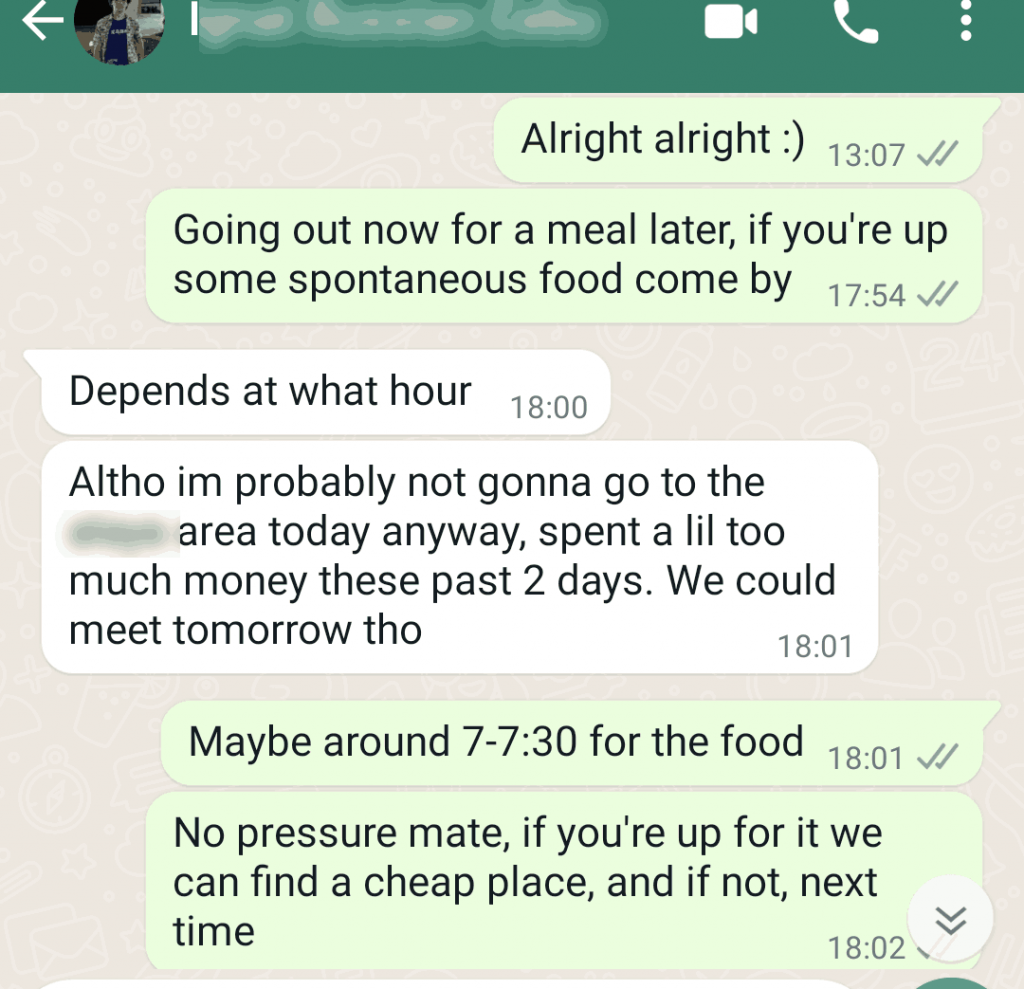
Him: spent a little too much money these past 2 dasy. We could meet tomorrow tho
Me: No pressure mate mate, if you’re up for it we can find a cheap place, and if not, next time
I’m not jumping to “tomorrow” because I preferred that day -and because I didn’t wanna commit to the day after-.
So I address his concern but do so with a casual “cool whatever way” attitude.
And we ended up meeting that evening.
9. Offer Value
And we go back to social exchange foundations again.
Offer advice and/or personal experience
This is where your self-development work really pays out dividends because:
Whenever you become an expert at something you can offer advice that can be very valuable to others while also being very easy for you to give.
However, a huge chunk of informational value is more about social intelligence and willingness to give than actual “depth of expertise”.
For example, most people miss that simply having done something once means they can share very valuable personal experiences. It includes anything, from paperwork to finding a good restaurant, to making friends, to finding a girlfriend/boyfriend, to finding a job. And, in large part, it’s about showing the willingness to give and share even more than about what you share.
So, whenever a friend mentions they want or need to do something you’ve already done, that’s your cue to share your experience with it.
Offer to lend an ear
Sometimes all a friend needs is someone to talk to.
As a matter of fact, that may be one of the most important aspects and benefits of a friendship.
Crazy enough, it’s so simple, and yet so few people can do this.
70% of all you gotta do is sit with him/her, ask questions, and let him talk it out.
Of course, if you can ask good questions, all the better.
If you can help normalize, all the better.
And if you can relate and offer solutions, that’s next-level gold.
But if you’re beginning, just sitting down and listening is already more than enough to be a great friend.
Offer concrete help and support if you can
In the Machiavellian lessons, we’ll see that the best value to offer is what’s easiest for you.
BUT…
I personally advise that you may want to have a few close friends you’d be happy to help, despite the costs.
This type of “higher cost help” is also often an honest signal of caring.
And, often, it doesn’t have to be anything crazy.
For example, I often make friends with expats, foreigners, or migrant workers who don’t have family ties where they reside.
Offering concrete help to them may be as simple as offering to bring some food if they’re sick -and all the emotional goodness that comes with it, such as the feeling that “they’re not alone and someone cares and can help”.
For example:

This type of support is much appreciated by those who don’t have a family because it helps assuage some survival fears.
The first time I moved out of my country I was sometimes afraid of getting sick and not having anyone to help me.
10. Get A Few Circles Going
This is not a must, BUT…
Several social groups can offer a lot of benefits.
So depending on your time, personality, and goals, you may want a few social circles, rather than just one.
If you can’t manage different social circles, then a good mix is to have one main circle, and then add a few extra friends who are not in that circle.
Why so?
Several reasons:
- It sub-communicates higher value: the guy who also has “other friends” just feels higher value than the guy who only has his one social circle
- You’re naturally scarcer more social and more socially successful, and even more mysterious (what is he doing and talking about with his other friends? You can even play on that mystery to further increase your allure. As a teenager, different circles of gear-heads, drug-taking friends, schoolmates, and “normal guys” made me come across a lot higher value within each different circle and I took full advantage of that)
- Higher confidence. Even if only subconsciously, people tend to be clingier, more defensive, and less confident when they come to depend on one single provider. And that’s true for socialization as well
- Higher power. If someone pulls a power move in the only circle you’re in, you may be a bit more afraid of calling it out just because you’re so careful about your position in your only group. But if you have a few, you have more inner confidence to also check power moves.
- Open-mindedness benefits, from getting inputs, ideas, and “vibes” from different groups. A great attitude to groupthink, tribalism, ingroup/outgroup, and various cult-like dynamics
Get friends from very different backgrounds
Similar to above, but for individual friends.
Get friends of different age groups, professions, and personalities.
Different people open different types of doors and connections and keep you open-minded, sharp, and skilled to deal with and handle the most disparate types of personalities.