
EASY SELF-DEFENSE: 10 Techniques Against “Tasking” & Orders
These are the power dynamics of tasking and executing:
- Someone tasks you
- They self-frame themselves as above you
- Their power and status increase
IF you execute:
4. You confirm the above, and self-frame yourself as below them
5. Your power and status decrease
If you DO NOT execute:
4. You self-frame yourself as either equal or above them
5. Your power and status increase
So the solution might seem easy: just don’t execute.
And depending on the situation, you can straight out, openly reject. For example, telling them they’re in no position to tell you what to do. Or that you don’t appreciate the tone if they’re being too commanding.
And whenever it’s appropriate to do it: do it. It’s very high power.
For example:
Random Guy: can you hold this beer for me one second (passes you a can of beer)
You: (not sticking a hand out) thanks man I don’t drink beer
Notice this far you’re still helping him save face by giving him an easy way out. You say “thanks”, so if he stops he won’t lose too much power.
But if he continues, you just keep on refusing more obviously. For example “nah man, I’m not in the holding business” or “I don’t wanna hold no half-drank can of beer mate”.
However, if you’re reading here, you already know that’s not that easy -or not always possible-.
Obviously, sometimes you can’t straight-out reject.
Sometimes they are your boss for example, so executing is just part of your job.
But some other times they are not your boss, and rejecting the task is still difficult.
First, let’s understand why:
Why Refusal Is Not Always Possible
This is where the little social games start.
First off:
- Smart taskers task you for small things: so if you refuse or reject, you look petty and overly-concerned about power.
- Smart taskers task your for small acts of kindness: for example “pass me the napkin”. And if you refuse, they can easily frame you as nasty
- Smart taskers task you for things you were supposed to do: so when you reject the task, you hurt yourself because:
- If you refuse to do it, you’re not doing your job: imagine a colleague tells you “send me the report for me to check please”. How can you say no if sending the report is part of your job?
- An escalation may turn lose-lose and you look petty: if you escalate it, they might lose power just for being dragged into the melee. But from the outside, it looks like you’re one who started the melee. So you lose as well.
Furthermore, when they first task you, they already gain momentum.
The frame is already set that “they can ask you to do X”, and that “it’s expected that you should X”.
So to stop that momentum, you need to expend an even greater force to change the frame and dynamics. And that requires some social smoothness.
Let’s see some of them:
Techniques
1. Low-Effort Execution
First-off, sometimes you just have to obey or execute.
A good way to lose as little power as possible is to execute while expending as little effort as possible.
Ideally, less effort than the individual assigning you the task or giving you an order.
As an example, sometimes ago I was in the Egypt Museum taking a picture of a new sarcophagus that the workers were working on.
This ensued:
Superintendent: (moving around, agitated, seemingly making a bid deal out of it) no pictures, please no pictures
Me: (nods his head, lowers the camera, keeps on watching the scene)
Little power loss because he was expending a lot of effort while my obedience was a zero effort one.
Similar options are:
Colleague: Please send me the file
You: (raise thumb up, turn around towards the computer)
The power loss is minimal and since nobody hears you saying “yes”, so there is no status loss.
Boss: Please be quick with your lunch break
You: (nods and spells “OK” with lips)
It’s not very empowering to have anyone, including your boss, tell you how fast you should have your lunch break.
So to avoid losing too much power without irking the boss, you nod to him and spell “OK” with your lips, but don’t say it out loud.
2. Strategic Disobedience
You still go ahead with the overall plan, but you refuse or alter the specifics of the command.
For example:
Him: welcome to the meeting guys. (looking at you and waving towards the chair) Please sit here
You: thank you, I prefer this other chair. Let’s get going
You’re still attending, you’re still going to participate, and you’re still going to sit.
You’re moving things forward.
So if they insist on you sitting on a specific chair, it’s them who look petty and “weird”.
Notice that “let’s get going” is your own power move.
Now you are the results-oriented guy who hasn’t got time to waste and who is tasking them.
Same if they invite you to an empty table.
Then you can also just say it “thanks, I prefer this other side”.
And now you’re ahead: they tried to lead you, and failed.
3. Strategic Self-Tasking
I love this one.
Simple, yet genius.
Much of the power-loss happens when you say “OK” or when you confirm your execution.
When you do that, you confirm and expand the disempowering power dynamics.
So instead of saying “OK”, you repeat what you just said, as if it were your own self-generated decision.
And bonus point if you change a detail, just to spite them.
Example:
Her: put the report in the folder by EOB please (something you were going to do anyway)
You: I’m going to put the report in the folder by 12pm. Cheers
And it doesn’t even look like you’re fighting them.
Cool, eh?
4. Power Align
Simple, yet very effective.
A great example from XH:
Tasker: Could you write down in a document the findings of your research?
You: It will bring us in sync. That would be good to be made, good idea. I’ll let you all know once done and share it with the team
Such as, instead of fighting the idea or task, you embrace it.
A specific form of power alining is also:
4.2. Set The Vision-Frame for The Task
If you’re driving towards a specific goal, then you can use that as leverage.
Every time someone tells you to do something, you frame it back as part of how it helps you achieve your goals.
For example:
Her: put the report in the folder by EOB please
You: much sooner than EOB, we need to move quick with this account, I really want to get them. I’ll give you a heads up as soon as it’s there
Now you’re not following anymore, you’re the one who drives things forward.
And if you’re in the driver seat, you can also play the same power move back on them:
4.3. Accept & Re-Task
Her: put the report in the folder by EOB please
You: I’m going to put it there right now, please check it by EOB, I want to send it to the customer within today
Host Power Dynamics
The “host” is the individual who:
- Owns the place
- Organized the gathering
- Leads the meeting
He is the one that tells people where to sit, where to go, when to move, etc. etc.
As we’ve seen in the lesson on dominance signals, if the individual is the owner, organizer, or “playing at home”, it’s OK to let them be the host.
However, some individuals overdo it.
And some others start acting like hosts when they’re really not the hosts.
However, rejecting their command can still be socially difficult if they place their commands strategically.
So here is what you do:
5. Executive delay
The biggest power-loss happens when they task you, and you act/obey right away.
That gives very much an owner-to-dog feel to the interaction.
But if you can wait long enough between tasking and execution, then you delink the command-action association.
For example, if the game-player invites you to sit, you can wait 10 seconds longer before sitting.
In between, you can do anything.
Check your watch, talk to someone, move the chair, “take in” the environment.
Whatever you do, it doesn’t even necessarily have to make a lot of sense. As a matter of fact, it’s OK if they get it that you were playing a game. The message you send is: “don’t be an ass with me, because I’m going to be an ass back to you”.
Reverse of The Law: Case Study
Look at this example:
Ben: Call Her Daddy is the name of the podcast, you don’t know the name of the girls
Charlie: so for you who don’t know Call Her Daddy is the name of the show, (back to Ben) you can tell the story you know better than I
Ben: (answering right away) yeah sure, so Call Her Daddy (keeps on telling the story)
Ben is usually really good.
And usually, he’d know how to answer this one well.
In this scene, he loses some power because Charlie interrupts him, starts explaining the story, then tasks him to explain it himself. Ben replies right away, as if on cue, and keeps on telling exactly what feels what he was going to say anyway.
What Ben could have done to re-empower himself:
Charlie: so for you who don’t know Call Her Daddy is the name of the show, (back to Ben) you can tell the story you know better than I
Ben: (looking at Charlie with a smile as if to highlight the power dynamics) yeah, that’s exactly what I was gonna do (let it hang a couple of seconds to allow Charlie to say sorry, and if he doesn’t apologize, juts move on and you re-empowered yourself anyway)
6. Strategic Volition
Similar to the above.
If you can make your obedience seem like it’s self-generated, then it’s not obedience at all.
So for example, if they invite you to sit, you can say this:
Game player: Let’s go back inside and finish our business talk. (invites to go through the door first) After you
You: Yeah man, I’m freezing, done with the outside, let’s go inside
Now the new frame is that you wanted to.
6.2. Nonchalant Volition
A similar approach to achieve the same goal go ahead nonchalantly, like you haven’t even noticed their invitations.
7. Power Breaker Technique
You also break the command-action chain if you can add any self-directed behavior in-between.
For example, if the game player invites you to go inside, turn to someone and ask a quick question. Then you can even add “OK, let’s go”.
You can also ask the game player a question.
For example:
Game player: let’s go inside now
You: yeah, sure (this is social grease, your next sentence flows more naturally and he’s more likely to comply), did you get what I mean though when I say…
As soon as they reply, you “broke” the task-execution chain, and then you can start walking inside without losing power.
Basically, the format here is:
- They task you
- You break the flow and task back with a smaller request (like a question)
- You take charge of doing what they initially proposed to do
And if you can’t avoid or if nothing comes to mind:
8 Ask “Why”
If you have the power to ask, ask for the rationale behind the task or request.
If it’s a boss and you don’t feel comfortable, you can use a softer ask, for example “do you think that’s a good idea”? Or you can do it with a collaborative frame such as “do you think that will help us to… “.
The format leads to an easy “yes” for them. And then you can reply “OK, let’s try”. Or, “OK, it also seems a good idea to me”. That way, you make them expand a bit of effort, and you take some agency on the decision.
9. Act As If They’re Serving You
This technique leverages this power dynamic:
The more you can frame his behavior as that of a servant expending effort do things for you, the more host (or tasker) loses power.
So some ways of doing this well include:
- Stress that he’s done something for you
- Say what they did make it easier for you
- Thread-expand on the work they did to make you comfortable
- Comment on how their proposal/task is a “nice gesture” to make things good for you
After that, you can also proceed to ignore.
For example:
Him: Let’s go inside the house now
You: I was just getting cold, thank you for thinking about that
10. Strategic Counter-Disempowerment
The concept is basic “power accountancy”.
Their behavior is disempowering you.
But if you disempower them back, then nobody is dominating anybody.
Of course, this is not ideal because we’re now in a socially vicious circle of lose-lose.
And, in TPM parlance, their turkey behavior pulls you down to their turkey behavior.
But alas, sometimes you don’t have a choice.
There are many ways of neutralizing power-taking behavior with counter power-taking behavior.
In the case of tasking, you can for example take action while looking away from him, as if you had disdain for his games.
See for example McGregor using this technique:
Security: make a left, make a left, that way
McGregor: (doesn’t acknowledge him, doesn’t say “OK”, and doesn’t nod in the slightest. He just turns and keeps on going)
In social you can purposefully start a conversation with someone else and cut him out (women do this often, example here with PUA Mystery).
We’ll see more examples later on.
But if you want more right now, check out this thread on “elevator power dynamics” (inviting people to go out first is typical host behavior).
Boss Tasking
Sometimes the person tasking you is your boss.
So they have formal authority to do it, and you lose little or no power because that’s simply part of what’s expected.
However, sometimes the boss orders you around too abruptly or too harshly, in which case you can lose some power -bosses don’t order around high-power employees, usually-.
We’ll deal with this scenario in the lesson on “bad bosses”.
Diagnostic Questions: Find Out If It’s A “Fair Task”
Realize that some tasks are fair for you to make.
And the truly disempowering ones are the ones that are not fair.
The diagnostic questions are very simple:
- Is he in a position to assign tasks?
- Is this task my duty and responsibility to execute?
Most people submit because they never question the legitimacy and authority of the tasker, and the legitimacy of the task itself.
But as analyzing the tasker and the request becomes more natural to you, discerning between fair requests and unfair requests will also become second nature.
Then, challenge and reject all tasks from people who have no authority and/or assign tasks in a curt and non-respectful way.
Example: Not Fair Tasking
This guy reached out to me to join Toastmasters, a volunteer-based organization of which I was the president:
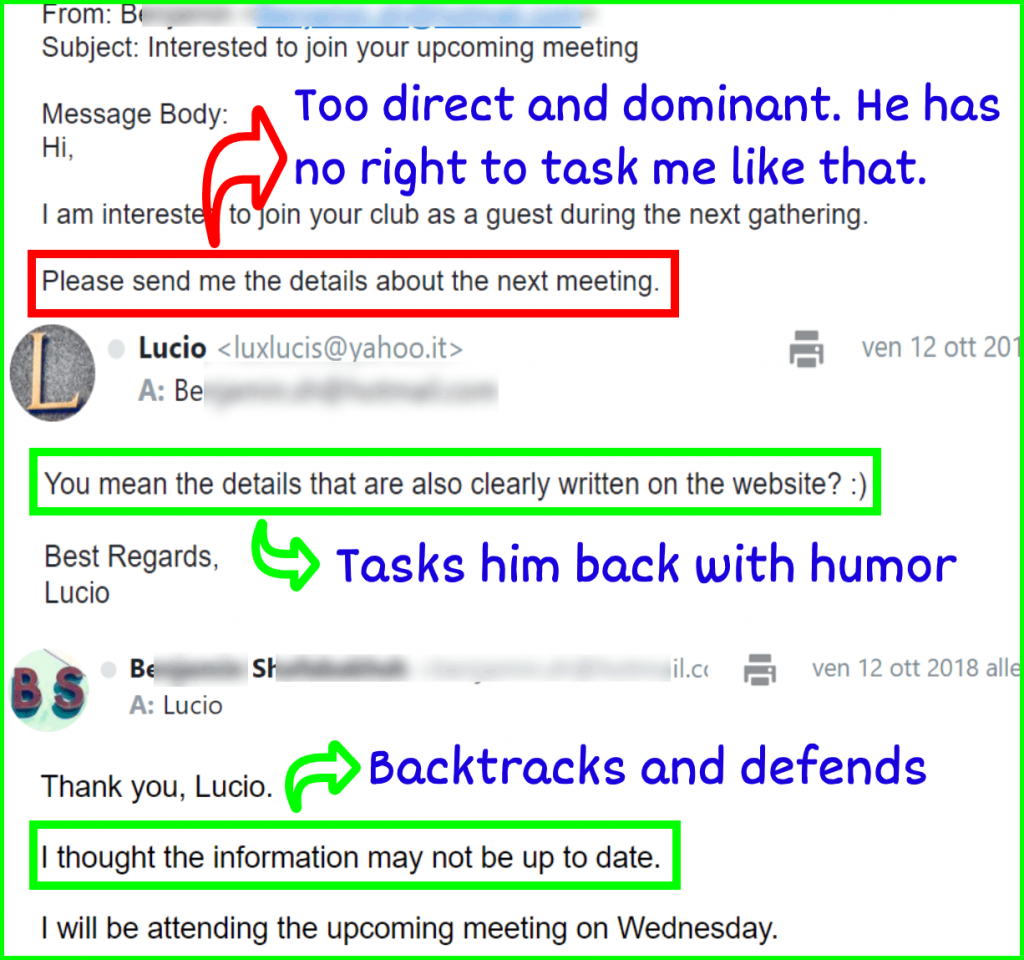
Why I deem it an unfair task:
- Social exchange: I’m providing him -and others- with a wonderful, public, free (or very low price) self-development opportunity on my own time. He’s not providing anything, just another “interested guy”. So he ought to do more legwork instead of tasking me
- The information he asks for is basic and public: he hasn’t taken a second to check the website homepage
- It’s not up to him to answer that question: since the information is readily available
- His tone: too direct and dominant
When you draw your boundaries most people realize they were being out of line and will naturally change tack (and respect you more for it).
Mindset: Just Do… Something
Sometimes pushing back can be difficult.
Especially when:
- They’re very dominant
- You’re more on the submissive / kinder / conflict-avoidant spectrum
- You depend on them somehow
But it can still be done.
See here an example from yours truly.
It’s a good example because it shows that you don’t need to be perfect to make it work. Even though I botched it and didn’t execute it perfectly, it still worked.
And here’s an example from a fellow PU student -see the section on “started seeing and using power moves to stand up for myself”, hats off to Mats-.