
Machiavellian Strategies: Foundations
Some Machiavellian thinking, strategies, and modus operandi:
1. Social Machiavellianism
Social Machiavellianism is advanced level social skills.
It requires high social intelligence, a good understanding of psychology, and confidence mixed with smoothness.
If you come across as brown-nosing or overpowering then you’re doing it wrong.
The good news is that this course is already giving you much of the benefits of social Machiavellianism.
Once you get the basics of power dynamics and strategic thinking, positive social Machiavellianism comes naturally.
And for more obvious Machiavellianism, see an example here:
Social Smoothness: Win, Without Losers
The best outcome is:
Get what you want, while making others happy.
The second best one is getting what you want, without making enemies.
That’s the approach that maximizes social effectiveness.
And to ensure the highest effectiveness on this website we came up with the “high-warmth high-power” matrix and approach.
From a Machiavellian perspective, the approach is especially useful when dealing with people who have some form of leverage over you.
An example of dealing with cops:
Lawyer: (advising on what to say to police after potential incidents) I’m friends with Mark Viktor and Mark advised me (blame-shift your uncooperative behavior to someone else) that I should never make any statements unless he’s here, and I’d love to talk to you (collaborative frame), but I really want Mark present, so can I (power-giving, makes the cop feel good) call him right now.
The lawyer strategy is good because it’s both effective, while also “power protecting” towards the cop.
Instead of just saying “I don’t want to talk to you”, which is confrontational, he blame-shifts towards a third party (the lawyer).
Keeping Friends, At Low Investment
Remember in the low-power lesson we had an example of a guy chasing me with multiple texts?
It was this one:

How do you address it when you’re on the receiving end?
The Machiavellian strategy looks at his value-giving potential.
If it’s someone with value to give, reply a few hours later with something like:
All good man, I was busy with X, my apologies. Thanks for Y, looking forward to catching up soon.
That keeps the relationship open and friendly, while also sub-communicating that you’re not the texting type.
If he texts again, let it sit again for a day or so, and then reply with a shorter text than what he wrote.
If you see him again in person, be warm and say you’re not really the texting type but more the “in-person” type, and that “you only text or call if there is a reason to”.
That leaves the door open for you to texting and calling him, without looking like the dickhead who only reaches out when he needs something.
Such as: you maintain a friendly relationship, on your terms (ie.: low investment).
If it’s someone with no value to give instead, you either ignore it, reply straight up that you don’t text much, or you adopt a “no burnt bridges” approach.
In that case, let the message sit for a day or two.
Then reply:
All good man, working a lot these days. I hope all good with you!
This message takes 10 seconds to type and it prevents the sender U-turning from “overly-friendly” to “hater”.
Whatever he replies, let it sit there without a reply. Don’t even open the message.
Then, if you meet him in person, be warm and say that you’re not the texting type and you’re more like the “in-person” type.
Machiavellian Debating
Imagine someone is trying to make you look bad.
And as they attack you, they come up with something that is obviously wrong.
Example:

The reader didn’t like an article I wrote. In her effort to character-assassinate, she says something that most people reading her message would know is false (ie.: that I’m a native English speaker, and that I never put myself in the shoes of someone learning a new language)
The beginner’s mistake is to correct them and score that “win”.
But there is a far better approach instead.
And it’s to be the (Machiavellian) eagle.
Let them wallow them in their mistake, show that you feel no need to defend, not even against false accusations. And you look superior and magnanimous, and above the petty game of “winning”.
By comparison, they look like their anger is making them blind to reality, and that they’re true turkeys ready to lie and make things up to defame an honest human being.
Adapt to The People You’re With (Machiavellian Chameleon)
A good Machiavelian adapts to the people he’s with.
He makes it seem like they’re close and similar, which increases people’s acceptance and liking.
Social Maneuvering
Social maneuvering consists of moving and strategizing to meet -or not meet- someone in a way that either:
- Makes you come across as higher value and status
- Minimizes visible effort, so it doesn’t look like you chased them. Such as, it makes it seem “natural”
Unluckily it’s not easy to explain these dynamics and strategies and there are no good videos for it.
If there is interest please let me know in the forum!
And I might make a pictorial guide on a few specific situations.
But as a very simple example, think of that time when I saw a girl I knew and liked walking on the other side of the street.
Then I walked backward well past her, crossed the street, and walked towards her. And it seemed like we bumped into each other naturally -“destiny”, you know :)-.
2. Strategic Power Dynamics
As we said several times here: dominance, coercion, and power are not the same.
Power is about achieving the goals that you want, it’s the bottom line.
To get there, it’s possible that sometimes you might want to act submissive, or strategically hide your power.
Take this example:
Hide Your Power When Your Power Is Threatening -“Foot In The Door”-
We’ve seen this in dating power dynamics.
Upon first approaching or interacting with a woman, it’s often a good idea to come across as non-threatening.
That might mean not starting at her, smiling more, or if it’s a risky environment, maybe even make yourself smaller.
The same applies to general social strategies.
Some time ago for example I was looking for someone to rent my place while.
This lady writes me:
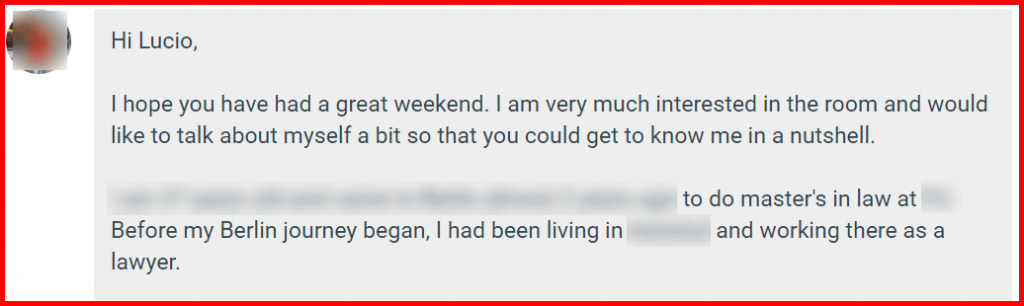
Being a lawyer is generally high power in today’s society (see “foundational laws of power”).
However, this is a situation in which she needs something from me, and has little leverage.
In case I wanted to rent without doing much or any paperwork, or doing my usual sloppy type of paperwork with some badly customized English-language template I’ve found online, her power is threatening to me.
Her knowledge, connection and, likely, ease and willingness to take things to court make her a potential risk.
Of course, these are more the exceptions, and it usually pays off to be generally high-power (hence the “high-power/high-warmth” approach).
However, advanced social skills are about exceptions.
Increase Your Power Once You’re In
Once you got to an important milestone thanks to hiding your power, it might be the perfect time to display your power.
As a matter of fact, it might even make sense to inflate your power.
To keep the example of housing markets and legal power, it can make sense to lie that you’re a lawyer.
In the past, I used this technique to protect myself against cheats.
Where I have been living it was SO common for landlords to never pay back the deposit that some friends of mine didn’t even consider it a risk: they just considered the deposit as lost money.
So to protect myself against that, after I got a place, the details of my job would soon change when it came to the owner.
Not anymore “a startup”, but a “legal startup”.
Or maybe I changed job to a high-powered legal firm.
3. Value & Social Exchanges
To be Machiavellian in the social exchange you first have to understand the social exchange.
Luckily, by now you do.
There are many ways one can maximize the social exchange with some Machiavellian thinking.
3.2. Surface & Thread-Expand Their “Ask” To Get Your Credit
For example, look at this exchange:
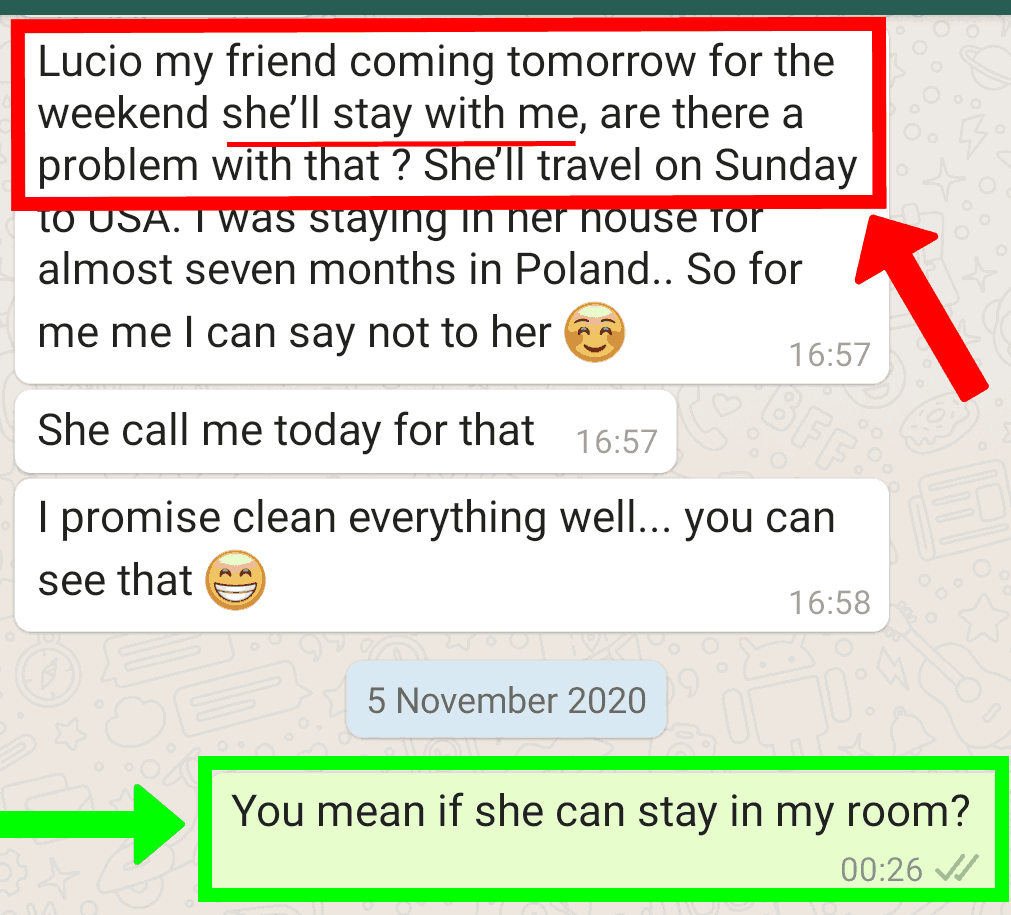
I thought my flatmate wanted to hide her real request.
I thought she was asking for access to my room while I wasn’t there. So my question was a way of uncovering the true extent of her request.
This isn’t even Mach thinking, it’s fair-exchange, it’s an eagle approach: I say yes because I’m happy to do a favor, but I do want my fair credit for it.
But to get to that point, it requires some more advanced social-accounting analysis that, in good part, rests on Machiavellian intelligence.
Insist to Give What Matters Little to You But Matters Lots to Others
Let’s stay with this example.
Whenever you can give something that matters little to you but it’s a big deal to others: insist t ogive it.
It’s win-win-win.
It helps others a lot, you get a big credit, and you make the relationship better for both.
In this example, I know that some people are jealous of their room and privacy.
Me, I don’t care.
So it makes sense for me to insist that her friend can sleep in my room while I’m not there:
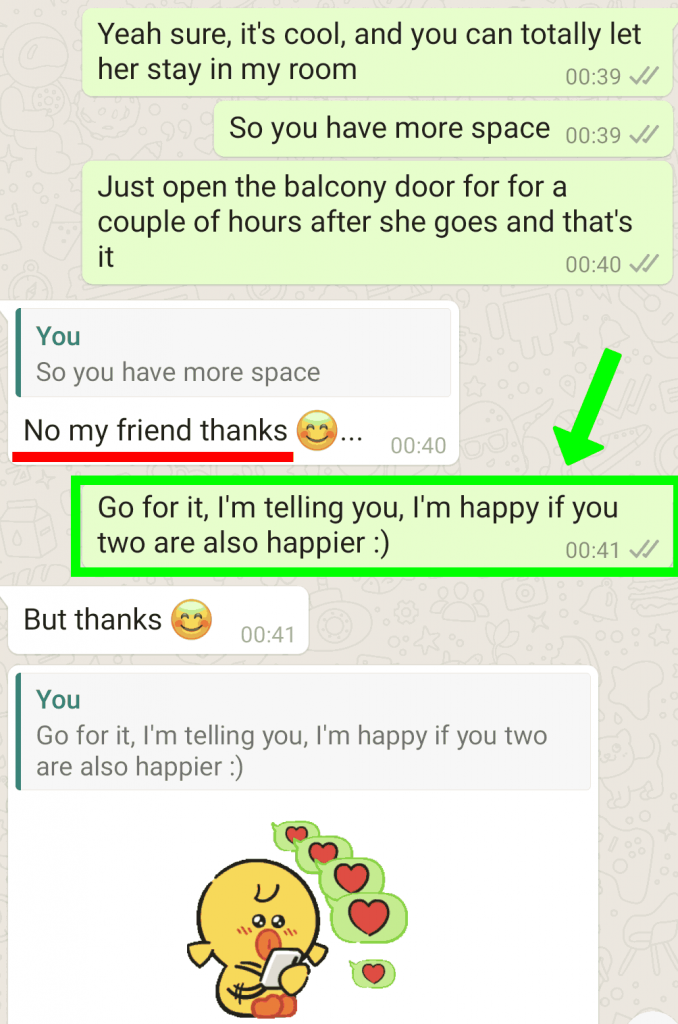
As you can see from these examples the Machiavellian thinking is put in the service of fair-exchange, and making the pie bigger for everyone.
This is why this website insists that Machiavellianism in a general value-adding person is a good thing.
3.3. Increase Your Giving’s ROI: Praise Publicly, Praise In Front of Bosses
So giving, so credit empowering, SO simple…
Think about it: you give praise to someone, you get some credit. But if you praise them in front of people, you are giving them so much more because you boost their status.
And if you praise in front of a superior or manager -or send an email with their boss in CC- you also boost their career chances.
When you do it, you also look more confident, more leader-like, and more socially intelligent to everyone who is around.
Here is a guy who’s so giving, and who isn’t afraid of speaking in front of people, they’ll think. Those are extremely sought-after qualities.
An incredible amount of people miss this easy win:
Reverse of The Law: Making Your Praise Private When You Could Have Done It Publicly
This one is a pet peeve of mine.
Maybe because it impacts ThePowerMoves.com very directly.
If you check the “reviews” for this same course, some of the best ones are on private emails.
And yes, it’s nice to read from happy customers.
But creators with a good product more or less know they have a good product, so the value-added with another “thank you, what a great course” email is limited.
It’s an opportunity loss.
Imagine how much more impactful if they had posted that exact same email on the forum, on a different forum they participate in, or on some large platform they’re already part of (Quora, Reddit, Yahoo Answers, etc.).
Much bigger impact, for the same amount of effort.
Now of course, some of these folks didn’t need anything back from me.
So, it might seem, purely from a Machiavellian point of view, they lose nothing.
However, that’s not the case.
To begin with, some were also attaching some requests to their emails. Some asked a question, some proposed some deal/exchanges, and some to meet up.
Obviously, as per social exchange, it was in their best interest then to increase their giving as that would have increased the odds of me giving back.
For the ones who didn’t ask anything in the email, they might have had a question or idea in the future. You never know.
Life is a question of odds.
And it’s always better to have more credit and more social capital, rather than less. Same as it’s always better to have more friends and allies. You never know when you might need one.
Finally, thinking of what you need right now is a pitfall of short-term mindset, a common trap of Machiavellianism.
Increasing the effectiveness of your giving is a mindset even before being a set of skills and techniques. Get in that mindset, and you will start seeing opportunities to do it everywhere. Over the long run, your increased giving will also result in getting back far more (plus, the simple pleasure of giving more for those who aren’t 100% natural Machs and also enjoy giving).
So, even when you need nothing right away, it’s a good strategy to increase your giving when it costs you no extra effort.
It’s simply a part of effective social exchange ROI maximization.
The same goes for feedback, by the way.
I did receive some really helpful and smart feedback on email.
But replying to it would force me to reply 1:1, which inherently lowers my ROI.
If that feedback had gone on the forum, more people could have chipped in and built upon it, making it even more useful.
3.4. Signal & Display Your Future Giving
Future giving makes you a more value, prized customer /asset.
There are a thousand ways of signaling your future giving.
Some examples:
- Inquire about their other products before you finalize the price (implying you might be buying more)
- Compliment their work done so far, this is “emotional giving”, and also implies you might become a valued customer (if they keep it up, is implied)
- Mention you’re a fan of whatever they’re selling -that sub-communicate you can be a great customer-
- Say before the service begins that you will tip: if you’re uncomfortable doing it, you say you don’t have cash and ask for their Venmo. Or be open and say “I care about this, do a good job and you get a good tip”. That aligns interests much better and makes everyone happier
- Mention you just moved in the area, or that you just found out about them, signaling you can become a repeat customer
I also like to signal future value to stave off the risks of one-off transactions.
For example, some taxi drivers are notoriously predatory and scammy with tourists.
So before the rise of ridesharing apps I’d chat with them in the car, and ask for their phone numbers. The prospect of a repeat customer turns the relationship from one-off, which is at high risk of defection, into a repeated one, which has more space for win-win.
And that’s ll save you from a lot of arguing over the fare.
3.5. Hide Your “WIIFM”
Why a Machiavellian would hide his “what’s in it for me”?
Again, we go back to the basics.
We go back to the social exchange dynamics.
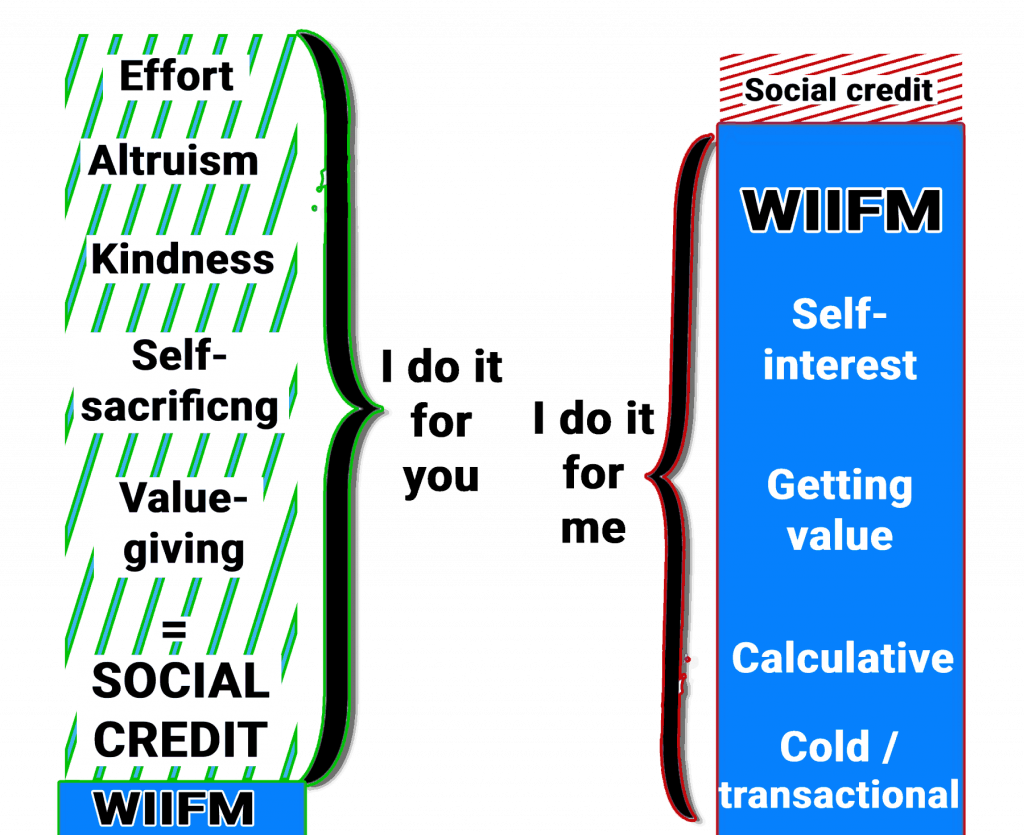
The reason is that the smaller your “WIIFM”, the more it seems like you’re doing it for others. And the more it seems like you’re doing it for others, the bigger your social credit.
Any effort you expend is then framed as you going out of your way to help others. That 10x your social credit (and 10x their debt).
On the other hand, when you do things for yourself, you can come across as self-interested.
And in any case, all your efforts give you less social credit because, in any case, “you’re doing it for yourself”:
However, this is where over-Machiavellianism departs from the “eagle” attitude we promote. And it’s the reason why Machiavellian people can come across as sneaky, untrustworthy, and generally lower quality.
You shouldn’t always hide your WIIFM.
As a general rule:
- Share your WIIFM in win-win relationships because it increases trust and respect: share what’s in it for you freely in win-win relationships or in relationships that you think have potential for win-win
As an example, this is me discussing the new theme/course with the TPM community :
This new course provider is from a bigger, established provider. And it targets people who are willing to spend money to provide a better service to their users. There is plenty in it for me in this change. But it also felt like a moral obligation and personal duty to provide the best infrastructure I could provide.
In another thread, I shared that the new provider allowed for installment payments, which I thought could increase revenues.
Pretending that my move was only for the customers would have been manipulative. Instead, sharing the truth of the win-win highlights that people can expect me to be upfront about what’s in it for me.
That’s the best approach with honest and collaborative relationships.
Now on when to hide your WIIFM:
- Hide your WIIFM with untrustworthy people or when you’re competin because it can provide others with “hooks” for games and manipulation: you share information and personal interests that are not necessarily public or obvious. People can leverage that information for persuasion or manipulation, or even to frame you as a selfish taker
So you must be careful with whom you share your WIIFM.
As an example, look at this forum exchange.
I had shared that my WIIFM in sharing advice was to see and learn from the reaction that the user was getting from his Tinder profile.
I was being honest, but also very giving: it’s not like the “test” was scientific or extremely significant in any way. And nothing I couldn’t have easily replicated myself, and done it even better.
But now look how the user leverages that information to manipulatively frame himself as a giver:
I was hoping you guys would find this experiment interesting ( <– leverages the WIIFM I shared to frames himself as having come to the forum to give)
but does not seem to be much interest at all ( <– passive-aggressive guilt-tripping, an indirect way of saying “you’re not giving back / you’re not doing enough)
several girls have now responded. if there is any interest I can upload screenshot ( <–uses the knowledge of my WIIFM, such as my interest for the reactions he was getting, to inflate his ability to give. What he’s saying sub-communicates “I’ve got so much to give you, BUT…)
I just do not want to waste time editing screenshots to hide private info if you guys do not really care about this experiment. ( <– “debt inflating”, he makes it seem like the value he’s providing costs a lot to him)
ill keep an eye on this thread in next 24 hours. ( <– and ends with an indirect threat, trying to put pressure on us to be quicker and prioritize his needs)
You can see my answer here.
4. Align Incentives
Remember the lesson on “basic strategies of power”?
We said that to ensure win-win (and cover against cheats), aligning incentives was crucial.
Well, the Machiavellian has many strategies and techniques that he uses to align incentives, increase the alignment, or frame-expand on the alignment to make it more relevant and obvious.
The amoral Machiavellian of course might even fake alignment as a cheating strategy.
Not something we necessarily recommend here, except for exceptional cases.
Some examples:
4.2. Silver Medal Technique: Cover Their Losses, Remove Incentives to Lie & Cheat
When people have only one way to win, they have incentives to lie, manipulate, and cheat to get their benefits.
A simple example in real-life is when you’re a buyer, interested in a product.
The seller has only one way to win: you buying that product.
So incentives are misaligned: his incentive is not to make sure the product is good for you, but that you buy the product, whether it’s good, or not.
The Machiavellian takes steps to reduce that misalignment.
He can, for example:
- Tell the seller you’re interested in several products and wants to find out the best fit: the seller’s incentive is still to sell you his highest margin product, but interests are far better aligned now. It’s not a binary win-all/lose-all anymore, so chances are much higher that you get more honest behavior
- Signal future business from you: the Machiavellian might say that:
- “I just moved in the area“, implying that he is now a potential future customer
- “I just entered this line of business”, signaling that he’s going to be a potential future business contact
- “I just became / acquired X“: for example, saying that he just gor promoted to a new position, or he just got rich and entered into a much higher income bracket. Very smart. That signals his future ability to provide value, while also justifying why he never was a customer or prospect in the past. Of course, the trick is in signaling that, without coming across as showing off. The best is to share it as personal information to someone you’re getting closer to. That way, you both raise your value, while also getting closer from a human perspective point of view
Also learn more here.
4.3. Hire Poor People For Your Incentives-Based Plan
People have an inherent preference for richer and well-off people.
Of course: they tend to be higher value.
However, richer people aren’t always the ones who are going to provide you with the most value.
Sure, they have value.
But having and providing are two very different things.
Think about it:
If you are setting profit shares, who’s more likely to work hard poor people, or wealthy people born into money?
You can’t be sure in advance of course and gotta look at the individual.
But, on average, people used to a comfy lifestyle, either because of their family or even because of the rich countries they were born-in, are well-fed, and have all their basic needs met.
So they might prioritize comfort or work-life balance if getting more means sacrifice and hard work.
How I Use This Strategy: Rent to Poor People
When I rent my flat in Berlin I rent one room only.
That gives me the freedom to go back whenever I want.
But because I also like to rent my room on a shorter-term basis if I’m not there. So I make an agreement to have the renter manage my room, and we split the income 50/50.
It’s a great deal for them: most external property managers only take 20%. If they do the job well, they might even end up staying there for free.
However, renting my room comes at a comfort cost for them: they need to clean and… They need to share the flat.
Guess how the income of my room correlated with the renters’ “need for cash”?
Almost 100%.
The Venezuelan woman without a job was the best. Found the most client, cleaned the best, treated guests the best.
The Mexican lady with an OK job did OK.
The German girl with a work-from-home arrangement barely had any guests.
5. Machiavellian Leverage-Seeking
Leverage is power.
Some ways to strategize around leverage:
Extend Your Leverage
- Wait before leaving a review: you might need something from the place or people you just stayed at. And that review can provide you with much needed leverage
- Say you’re provididing future value for example:
- Say you’re buying more in the future: to better align incentives, remind people that they can still gain from you
- Say you’re coming back: in hotels and Airbnbs, if you go for good and for ever at a certain date, people have less incentive to treat you well. Or to ship something for you if you forgot something.
- Postpone payment: including Machiavellian ways of doing so
- Strategic white lying: let them believe they have a chance at win-win dealing and/or getting value from you, which will keep them on their best behavior. See a case study
- Buy the highest leverage option: when the price is the same, it’s often best to buy through a platform. A platform allows you to request refunds. And it allows you to leave a review certified to come from an actual user/buyer, which carry far more weight. And if the platform represents a large revenue stream for the buyer, that’s even more leverage. So, for example, don’t buy tourist packages at the hotel reception. Buy through the platforms.
Trick Others to Give Up Their Leverage
See:
- Honey deal traps: play it friendly and support, and pretend to offer a great deal to entice them to withdraw their lawsuit, or close their dispute with an escrow service
- Extend or delay talks past a legal end date: if you can delay talks, or lead people on to believe a solution in sight until past a certain legal date is -say, for example, a refund date-, they lose their main levearge. After that date, you can then play hardball
6. Apply Psychology Principles to Everyday Life
As we mentioned earlier: psychology is useless unless it’s applied.
I know that very well with my marketing :).
I prioritize products so albeit I technically know the psychology of selling, this course’s marketing has never been best in class.
You don’t want to like me in marketing: having knowledge that you don’t apply.
Instead, you want to apply psychology to your everyday life.
Two examples:
Marketing Example: Social Proof
Some time ago this website had an issue collecting subscription payments for a few days.
So I contacted subscribers to re-process the payment. And this is the picture I sent to show their failed payment:

Question:
Why did I send a large screenshot?
Why not just text, or just their single failed payment?
Because the list of transactions shows social proof from other buying customers.
In simple terms, it works like this:

This is applied psychology.
Take a known psychological principle, in this case, “social proof” (Cialdini, 1984), and find everyday applications to it.
A non-Machiavellian might have sent no picture, or only sent the individual customer’s failed transaction.
And without social proof, his collection rate would have been far lower.
As you can see, Machiavellian skills are money.
No wonder many marketers are Machiavellians :).
Now imagine the upshot to your life when you apply a hundred different principles, on a thousand different scenarios, over a whole lifetime.
It’s the difference between languishing at the bottom of society, or climbing upwards.
Persuasion Example: Forging Consensus
The Toastmaster presidency provides great persuasion case studies.
The president has the title, but he has no power to “impose” his will.
Instead, the decisions are taken by a majority vote by the board.
In this case, power is all about personal influence.
Luckily, when you have personal influence + Machiavellian strategies, you don’t need anything else.
In step-by-step terms, here’s this Machiavellian influencing process:
- Present all options with a strategic preframe: preframing is half the persuasion (Cialdini, 2016)
- Gather intel as you speak: who is nodding along, who’s going to support your favorite option?
- Negatively frame the options you don’t like: don’t overdo it, just ending with the “cons” is enough (“recency effect”)
- Present your favorite option last
- Positively frame your favorite option: frame it as fixing important cons from the previous options, plus some benefits that make it seem an obvious win
- Imply it’s your preferred option: smoothly is the name of the game, avoid imposing. If you have status, people will naturally want to support your preferred option
- Ask the group if “they also like this last option”: power-protecting, everyone feels it’s up to them
- Start the group vote with your most ardent supporter: pick the person most likely to say “yes”
- Democratically go to your second-best supporter: after the “most ardent supporter” choose left or right according to where the most supportive member sits
- Jump in with your vote: jump in saying you also support the decision. Now it’s 3 people, a small group
- Continue the vote: most of the time you reach consensus with this process. If not, you’ll most likely still get the majority. If still not, use your social capital to graciously impose and “just this time give you a chance”
- Alternatively, after 3 people agree, say: “would you guys all be OK with this option”? Notice you don’t say “do you agree”, but “would you be OK”, which lowers the bar for “yes”
There you have it, how to democratically always get it your way.
7. The #1 Machiavellian Strategy

This website uses the expression “value-taking”.
“Value-taking” is an umbrella term for actions or people that make you worse off.
People who are amoral, selfish, and lacking empathy are more likely to turn value-takers.
So the Machiavellian strategy #1. is to spot Machiavellians, and either avoid them, or deal with them judiciously.
Paradoxically, this is also true for Machiavellians, since they cannot gain as easily with other Machiavellians.
Failing this rule can have grave consequences in your life:
Business Example: Cohen / Trump
Cohen was a Trump fan.
He even said he’d “take a bullet for Trump”.
As most good and loyal admirers, Cohen thought that Trump would reciprocate and form a win-win relationship.
Big mistake #1: Machiavellians with no empathy don’t reciprocate love.
Big mistake #2: in his misguided belief that Trump would stand behind him, Cohen became Trump’s “fixer”, doing dirty work for him.
And when things started getting hot, Trump let Cohen go down like the fall guy he always intended him to be.
Cohen called himself a “fool” and says that he is “ashamed of his weakness and misplaced loyalty”.
And after he “got Mach’d”, he warns those who are making the same mistake:
They’ll all get up there and continue to spew the Trump doctrine, which as you can see from me, doesn’t bode well. It doesn’t put you in the position that you think you’re going to be in. I mean, just look at Rudolph Giuliani
Charismatic and Machiavellian men like Trump can inspire ardent support.
But as an enlightened Machiavellian, you now know better: avoid blind faith in Machiavellians.
When incentives misalign, they’ll throw you under the bus like a used rug.
Also see:
Relationship Example: Tyson / Givens
A cautionary tale of amoral Machiavellians in relationships:
The video refers to the “dumb rule”, which we might more aptly re-christen as “IQ rule”:
Relationship IQ Rule
It’s generally safer to pick partners who are less Machiavellian than you are.
For men who want to remain the relationship leaders, partners who are not much smarter than they are better.