
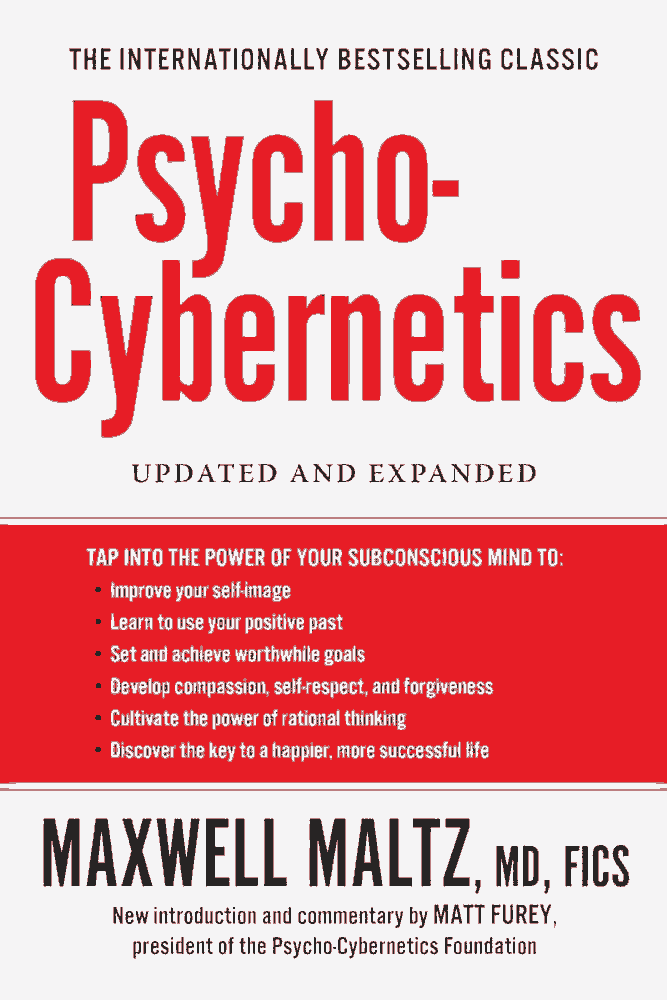
Psycho-Cybernetics (1960) compares the mind to a machine and teaches readers how to develop a positive self-image to increase self-esteem and confidence. Maxwell Maltz, the author, insists that psycho-cybernetics is a “scientific discipline” that can make readers happier and more successful.
Exec Summary
- The mind works like a computer (note: you can see some overlap between human mind and computers, but they are fundamentally different)
- We all have installed a “success programming” we only need to learn how to use (🙋🏼♂️ Lucio’s note: if you see this in allegorical form, it’s passable. In the literal sense, it’s BS)
- Always have a goal. It gives you a sense of direction, and adds meaning to your life
FULL SUMMARY
About the Author:
Maxwell Maltz was an American cosmetic surgeon interested in psychology and later turned self-help author.
The 7 successful personality traits
You can’t have a popular self-help book without a simple “list for success”.
And you get bonus points if you do it in the form of a memorable acronym.
So here are for you the 7 steps to a successful personality, conveniently spelled “SUCCESS”:
- Sense of direction
- Understanding
- Courage
- Compassion
- Esteem
- Self-Confidence
- Self-Acceptance
I personally only saw a random list of positive traits.
But although I wouldn’t necessarily consider them “key” to success, most readers wouldn’t be harmed pursuing them.
Like yourself
The secret is this: To really “live,” that is, to find life reasonably satisfying, you must have an adequate and realistic self-image that you can live with. You must find your self acceptable to “you.” You must have a wholesome self-esteem.
The author then also adds:
- A self that you can trust and believe in.
- A self that you are not ashamed to “be,” and one that you can feel free to express creatively, rather than hide or cover up.
- A self that corresponds to reality, so that you can function effectively in the real world.
- Knowledge and honest self-assessment of both strengths and weaknesses
Stop comparing yourself unfavorably with others
Overcome your inferiority complex realizing that everyone is either superior or inferior at something.
Says the author:
(…)I do not compare myself unfavorably with them and feel that I am no good merely because I cannot do certain things as skillfully or as well as they. I also know that in certain areas, every person I meet (…) is superior to me in certain respects. But neither can any of these people repair a scarred face, or do any number of other things as well as I. And I am sure they do not feel inferior because of it.
Basically, everyone is superior or inferior.
You are not inferior, nor superior. You are simply you.
Use anger and indignation to remove disempowering beliefs
Indignation and anger can sometimes act as liberators from false ideas. Alfred Adler “got mad” at himself and at his teacher and was enabled to throw off a negative definition of himself.
Decide & focus on what you want, not what you don’t want
I disagree with the author’s rationale, but the tip itself is good.
Always have a goal in life
The author says we are “engineered as goal-seeking mechanisms” because “we are built that way”.
Not sure how true that is, but this is still another great tip for many.
He says:
When we have no personal goal that we are interested in and that “means something” to us, we are apt to “go around in circles,” feel “lost,” and find life itself “aimless” and “purposeless.” We are built to conquer environment, solve problems, achieve goals, and we find no real satisfaction or happiness in life without obstacles to conquer and goals to achieve. People who say that life is not worthwhile are really saying that they themselves have no personal goals that are worthwhile.
That was a good point.
Build a mental retreat within yourself
The author recommends an actual imaginary room:
(…) build for yourself, in imagination, a little mental room.
Furnish this room with whatever is most restful and refreshing to you (…)
(…) The colors of the walls are your own favorite “pleasant” colors, but should be chosen from the restful hues of blue, light green, yellow, gold.
(…) It is very neat and everything is in order. Simplicity, quietness, beauty are the keynotes. It contains your favorite easy chair.
From one small window you can look out and see a beautiful beach. The waves roll in upon the beach and retreat, but you cannot hear them, for your room is very, very quiet.
I personally find that simply the ability to shut off in meditation is beneficial.
CRITICISM
We don’t mince words on TPM.
So here’s my verdict:
Maltz sounds a lot like a charlatan.
As for the author of the updated version, I don’t know much about him.
But he has a conflict of interest because he acquired the psycho-cybernetics brand/operation.
Psycho-cybernetics is pseudoscience from a charlatan
How do you recognize a charlatan?
Here are 2 red flags:
- All their assumptions are presented as (made-up) “science”
- Try too hard to convince you it’s science, including talking with over-confident teacher frames instead of the scientist’s healthy skepticism
Here is just a list of curated examples for you:
For example, there is today irrefutable clinical evidence in the fields of individual psychology, psychosomatic medicine, and industrial psychology that there are “success-type personalities” and “failure-type personalities,” “happiness-prone personalities” and “unhappiness-prone personalities,” “health-prone personalities” and “disease-prone personalities.”
I would have loved to look into that irrefutable evidence.
But of course, no resources were provided. 🤷♂️
There is an abundance of scientific evidence that shows that the human brain and nervous system operate purposefully in accordance with the known principles of cybernetics to accomplish goals of the individual
This guy is really trying SO hard to convince you that psycho-cybernetics is a recognized science.
Just try to find “psycho cybernetics” as a branch of science or higher-education though, and see for yourself.
And:
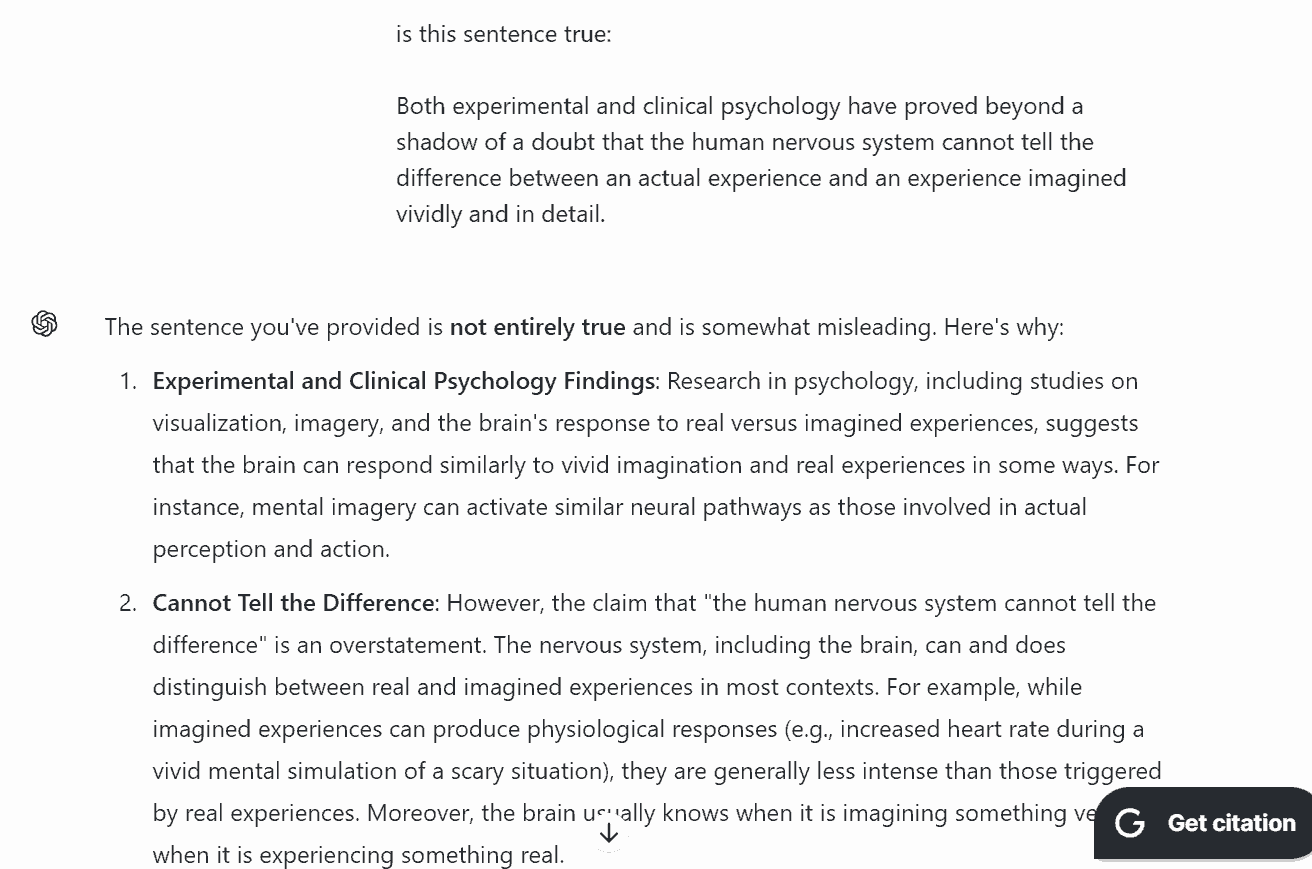
Both experimental and clinical psychology have proved beyond a shadow of a doubt that the human nervous system cannot tell the difference between an actual experience and an experience imagined vividly and in detail.
This is so dumb I can’t even start.
But just to give you a different take, I asked Chatgtp:
And:
This life force was established as a scientific fact by Dr. Hans Selye of the University of Montreal. Since 1936, Dr. Selye has studied the problems of stress. Clinically and in numerous laboratory experiments and studies, Dr. Selye has proved the existence of a basic life force, which he calls “adaptive energy.”
(…)
Suffice it to say that his findings are recognized by medical experts the world over.
Yeah, that last line. When spinning a man’s work is not enough, you reinforce it by implying non-existing, made-up consensus.
And let’s finish with one of the sweetest BS just to fix our palate:
Telepathy, clairvoyance, precognition have been established by scientific laboratory experiments. Dr. Rhine’s finding, that man possesses some “extra-sensory factor,” which he calls “Psi,” is no longer doubted by scientists who have seriously reviewed his work.
Yeah, kid you not, that’s what he wrote.
And Psycho-cybernetics made into some popular “self-help book classics” list 🤢
The charlatan pre-emptive self-defense
And here comes the charlatan power-move:
As Dr. Maltz said in the beginning of this book, he was reluctant to discuss or talk about many of these experiences because “if I presented some of the case histories and described the rather amazing and spectacular improvements in personality, I would be accused of exaggerating, or trying to start a cult, or both.”
Same power move as Joe Dispenza, who complained he left science because they didn’t appreciate his findings. Truth: he was never a scientist. He’s a charlatan.
Or popular male influencers who are chased by “the Matrix”.
Truth: they attracted that attention themselves with narcissistic self-snitching.
But as long as you speak with confidence, legions of naive men are ready to believe.
Psycho-cybernetics’s main claim is doubtful (at best)
Psycho-cybernetics is built on the idea that the mind is like a computer.
With the usual manipulative charlatanism, says the author:
these scientists began to ask themselves: Could this be the way that the human brain worked also? Could it be that in making man, our Creator had provided us with a servo-mechanism more marvelous and wonderful than any computer or guidance system ever dreamed of by man, but operating according to the same basic principles? In the opinion of famous Cybernetic scientists like Dr. Norbert Wiener, Dr. John von Neumann, and others, the answer was an unqualified yes.
Of course the human mind as a biological organ does not work like a machine.
Plus, I checked it, and Wiener and von Neumann never gave any “unqualified yes”.
Chances are, those two scientists would be horrified and fully reject Maltz’ quote.
Manipulative spins to force his narrative
Manipulative spins to support his made-up claims
The author is a spin-master.
He says:
For example, Dr. Wilder Penfield, who was the director of the Montreal Neurological Institute, reported at a meeting of the National Academy of Sciences that he had discovered a recording mechanism in a small area of the brain that apparently faithfully records everything that a person has ever experienced, observed, or learned.
“Apparently”.
So now he’s trying hard to tell us that’s like a flashcard or memory storage -like a computer, get it?-.
Of course, although chances are we record and store more than we can recall, there is no “recording mechanism”. And, most of all, there is no faithful memory.
If anything, our memory has been well proven to NOT be reliable.
Several made-up BS
The made-up claims abound.
And of course, they’re always “confirmed by scientists” -how could they not?-.
Science has now confirmed what philosophers, mystics, and other intuitive people have long declared: Every human being has been literally “engineered for success” by his Creator. Every human being has access to a power greater than himself.
“Other intuitive people”, LOL.
I bet he thought of himself as one of the “highly intuitive one” -aka “bullshitters”-.
CONS
- Insists on envisioning rather than practicing. Why not BOTH? Or, having to choose, I’d 100% recommend real-world practice
PROS
- Many good tips for empowered mindsets and more positive thinking
REVIEW
Psycho-Cybernetics is a book with many good self-development principles, but presented under a false guise of non-existent scientific rigor.
And that makes it challenging for me to review.
On one hand, I deeply dislike charlatans.
And on the other hand, some of the content was good and I agree with it.
It could have been more systematized and richer, but for a list of good tips and ideas, it’s great.
P.S.:
If you’re looking for confidence and self-esteem, our course maybe a good alternative to consider.
See here a preview of our approach:
Check the best books to read or get this book on Amazon.


