The Essays of Warren Buffett (2023) is a collection of Warren Buffett’s insights on various topics related to investing, management, and corporate governance. Compiled by Lawrence A. Cunningham, this book features a curated selection of Buffett’s famous shareholder letters, organized by theme.
Exec Summary
- Only associate with good characters you like and trust
- Stick to what you understand well, or you’re gambling
- Stop listening to “market predictions”… And predictions in general
FULL SUMMARY
About the Author:
Warren Buffett and Charlie Munger are a legendary duo in the world of finance and investing. Buffett, often hailed as the “Oracle of Omaha,” is the chairman and CEO of Berkshire Hathaway, a multinational conglomerate holding company.
Charlie Munger is Buffett’s longtime business partner and vice chairman of Berkshire Hathaway. He is known for his straightforward approach to investing and his insightful commentary on business and life. Together, Buffett and Munger have forged one of the most successful partnerships in the history of finance.
1. Only associate with people you like and admire
This was probably my main takeaway from The Essays.
First off, says Buffett:
After some other mistakes, I learned to go into business only with people whom I like, trust, and admire
That, by itself, will not make you money, he adds.
But it decreases the odds you lose money. And it makes life that much easier and better.
It’s so important to Buffett, that he’s willing to make less money with that policy:
We intend to continue our practice of working only with people whom we like and admire. This policy not only maximizes our chances for good results, it also ensures us an extraordinarily good time. On the other hand, working with people who cause your stomach to churn seems much like marrying for money—probably a bad idea under any circumstances, but absolute madness if you are already rich.
LOL, not only great wisdom, but also delivered with great humor :).
2. Stick to what you know and understand
This is one of the most famous of Buffett’s approaches:
If we have a strength, it is in recognizing when we are operating well within our circle of competence and when we are approaching the perimeter. Predicting the long-term economics of companies that operate in fast-changing industries is simply far beyond our perimeter. If others claim predictive skill in those industries—and seem to have their claims validated by the behavior of the stock market—we neither envy nor emulate them. Instead, we just stick with what we understand. If we stray, we will have done so inadvertently, not because we got restless and substituted hope for rationality.
3. As a high-value man, only stick with people you know are great
Buffett says that he and Munger generally stick with people they know and like.
They know there are plenty more great people in the world. But the odds of meeting them are not high enough to make meeting strangers a good use of their time.
Unluckily I lost the bookmark for this passage or I’d love to quote it.
4. Pick managers who think like owners
The best managers think like owners in making business decisions.
They have shareholder interests at heart.
5. Only do 1-to-many communication 📣
Because the annual meeting is the time and place for these, Charlie and I are happy to answer them all, no matter how long it takes. (We cannot, however, respond to written or phoned questions at other times of the year; one-person-at-a-time reporting is a poor use of management time in a company with [thousands of] shareholders.)
6. Only buy businesses from sellers who love their business
Buffett says that he wants people who love their business because that guarantees that interest align.
When people love their business, they’ll work hard for it, give it all, and always with a long-term horizon in mind.
That’s why they want businesses with people who are going to keep working on their business.
And if they don’t love it, don’t buy.
Says Buffett:
Very simply, we would not want to buy unless we felt key members of present management would stay on as our partners. Contracts cannot guarantee your continued interest; we would simply rely on your word.
And the second part reminds us of how important it is to read characters.
Let them independent
Buffett then lets them free to operate with almost total freedom.
They know what’s best for the business.
That allows Buffett to attract the best possible sellers: great businesses with great founders who love their business and will be great long-term managers.
7. Don’t listen to macro-predictions
We will continue to ignore political and economic forecasts, which are an expensive distraction for many investors and businessmen.
So… Quit listening to Ray Dalio‘s predictions of doom and gloom :).
He’s been doing that his whole career and his predictions were terrible anyway.

MORE WISDOM
Be suspicious of those who “always make the numbers” (or who promise so)
Charlie and I not only don’t know today what our businesses will earn next year—we don’t even know what they will earn next quarter. We are suspicious of those CEOs who regularly claim they do know the future—and we become downright incredulous if they consistently reach their declared targets. Managers that always promise to “make the numbers” will at some point be tempted to make up the numbers.
Let’s all take steps to reduce global warming
Buffett says that it makes sense to take climate change seriously, and take action.
Even if there is only a 1% chance of disaster, says Buffett, it does make sense to act anyway.
Beware of past-performance “proof”
Beware of past-performance “proofs” in finance: If history books were the key to riches, the Forbes 400 would consist of librarians.
QUOTES
On the blessing of having dumb competition:
what could be more advantageous in an intellectual contest—whether it be bridge, chess, or stock selection—than to have opponents who have been taught that thinking is a waste of energy?
CRITICISM
Over-optimism and over-extrapolation of positive trends (nonsense)
For example:
In the future the U.S. population will move more goods, consume more food, and require more living space than it does now. People will forever exchange what they produce for what others produce.
Our country’s businesses will continue to efficiently deliver goods and services wanted by our citizens.
How can you say for sure?
During his lifetime, probably yes.
But the longer you extrapolate that trend, the more sure you can be it’s gonna be wrong.
America Always Wins Long Terms…
There seems to a general over-confidence on “America”.
Sometimes, even feels a bit overly “patriotic”.
For example:
Be clear on one point: In no way does our thinking about currencies rest on doubts about America. We live in an extraordinarily rich country, the product of a system that values market economics, the rule of law and equality of opportunity. Our economy is far and away the strongest in the world and will continue to be. We are lucky to live here.
“Will continue to be”?
Same as before, how can he say that?
Stretch that prediction on a long enough time horizon, and you can be almost 100% sure it will turn out to be wrong.
I’m astonished such a smart person would say such a, how to say it… Non-smart thing.
And:
American business, and consequently a basket of stocks, is virtually certain to be worth far more in the years ahead
(…)
This powerful trend is certain to continue
(…)
America golden goose of commerce and innovation will continue to lay more and larger eggs
These are the types of statements that not only leave me scratching my head, but also make me wonder how successful Buffett would have been less rosy historical periods.
His over-optimism may have cost him, in those scenarios.
The “future estimates” are all based on trend extrapolation
For example, when he estimates future growth based on the current population growth.
That was so nonsensical to me, that I won’t even spend further time debunking.
America supposedly “starting from scratch” in 1776 betrays poor thinking
Says Buffett:
From a standing start 240 years ago a span of time less than triple my days on earth Americans (…) starting from scratch America has a mask wealth totally 90 trillion dollars true of course that other
What an ignorant thing to say.
That’s what happens when you focus on investing and read financial reports only, and then talk about history, maybe.
As if:
- All the inhabitants erased their brains from all their knowledge in 1776
- All the knowledge accumulated in the millennia past was erased
- All the capital and machinery was destroyed
Of course, the opposite is true.
Which is why it was NOT a “standstill” or “start from scratch”.
I even find this take ignorantly insensitive.
The American story is an impressive story.
Like all the great empires that have led humanity forward before it, it’s bound to be an impressive story.
And we must all be grateful to leading civilizations/countries because leading civilizations pull the world forward. They are givers.
But we’re not going to provide appropriate credit by making shit up.
Or by erasing the contribution of the long history of great men and civilizations that have led us here.
Instead, to be great today, pay respect to past greats.
The “compound interest” story paraded once again…
You know, the:
“if you had invested X dollars in the S&P in the year XXXX, you’d be a multimillionaire by… .”
I’ve never been a fan of those.
And … I didn’t expect that from Buffett.
CONS
Sometimes tries too hard the “funny quips”
Sometimes it feels Buffett tries a bit too hard to sound smart.
Especially felt off to me when he sought to reference sex.
For example:
When such a CEO is encouraged by his advisors to make deals, he responds much as would a teenage boy who is encouraged by his father to have a normal sex life. It’s not a push he needs.
And:
Woody Allen, in another context, pointed out the advantage of open-mindedness: “I can’t understand why more people aren’t bi-sexual because it doubles your chances for a date on Saturday night.”
To me, it felt almost as if he wanted to remind us that he’s not always been a geekier financial analyst.
Bit of bragging
Covert bragging, mostly.
Some outdated stuff
Since the letters sometimes refer to then-contemporary events, it’s bound to have several outdated sections.
Some rants
Such as against American’s poor balance of payments, Wall Street greed/mistakes, etc.
All about money (through investments). Is that even a good life?
This is just me, but… I was hoping for more life-wisdom.
And, if about money, I’m more interested in entrepreneurship.
All this returns talk even felt tacky to me and not a good way to live.
There is more to life than returns and stocks.
REVIEW
The Essays of Warren Buffett is a good book if you’re interested in Berkshire and Buffett’s approach to investing.
And it’s a poor use of your time if you’re looking for wisdom outside of investment.
I was looking for more wisdom on “how to live”, let’s say.
There are some fantastic golden nuggets, like the ones listed in this review.
But overall, The Essays of Warren Buffett is mostly about investments and Berkshire.
It just wasn’t the ideal book for me.
But it may be great for you.
Check the best books to read or get this book on Amazon.
The Essays of Warren Buffett Summary: 7 Timeless Lessons
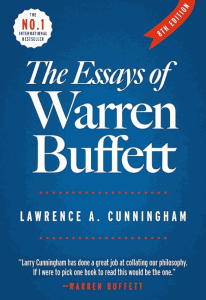
The Essays of Warren Buffett (2023) is a collection of Warren Buffett’s insights on various topics related to investing, management, and corporate governance. Compiled by Lawrence A. Cunningham, this book features a curated selection of Buffett’s famous shareholder letters, organized by theme.
URL: https://thepowermoves.com/the-essays-of-warren-buffett-summary-review/
Author: Lucio Buffalmano
4.2