

Open body language is one of the clearest signs of confidence, comfort, and social power.
From job interviews to dating and leadership, understanding and using open body language helps you appear more trustworthy, approachable, and dominant—all without saying a word.
In this guide, you’ll learn exactly what open body language looks like, how it differs from closed body language, and how to use it to your advantage.

This is a stereotypical open body language pose for a man. Perfectly suited for ‘management by wandering around’ to display power and approachability. But showing your hands is important in many other contexts
What’s Open Body Language
Open body language refers to physical cues like relaxed posture, uncrossed arms and legs, exposed torso, and expressive hand gestures that signal comfort, emotional openness, and confidence with
To properly understand open body language, we must contextualize it within the continuum of open-to-closed body language.
Open Body Language Continuum
Open body language is part of the ‘open/closed’ body language continuum with physical cues like relaxed posture, uncrossed arms and legs, exposed torso, and expressive hand gestures.
At the other end of the continuum, closed body language signals the opposite: discomfort, defensiveness, or low confidence.

Open vs. Closed Body Language
Open and closed body language represent one of the five main body language dimensions besides dominance, warmth, calmness, and interest.
Let’s compare each:
| Trait | Open Body Language | Closed Body Language |
|---|---|---|
| Posture | Upright, relaxed spine, head up, shoulders back | Slouched, tense, head down, shoulders rounded |
| Arms & Hands | Uncrossed arms, open palms, expressive gestures | Arms crossed, hands hidden, constricted gestures |
| Legs & Feet | Legs uncrossed, feet flat or pointed toward others | Legs crossed, feet turned away |
| Torso Orientation | Chest open, facing the person | Turned away, torso shielded |
| Facial Expression | Relaxed face, genuine smile, steady gaze | Tense face, tight lips, minimal or fake smiles |
| Eye Contact | Direct, steady, calm gaze | Avoidant, darting, excessive blinking |
| Proximity | Comfortable closeness, grounded | Withdrawal, sitting at edges, leaning away |
A typical closed body language pose arms and legs is this:

Not terrible body language, but stereotypically closed off, and crossed legs take away from it
Open Body Language and Power
Open body language signals power and status because it overlaps with dominant body language, which tends to be open and spread out.
However, openness and dominance are not the same, and it does not follow that ‘the more open, the more dominant’.
Ultimately, while confident body language tends to be open, context determines when openness signals confidence, power, and status.
For example:

Although arms close off the torso, this is still a high-power position. It suggests confident defiance
How to Optimize Open Body Language
Let’s learn now how to adopt an open language:
1. Adopt an Open Baseline
While the best body language to adopt depends on context, in general, men should lean towards a more open body language baseline.
How open depends on context, but to give you an idea, this spectrum applies to many social contexts:


The middle image strikes a good balance of openness for a high-status, dominant man.
Don’t overdo it: constant openness is low value
Constant openness can sub-communicate you’re always free and always ready to entertain anyone who comes along. Remember: high value people get busy with their goals and mission and aren’t always open to the whole world
2. Execute Daily Action With Open Poses
Once you adopt a good baseline, it’s time to focus on daily actions.
Many of our daily actions tend to close off our body language, including:
- Working on a laptop
- Checking the phone
- Checking the time
Be more conscious of how do you all of them until it becomes second nature

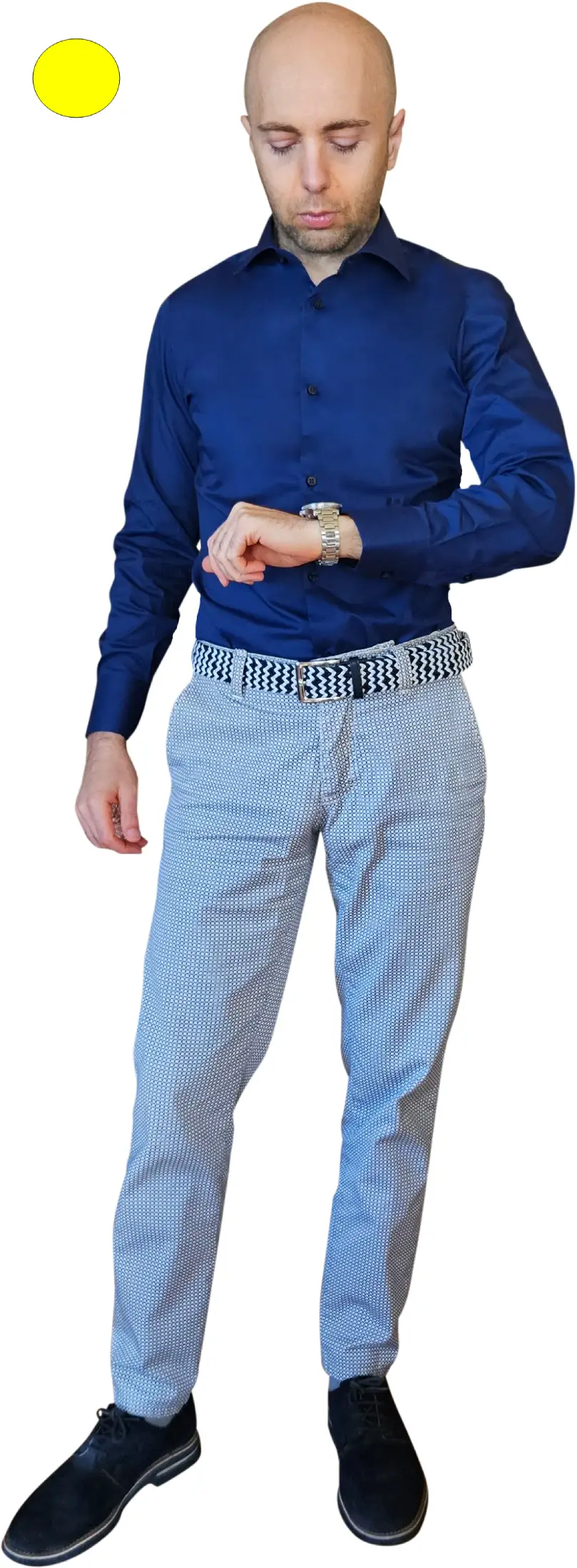

Check the time on the side, arm up, and with a glance. It’s a small detail, but details add up.
| Action | Open Body Language | Closed Body Language |
|---|---|---|
| Check Phone | Eye level | Crouched towards phone |
| Check Time | Slightly to the side, eye level | Crunched in front of torso |
| Hold Drink | To the side | In front of torso |
| Standing | Hands on hips | Both hands deep in pockets |
3. Strike A Balance of “Optimal Openness’
Remember, the goal is never to be ‘as open as possible’, the goal is to be appropriately open.
For example, none of these are 100% open or extremely open, but they are ALL good open body language poses:


Despite some poses featuring crossed legs or arms, they’re still solid open body language poses for men, in their given context.
Also see:
4. Feel Open & Confident, Let Body Language Follow
While adopting certain poses may help to feel differently, it’s more effective to go from the mind to the body.
Such as, focus on feeling confident and open, and let body language follow naturally.
🎗️ The gift of closeness: listen to your subconscious
The more advanced and accomplished you become, the less you want to force yourself to ‘change your state’.
If you’re not feeling open towards someone or in a certain place, there may be good reasons for it. Consider staying close, cutting contact, and moving to better people and places.
🎓 5. Strategically Switch Between Open & Closed
Just like the goal is not to be ‘as open as possible’, the goal is not to always display open body language.
You shouldn’t be open to everyone or any idea—that’s naive.
Instead, advanced players know that body language is a tool of advanced frame control, and strategically switch between open and closed body language.
Do the same and match your body language openness to your goals.
Open up for good people and when persuading, and close down when you disagree, dislike someone, or are busy with your things.
Some examples of using nonverbal openness for strategic sub-communication:
| Context | Strategic Open Signal | Strategic Closed Signal |
|---|---|---|
| Initial introductions | Lean in slightly and face frontally for confidence and respect | Look away and speak little to display distance or superiority |
| Negotiations | Palms up, nods and silences to increase rapport | Angle away, lean back and check the time to display unneededness |
| Group settings | Prolonged eye contact, smile, and face toward to display approachability | Unfocused gaze towards the crowd, hand in pocket to display you’re not |
💪🏼 Advanced power move: close up slightly to signal high value that’s not for everyone to enjoy
💪🏼 6. Power Move: Strategically Send Mixed Signal
Open books are dull.
Advanced players maintain power by never giving themselves fully, keeping others on the edge in nagging suspicion.
Some examples:
- Open torso but legs pointing away
- Lean in but stroking your chin in doubt (judge power move)

Open torso, fully relaxed, straight gaze, but torso slightly leaning away and feet pointing away. Sub-communication: you have a chance, but you don’t have my full approval yet
FAQ
What is open body language?
Open body language refers to nonverbal cues—like uncrossed arms and legs, open torso, and visible palms—that signal confidence, comfort, and emotional openness. It’s the body’s way of showing that you are receptive, secure, and socially engaged.
What is closed body language?
Closed body language includes nonverbal cues that signal discomfort, insecurity, or emotional withdrawal—such as crossed arms, crossed legs, hunched shoulders, and avoiding eye contact. It often suggests someone is defensive, anxious, or not open to connection.
What’s the difference between open and closed body language?
Open body language shows confidence and approachability through relaxed and exposed movements, while closed body language signals discomfort or defensiveness with crossed limbs, hunched posture, and withdrawn gestures. Open cues invite connection; closed cues create distance.
Why is open body language important?
Open body language builds trust, signals confidence, and increases influence. It makes you appear more credible in job interviews, more attractive in dating, and more authoritative in leadership. People subconsciously respond better to open cues.
Is open body language always better?
No. While generally positive, constant openness can signal neediness or low value if overused. High-status individuals calibrate their body language to the context—being open when it builds rapport and closed when it commands respect or deters unworthy attention.
Advanced Mastery
If you find our articles helpful, we developed a training program built to internalize the mindsets and skills of a high-quality, effective, winning man:
- Power University: our best guide to becoming a strategic winner


