Brag!, whose full title is “Brag! The Art of Tooting Your Own Horn Without Blowing It”, teaches readers how to brag and how to effectively self-promote without coming across as a big show-off.
TPM Take: An Interesting Take on Bragging—but Only a Starting Point
Brag! is a useful introduction for people who are overly uncomfortable talking about their accomplishments.
At TPM, we view bragging as part of a broader skill: signaling value. The goal isn’t to tell people how great you are. It’s to communicate credible evidence of your value in a way that increases how others perceive your competence, status, and desirability—without coming across as needy or insecure.
For a deeper dive, start here: Value Signaling: a framework for understanding value-signaling
Notes
About the Author:
Peggy Klaus is a communication and leadership coach who works with Fortune500 corporations to help executives improve their self-presentation and promotion.
To Brag Effectively, Know Yourself
To brag effectively, you need to know what you should be bragging about.
Some questions to better know yourself the author recommends:
- What are your five personality pluses? <— TPM’s note: Don’t say this, good bragging is to SUB-COMMUNICATE IT
- What are the ten most interesting things you have done?
- What do you like/love about your current job/career?
- What projects are you working on right now that best showcase your skills and talents?
- What success are you most proud of?
- What obstacles have you overcome to get where you are?
For more on how to brag, read:
A Job Well Done Does NOT Speak for Itself
Some people believe that doing a good job is all the promotion they need.
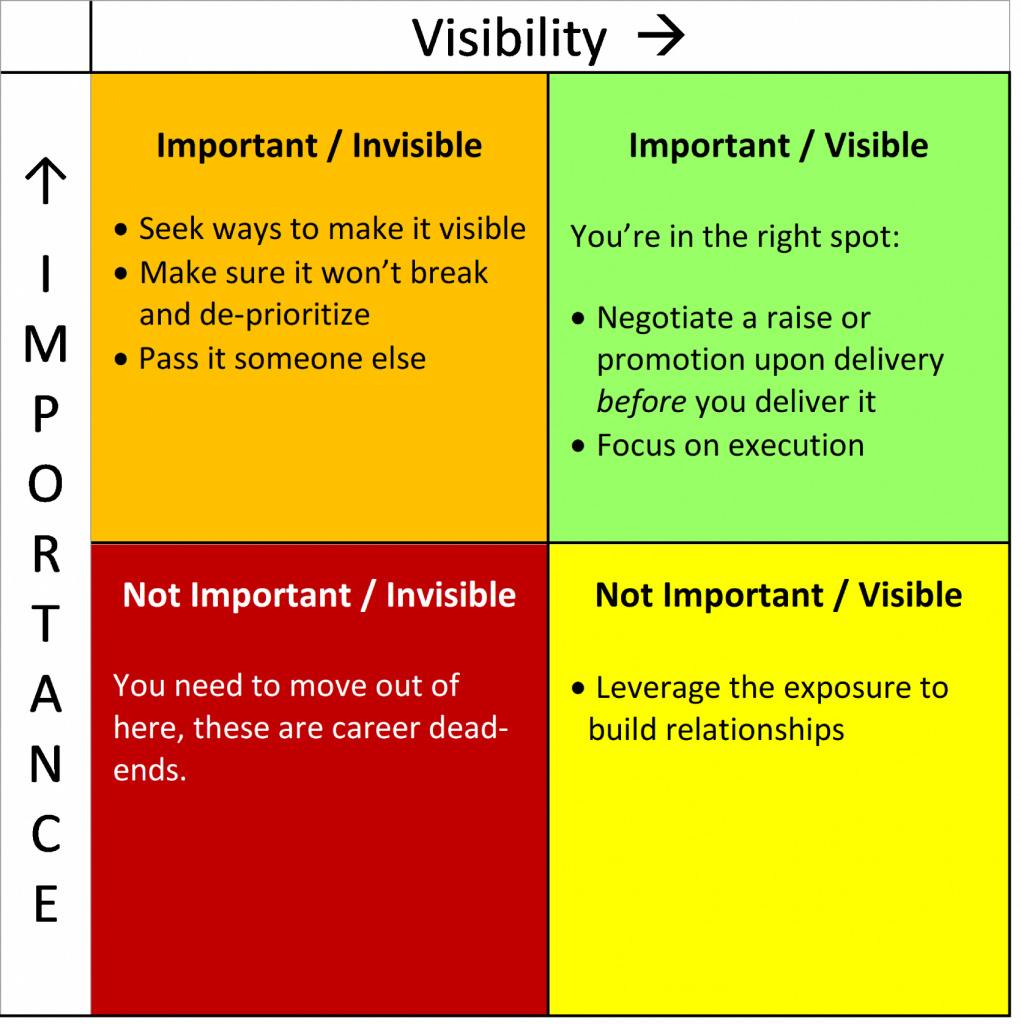
TPM Note: It Actually Depends on Visibility
Some jobs speak for themselves, while others don’t.
If you have the spotlight on you and people see you struggling and achieving, for example, you don’t need to brag. Let others do it for you, and it’s much more powerful.
But in cases where people only get to see the result without the hard work and skills, then you do want to add some promotion.
Humility Does Not Get You Noticed
Yes, being humble can be good.
But if being humble means never promoting yourself, then that does not work.
Few people have managed to combine humility with the need to self-promote success.
Don’t be one of those people who fail to self-promote and hide behind humility as if it were a virtue.
Sell Stories, not Numbers
No matter how good your numbers are, they do not make you sound impressive.
Klaus says that you want to talk about how you achieved those numbers, weaving a good story around them.
How it started, the challenges you overcame, how you insisted and maneuvered, and only after all the tribulations, how you managed to turn into a win
Mix Bragging With Interesting Content: A Bragalog
If you only brag, people will think you’re a showoff and they will not like you.
If you only tell facts, you are boring.
And if you only tell interesting stories, you are an entertainer, but you’re not marketing yourself.
Peggy Klaus says that the solution is to mix an entertaining story with your bragging strong points.
Then people will want to hear more about your marketing and, while you sell yourself, you also come across as intelligent and likable.
One example of a bragalogue, is for a NASA engineer introducing himself:
Hi, I’m Dan.
I’m one of those rocket scientists everyone always makes jokes about. I work on the space station program for NASA
TPM Note: this is already pushing the bragging
If your ‘joke’ is too obvious and too close to your brag, it can seem just that: a failed attempt at covering up your brag. But it fails to cover, and you lose twice the points: poor humor, and distasteful bragging. Plus, you’ve already disclosed your biggest brag, what’s left more valuable to discover about you?
CONS
- Confused non-neediness with a failure to brag?
The author shares an example of a guy who “failed” to brag effectively.
On a plane, she asks questions to the man next to her, and then based on his short replies, she notes that he is failing at selling himself and making it interesting for her.
To me, it looked like the guy just didn’t wanna talk and had no interest in displaying value. It’s a position of high power self-sufficiency, not bragging failure.
- Does not differentiate between the time to brag and the time to show strategic humility
There are situations when humbleness is the ultimate bragging.
For example, when others are touting your own horn, that’s the perfect time to say little and come across as bigger than life.
I wish the author differentiated between the two scenarios: when you need to brag, and when it’s best to be self-effacing.
That’s true strategic thinking, but I didn’t see it here.
PROS
- Lots of examples, some of them good
The book lists a lot of examples of how to turn descriptions, facts, and accomplishments, into effective self-promotion messages.
Some of them were good.
- Good concept idea of mixing entertainment with bragging
There is one great idea I take away from this book, and that’s to mix entertainment, storytelling, and bragging.
That was an eye-opener for me.
Review
Brag! is an interesting book with some good ideas and examples, though I missed a good overarching framework on how to signal value effectively, making it calibrated to your goal and context.
Check the:
And if you’re interested in an integrated framework on becoming higher value and then signaling it effectively to achieve life goals, check Power University: