
Former Community – We Moved
🆕 Coached community here, for posts & feedback public community here.
White folks "support" to black folks: the power dynamics of condescending sympathy

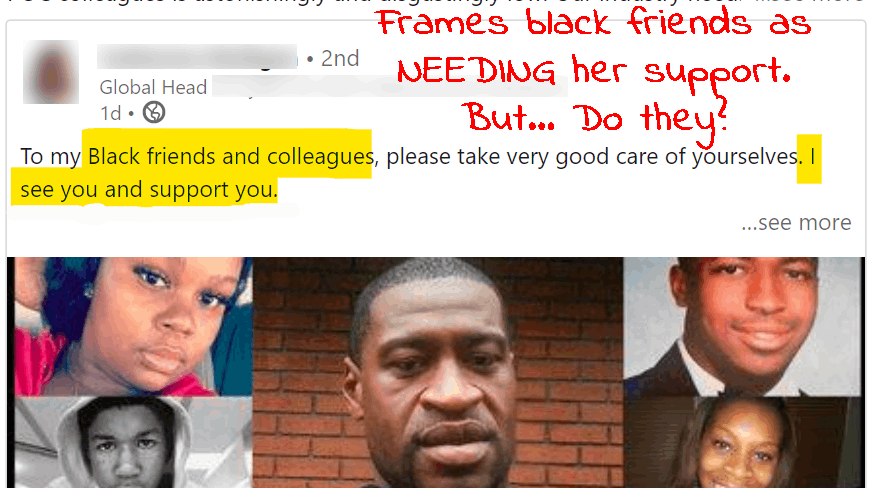
Quote from Lucio Buffalmano on June 4, 2020, 8:15 amThe messages of supports towards the black community, mostly from the white community, are flooding the world.
In many ways, that's a good thing.
But from a power dynamic point of view, we can see a different story to it.
And from a mental empowerment point of view, those messages can actually be harmful.
The Power Dynamics of White's Sympathy
On this website and in the Power University course we talked about hidden power moves.
Hidden power moves are words or actions that on the surface are friendly and supportive. But that, on a second level order, hide a power relationship where the person being friendly and supportive is actually disempowering the receiver.
Example of hidden power moves are:
- "Sorry for not picking up your call" (= you were not a high priority for me)
- "I'm sorry that you had to wait for me here" (= I have the power to let you wait)
Well, it's the same for offering support.
Offering support indirectly says that someone needs your support because, apparently, they aren't doing too well in life (and you are).
I'm not saying that most white folks are consciously demeaning black folks.
Most people are being warm and welcome and really want to help and support (while some are riding the SJW wave, of course).But the support and sympathy also indirectly say "I am (somewhat) superior and more powerful". Or, at least, "I am somewhat higher class citizen".
Support Individuals, NOT Groups or Races
Supporting "black folks" is demeaning and disempowering towards individuals.
Individuals are made up of a multitude of traits and belonging.
Their genders, skin color, eye color, nationalities, sexual preferences, preferences, skills, attitudes etc. etc. are all one of a multitude of traits and belongings.
Reducing them to just one of them is disempowering.There might be some truth in the "white privilege" thing.
White skin might confer some advantages under some circumstances.
So what?It's still a poor mindset to accept.
And it's still condescending.
And it's still fucking meaningless.Advantages and disadvantages are part of life, and cover all possible traits.
From eye color, to amount of hair on your head, to height, to IQ, to... Whatever.As much as you don't publish posts telling short or dumb people that you "support" them, it's condescending to tell black people that you "support" them.
Me, I don't think that any race or group as a whole needs my support.
I think there are countless individuals within those races who are strong and capable enough to be far more successful than most individuals in any other race or group.White People: Let's Put Ourselves in The Condescended Shoes
Some white folks these days are inviting others to put themselves in other people's shoes.
That's always a great exercise.
The first part of that exercise, the one that everyone is embracing, is to "feel the pain" of black people.
Great.Now let's finish the exercise, though.
Let's add the power dynamics part I'm addressing here.And put yourself in the shoes of being the subject of your own friendly support.
Here is what other races could tell white people:
- Jew person: I'm sorry there is a pandemic of white people being born with such lower IQs compared to us. Society shouldn't discriminate against lower IQ
- Asian person: I'm sorry white people have to be born so asocial and selfish. And so unconscientious, with such poor work ethics. Society shouldn't discriminate against people with ADHD. My sympathy goes to them.
- Asian woman: I'm sorry white girls are so unfeminine and white guys prefer us. It's not fair that men like feminine women more. My sympathy goes out to them.
- Black person: I'm sorry white people have so little street smarts, have little dicks, and cannot spring or jump. Society shouldn't discriminate against any of that
How would any empowered white person answer to any of that?
Any empowered wite person wouldn't even want to hear any of that.And this is how they might answer:
- Thanks, but not need to. My IQ is fine. And emotional Intelligence matters more anyway: all that IQ didn't help you avoid a history of prosecutions, it seems
- Thanks, but not need to. Western work ethics allowed Westerners to rule the world, so I think we're pretty fine
- Thanks but not need to. Girls love my dick, and I prefer swimming and long-lasting sports to sprints
These answers are more on the aggressive aside.
From a framing point of view, they all read the initial "offer of help" not as a friendly gesture, but as an attempt at one-upping, and they answer with a one-up back of their own.
Answering with a one-up defends your own power, and also serves to protect one's own mind and self-esteem.
After that, you can move to move conciliatory tones.Answering to Condescending Support: The Socially Intelligent Way
Usually, the messages of support are too hidden for you to one-up back.
So you need a more socially intelligent answer.
This is how a black person should answer to condescending support:
White Person: All my support and sympathy, I stand beside you
Black Person: Thank you, I appreciate your friendliness (don't call it "support", frame it as "friendliness").
It can be helpful to some black people indeed (distance yourself from the group, reclaim your power as an individual). Some policemen can see some particular races with more animosity than others sometimes, I suppose (philosopher frame).
But personally, I'm doing great (reclaim your power as an individual 2).
I see life as a world of opportunities, not threats (frame yourself as a high quality man, not as "a black dude"). This is a life of opportunity for those who want to take them (swtich the tables: maybe he could use some of your support?).That's it.
Power reclaimed.The Dangerous Effects of Sympathy: You Might Start Believing That Shit
There is a pernicious, dangerous effect of constant supportive and sympathetic messages.
And unless you're aware of the power dynamics, it can go unnoticed.
The danger of accepting people's support without questioning it is the internalization of the belief that you do need support.
When you internalize that, you are also accepting that you do are indeed a second class citizen.You should be worried and afraid of internalizing that belief, because it's terribly dangerous.
When you internalize it, you start believing it, and accordingly:
- You start believing success is harder for you
- You start believing you are a target for all cops
- You start believing you can't win in a racist society
- You start believing you are not good enough (self-esteem and confidence will tank)
And, of course, you become angrier, more resentful, and unhappier.
It's ironic, but those same messages that wanted to offer support can actually do more harm than good.
That's why I recommend black folks to put up shields against superficial and general support and sympathy.
Stand guard to the gates of your mind, my friends.
The messages of supports towards the black community, mostly from the white community, are flooding the world.
In many ways, that's a good thing.
But from a power dynamic point of view, we can see a different story to it.
And from a mental empowerment point of view, those messages can actually be harmful.
The Power Dynamics of White's Sympathy
On this website and in the Power University course we talked about hidden power moves.
Hidden power moves are words or actions that on the surface are friendly and supportive. But that, on a second level order, hide a power relationship where the person being friendly and supportive is actually disempowering the receiver.
Example of hidden power moves are:
- "Sorry for not picking up your call" (= you were not a high priority for me)
- "I'm sorry that you had to wait for me here" (= I have the power to let you wait)
Well, it's the same for offering support.
Offering support indirectly says that someone needs your support because, apparently, they aren't doing too well in life (and you are).
I'm not saying that most white folks are consciously demeaning black folks.
Most people are being warm and welcome and really want to help and support (while some are riding the SJW wave, of course).
But the support and sympathy also indirectly say "I am (somewhat) superior and more powerful". Or, at least, "I am somewhat higher class citizen".
Support Individuals, NOT Groups or Races
Supporting "black folks" is demeaning and disempowering towards individuals.
Individuals are made up of a multitude of traits and belonging.
Their genders, skin color, eye color, nationalities, sexual preferences, preferences, skills, attitudes etc. etc. are all one of a multitude of traits and belongings.
Reducing them to just one of them is disempowering.
There might be some truth in the "white privilege" thing.
White skin might confer some advantages under some circumstances.
So what?
It's still a poor mindset to accept.
And it's still condescending.
And it's still fucking meaningless.
Advantages and disadvantages are part of life, and cover all possible traits.
From eye color, to amount of hair on your head, to height, to IQ, to... Whatever.
As much as you don't publish posts telling short or dumb people that you "support" them, it's condescending to tell black people that you "support" them.
Me, I don't think that any race or group as a whole needs my support.
I think there are countless individuals within those races who are strong and capable enough to be far more successful than most individuals in any other race or group.
White People: Let's Put Ourselves in The Condescended Shoes
Some white folks these days are inviting others to put themselves in other people's shoes.
That's always a great exercise.
The first part of that exercise, the one that everyone is embracing, is to "feel the pain" of black people.
Great.
Now let's finish the exercise, though.
Let's add the power dynamics part I'm addressing here.
And put yourself in the shoes of being the subject of your own friendly support.
Here is what other races could tell white people:
- Jew person: I'm sorry there is a pandemic of white people being born with such lower IQs compared to us. Society shouldn't discriminate against lower IQ
- Asian person: I'm sorry white people have to be born so asocial and selfish. And so unconscientious, with such poor work ethics. Society shouldn't discriminate against people with ADHD. My sympathy goes to them.
- Asian woman: I'm sorry white girls are so unfeminine and white guys prefer us. It's not fair that men like feminine women more. My sympathy goes out to them.
- Black person: I'm sorry white people have so little street smarts, have little dicks, and cannot spring or jump. Society shouldn't discriminate against any of that
How would any empowered white person answer to any of that?
Any empowered wite person wouldn't even want to hear any of that.
And this is how they might answer:
- Thanks, but not need to. My IQ is fine. And emotional Intelligence matters more anyway: all that IQ didn't help you avoid a history of prosecutions, it seems
- Thanks, but not need to. Western work ethics allowed Westerners to rule the world, so I think we're pretty fine
- Thanks but not need to. Girls love my dick, and I prefer swimming and long-lasting sports to sprints
These answers are more on the aggressive aside.
From a framing point of view, they all read the initial "offer of help" not as a friendly gesture, but as an attempt at one-upping, and they answer with a one-up back of their own.
Answering with a one-up defends your own power, and also serves to protect one's own mind and self-esteem.
After that, you can move to move conciliatory tones.
Answering to Condescending Support: The Socially Intelligent Way
Usually, the messages of support are too hidden for you to one-up back.
So you need a more socially intelligent answer.
This is how a black person should answer to condescending support:
White Person: All my support and sympathy, I stand beside you
Black Person: Thank you, I appreciate your friendliness (don't call it "support", frame it as "friendliness").
It can be helpful to some black people indeed (distance yourself from the group, reclaim your power as an individual). Some policemen can see some particular races with more animosity than others sometimes, I suppose (philosopher frame).
But personally, I'm doing great (reclaim your power as an individual 2).
I see life as a world of opportunities, not threats (frame yourself as a high quality man, not as "a black dude"). This is a life of opportunity for those who want to take them (swtich the tables: maybe he could use some of your support?).
That's it.
Power reclaimed.
The Dangerous Effects of Sympathy: You Might Start Believing That Shit
There is a pernicious, dangerous effect of constant supportive and sympathetic messages.
And unless you're aware of the power dynamics, it can go unnoticed.
The danger of accepting people's support without questioning it is the internalization of the belief that you do need support.
When you internalize that, you are also accepting that you do are indeed a second class citizen.
You should be worried and afraid of internalizing that belief, because it's terribly dangerous.
When you internalize it, you start believing it, and accordingly:
- You start believing success is harder for you
- You start believing you are a target for all cops
- You start believing you can't win in a racist society
- You start believing you are not good enough (self-esteem and confidence will tank)
And, of course, you become angrier, more resentful, and unhappier.
It's ironic, but those same messages that wanted to offer support can actually do more harm than good.
That's why I recommend black folks to put up shields against superficial and general support and sympathy.
Stand guard to the gates of your mind, my friends.

Quote from JP on June 4, 2020, 3:55 pmIt's a very insidious way of indoctrinating beliefs in others. When a large enough group of people repeats the same rhetoric to you repeatedly, you will slowly succumb to ingraining these beliefs—all while being completely unaware of its effect on you. Even if you are a rational person with a high level of critical thinking, you'll still be open to being completely "gas-lighted" just due to the sheer number of people involved. This is similar to that Black Mirror episode "White Bear," where literally everyone around the protagonist is in on the act.
The only ways I can think of to stop this indoctrination is to avoid the sources of it, which can mean:
- Not relying so much on Google (Google is known to increase the amount of traffic, which means it will create your own echo chamber)
- Avoiding certain people
- Moving to a place where the belief is not as widespread
The other way is to simply have blind faith in what you believe, similar to those Muslim extremists.
About this particular power move though, I find these are probably one of the toughest to deal with. However, if in the middle of a conversation, the other person mentions a family member of mine and I mention that they're deceased, they'll usually respond with "I'm sorry," would you consider this a power move if it's been 5 - 6 years ago? I know it's the polite thing to do, and I don't feel slighted, but I can't help but feel annoyed since I get this a lot. This feeling is similar to disabled people who hate when others feel pity for them.
It's a very insidious way of indoctrinating beliefs in others. When a large enough group of people repeats the same rhetoric to you repeatedly, you will slowly succumb to ingraining these beliefs—all while being completely unaware of its effect on you. Even if you are a rational person with a high level of critical thinking, you'll still be open to being completely "gas-lighted" just due to the sheer number of people involved. This is similar to that Black Mirror episode "White Bear," where literally everyone around the protagonist is in on the act.
The only ways I can think of to stop this indoctrination is to avoid the sources of it, which can mean:
- Not relying so much on Google (Google is known to increase the amount of traffic, which means it will create your own echo chamber)
- Avoiding certain people
- Moving to a place where the belief is not as widespread
The other way is to simply have blind faith in what you believe, similar to those Muslim extremists.
About this particular power move though, I find these are probably one of the toughest to deal with. However, if in the middle of a conversation, the other person mentions a family member of mine and I mention that they're deceased, they'll usually respond with "I'm sorry," would you consider this a power move if it's been 5 - 6 years ago? I know it's the polite thing to do, and I don't feel slighted, but I can't help but feel annoyed since I get this a lot. This feeling is similar to disabled people who hate when others feel pity for them.
Quote from Lucio Buffalmano on June 5, 2020, 7:14 amYes, so true!
These are society-level frames and power moves, and they're very difficult to counteract, even mentally.
When someone keeps repeating you that police hates you and that you have fewer chances of being successful, it's harder to combat that mindset.
But that's all the more reason to do it, because you can't internalize that shit.
Especially in this case, where I don't even feel it's true. This wolrd offers more opportunity to anyone to be successful and happy than it's ever been the case in history.
It's just so self-sabotaging to believe otherwise.By the way, I thought this was important, so I made a full post out of it:
I'm not sure I follow on the deceased family member.
You mean if people might ask you on purpose even while knowing that they are not alive anymore?
If that's what you mean, I don't think that's a power move.
At least not most of the time.It would be SO low that I don't think most people would willingly stoop that low.
Yes, so true!
These are society-level frames and power moves, and they're very difficult to counteract, even mentally.
When someone keeps repeating you that police hates you and that you have fewer chances of being successful, it's harder to combat that mindset.
But that's all the more reason to do it, because you can't internalize that shit.
Especially in this case, where I don't even feel it's true. This wolrd offers more opportunity to anyone to be successful and happy than it's ever been the case in history.
It's just so self-sabotaging to believe otherwise.
By the way, I thought this was important, so I made a full post out of it:
I'm not sure I follow on the deceased family member.
You mean if people might ask you on purpose even while knowing that they are not alive anymore?
If that's what you mean, I don't think that's a power move.
At least not most of the time.
It would be SO low that I don't think most people would willingly stoop that low.
Quote from JP on June 6, 2020, 6:09 amYou mean if people might ask you on purpose even while knowing that they are not alive anymore?
If that's what you mean, I don't think that's a power move.
At least not most of the time.It would be SO low that I don't think most people would willingly stoop that low.
No sorry, that's not what I meant. I don't think I phrased it very well. Here, let me use an example to illustrate:
Me: "Hey you got plans with your dad on father's day?"
Friend: "Yeah! I got tickets for the two of us to go watch the game! Then we're gonna grab drinks afterwards! What about you?"
Me: "Oh I don't really have plans"
Friend: "Oh so you're just gonna chill with your dad?"
Me: "Yeah actually, he passed away 6 years ago"
Friend: "Oh, sorry to hear about that..."
Of course, the friend was only being polite so I can't get upset with that. But I can't think of a way to mention the fact that he's deceased without looking weak. It's like an anti-Power move on myself. The only way I can think of to NOT have this awkwardness is to just continue to be vague, redirect the conversation elsewhere, or just lie.
You mean if people might ask you on purpose even while knowing that they are not alive anymore?
If that's what you mean, I don't think that's a power move.
At least not most of the time.It would be SO low that I don't think most people would willingly stoop that low.
No sorry, that's not what I meant. I don't think I phrased it very well. Here, let me use an example to illustrate:
Me: "Hey you got plans with your dad on father's day?"
Friend: "Yeah! I got tickets for the two of us to go watch the game! Then we're gonna grab drinks afterwards! What about you?"
Me: "Oh I don't really have plans"
Friend: "Oh so you're just gonna chill with your dad?"
Me: "Yeah actually, he passed away 6 years ago"
Friend: "Oh, sorry to hear about that..."
Of course, the friend was only being polite so I can't get upset with that. But I can't think of a way to mention the fact that he's deceased without looking weak. It's like an anti-Power move on myself. The only way I can think of to NOT have this awkwardness is to just continue to be vague, redirect the conversation elsewhere, or just lie.

Quote from lzy on June 6, 2020, 7:13 amthis is very on-point - any0n3 who gets offended by this is a n00b and should re-evaluate their slave mentality.
this is very on-point - any0n3 who gets offended by this is a n00b and should re-evaluate their slave mentality.
Quote from Lucio Buffalmano on June 7, 2020, 7:47 amQuote from JP on June 6, 2020, 6:09 amYou mean if people might ask you on purpose even while knowing that they are not alive anymore?
If that's what you mean, I don't think that's a power move.
At least not most of the time.It would be SO low that I don't think most people would willingly stoop that low.
No sorry, that's not what I meant. I don't think I phrased it very well. Here, let me use an example to illustrate:
Me: "Hey you got plans with your dad on father's day?"
Friend: "Yeah! I got tickets for the two of us to go watch the game! Then we're gonna grab drinks afterwards! What about you?"
Me: "Oh I don't really have plans"
Friend: "Oh so you're just gonna chill with your dad?"
Me: "Yeah actually, he passed away 6 years ago"
Friend: "Oh, sorry to hear about that..."
Of course, the friend was only being polite so I can't get upset with that. But I can't think of a way to mention the fact that he's deceased without looking weak. It's like an anti-Power move on myself. The only way I can think of to NOT have this awkwardness is to just continue to be vague, redirect the conversation elsewhere, or just lie.
I don't see this situation as taking any power away from you, unless you react like you're taking it as a personal slight.
Depending on how you feel about your family member, you might say something like this:
It's OK. That's life, man. We die, that's what we all do. It's par of nature. The point is how to make the most out of life while we're alive. Cheers.
It's a philosophical frame that empowers you.
Or much simpler, if you don't feel that light-hearted about it (yet):
Thanks man, it's OK. It's always painful when a family member passes away, but that's also life.
Anyway, about your plans...Such as, you acknowledge that they want to be helpful, but then also bridge the conversation back to "normality", which shows strong social skills.
Quote from JP on June 6, 2020, 6:09 amYou mean if people might ask you on purpose even while knowing that they are not alive anymore?
If that's what you mean, I don't think that's a power move.
At least not most of the time.It would be SO low that I don't think most people would willingly stoop that low.
No sorry, that's not what I meant. I don't think I phrased it very well. Here, let me use an example to illustrate:
Me: "Hey you got plans with your dad on father's day?"
Friend: "Yeah! I got tickets for the two of us to go watch the game! Then we're gonna grab drinks afterwards! What about you?"
Me: "Oh I don't really have plans"
Friend: "Oh so you're just gonna chill with your dad?"
Me: "Yeah actually, he passed away 6 years ago"
Friend: "Oh, sorry to hear about that..."
Of course, the friend was only being polite so I can't get upset with that. But I can't think of a way to mention the fact that he's deceased without looking weak. It's like an anti-Power move on myself. The only way I can think of to NOT have this awkwardness is to just continue to be vague, redirect the conversation elsewhere, or just lie.
I don't see this situation as taking any power away from you, unless you react like you're taking it as a personal slight.
Depending on how you feel about your family member, you might say something like this:
It's OK. That's life, man. We die, that's what we all do. It's par of nature. The point is how to make the most out of life while we're alive. Cheers.
It's a philosophical frame that empowers you.
Or much simpler, if you don't feel that light-hearted about it (yet):
Thanks man, it's OK. It's always painful when a family member passes away, but that's also life.
Anyway, about your plans...
Such as, you acknowledge that they want to be helpful, but then also bridge the conversation back to "normality", which shows strong social skills.
