
Most leaders stop at transactional exchanges: salaries, bonuses, or punishments.
But the best leaders go beyond.
They inspire people, craft shared identities, reach goals, and make their teams thrive.
This guide dives into transformational leadership strategies—with our expertise in psychology, power dynamics, and strategies—to make you an influential and successful leader.

Start With the Foundations: Yourself
Leadership is both the pinnacle and natural consequence of an effective process of self-empowerment.
On the other hand, that self-empowerment is also a requirement because to be an exceptional leader, you must be an exceptional man.
See:
Build Identity
Researcher Haslam calls it “entrepreneurs of identity”.
It includes:
- Values
- What you stand for
- ‘What it means to be ‘us’
It’s especially important for group formation or when changing direction.
Once you have a social identity, you then want to align your policies with the group identities and they will be far more persuasive.
Alternatively, you must adapt the identity to fit the policies.
🔎 Example: Bush & the ‘leader’s burden’
When Bush sought support for the Iraq invasion, he often referred to ‘the world’.
It was a persuasive move to dominant ‘revenge’ motive with warmth.
He framed the operation as a duty of the world leader, leveraging Americans’ identity as champions of global freedom and democracy.
Some passages from the war announcement:
Bush: (…)
Disarm Iraq to free its people and to defend the world from grave Danger
(…)
Armed forces now in the Middle East: the Peace of a troubled world and the hopes of an oppressed people now depend on you
(…)
my fellow citizens the dangers to our country and the world will be overcome
P.S.:
Don’t judge late Bush, who failed the ‘character’ and the ‘deliver’ test with lies and a non-victory.
Bush at this point had sky-high ratings.
1.2. Facilitate friendships among team members
Team of friends are happier to meet and naturally contribute and cooperate more.
And best of all if it’s you to connect them so you maintain ‘host power’ and reinforce prestigious value-adding leadership.
2. Be “one of us” (‘prototypical’)
Studies show that people perceive power much differently if it comes from “within the group” or from outsiders.
Power and influence from outsiders feel oppressive. But power and influence from an ingroup member is more positive or even uplifting.
Be similar to the team in its key features to increase leadership acceptance. And influence those virtues to align with your goals.
For example, a commander should display the value of courage.
Being prototypical allows leaders to:
- Receive more support
- Receive higher ratings on effectiveness
- Drive change more easily
- Be excused more readily for mistakes (even when behaving unfairly)
Be similar, but exceptional
There is a dichotomy of leadership here and you must strike the right balance.
Says leadership researcher Alexander Haslam:
Leaders can be ahead of the group, but never so far ahead that they are out there on their own.
Albeit teams differ, common traits where exceptionalism helps include:
- Values
- Responsibility
- Work ethics
- Demanding more of yourself than of others
- Social skills / power awareness
👉🏼 But never make it a competition!
Remember: you’re the leader no matter what.
The competition mindset pulls you down to a team member.
And poorly done may even sub-communicate you’re insecure about your leadership.
Instead, reward the top performers to display your self-confidence.
And own possible limitations.
For example, if you’re older, don’t try to be physically ‘better’.
Be strategic instead.
Stay in shape, subtly highlight past high performance, and demand excellence to show you’re accustomed to excellence.
3. Differentiate “us” from “not-us”
Make the team feel uniquely and positively distinct from others.
This reinforces the ‘sense of team’ and keeps people united and cohesive.
Make them feel great for belonging to such a great team, and being close to you.
As the leader, embody that sense of being special.
Carry yourself with confidence and pride.
And some ‘positive power moves‘ may be allowed here with ‘positive social climbs’, criticizing others with the only goal of self-framing as higher value, more ‘honorable’, or generally superior.
This motivates people to stick with the team for the good feelings they get from ‘being special’.
4. Do it “for us”
Whenever possible, frame your actions and goals as ‘for the team’.
The team will appreciate you more, and you display good values of cooperation and contribution.
🔎 Example: I sought victory for the team
🙋♂️Lucio’s Experience

Lucio:
As a Toastmasters president, I placed 2nd in a European-level speech competition.
I shared that I sought victory for myself first, a great display of the value of honest.
And added that I also really wanted to bring a trophy back to the club -for ‘us all’-.
5. Make “us” proud
Make the team matter, give it status and respect among other teams.
Part of it comes down to effectiveness and achieving goals of course.
But a good part of it is also about communication:
- Communicate progress
- Celebrate milestones
- Display optimism
🛠️ Use strategic bluster
For example:
Value-adding Bluster: Team, this is a memorable day.
What we have achieved is unbelievable. What you guys did is incredible. This is the first time ever that…
You guys are the best team I’ve ever been in.
I’m proud to be here with you.
Build Commitment
6. Care personally
Care both for the team member as a human being, but also for what he does for the common good and common purpose.
Do 1:1s, even if just by the side of a social gathering. Check in, offer advice, encourage them to try, and celebrate their wins.
1.2. Pull people up
Speak well about people.
And speak particularly well about great performers and team representatives.
It’s good for leaders to be a ‘bit of a judge‘, and use your emotional rewards to motivate positive behavior.
7. Empower them to be role models
Create smaller leaders in your team.
Encourage them to be role models outside, and for the newer members. And reward them for well-representing and ‘doing the team honor’.
This approach motivates people to be better not just for them, but for others, and for the team.
Inspire
8. Minimize transaction-talk
Research suggests that focusing on transactions such as salaries and bonuses can undermine intrinsic motivation.
This seems to be especially true for creative or complex tasks, and potentially for top perfomers.
To avoid ‘crowding out’ of intrinsic motivation:
- Keep rewards and motivation separated
- Reward emotionally, which also empowers you as a leader
- Reward with growth opportunities
- Have HR negotiate salaries, while you support your team’s negotiation preferences
9. Frame your goals as meaningful
Meaningful goals motivate.
And even mundane businesses can be more inspiring:
- We wash cars ➡️ We make men proud of their drive
- We clean toilets ➡️ We maintain public health and provide hygiene when people need them the most
- We serve drinks ➡️ We foster connections and unforgettable moments among friends
Speak of ‘(moral) duty’ instead of ‘job requirements’
You’re more persuasive when you assign tasks by appealing to moral duties:
- You must clean the restaurant ➡️ It’s our duty to our customers to provide an environment as clean as possible
Link tasks to meaningful causes
Frame someone’s work in light of what it does for the mission, or the final user.
For example:
- Your job is to sell ➡️ You help the prospect solve X problem
- Your job is to clean ➡️ Your contribution is invaluable to help us please our customers
Knowing they’re contributing to a larger cause inspires people to do better.
💪🏼 Frame the goal as a challenge and ‘test of value’
A possible power move, but a stretch goal may become a man’s test.
And the achievement of that goal his ‘badge of honor’.
This approach is extremely motivational for ambitious men who crave the feeling of conquest and victory -and fear failure-.
Sustain Performance
10. Keep “us” effective
The most underrated leader’s objective is to keep the team effective, motivated, and cooperative.
- Recognize toxic team members or employees
- Remove toxic team members before they spoil the bunch
- Recognize top performers
- Promote top performers, set them as examples to follow
To read characters and people undermining your leadership you need power-awareness.
And you must be ruthless in removing them -remember: to be good, you need to be ‘bad’ sometimes.
Do that, keep setting the example, and the virtuous cycle maintains the group cohesive, inspired, and effective:

Chart adapted from the group engagement model
Case Studies
Let’s review two examples of leaders asking for contribution.
But one does it with transformational leadership, and one with transactional leadership.
Let’s see the stark difference:
Kennedy: Transformational Request
Most examples of great leaders are transformational.
Kennedy gave the nation a dream.
The U.S. became the torchbearer for Western democracy and freedom. And moon-landing the culmination of a joint effort to bring humanity to higher heights.
That’s why Kennedy’s big ask worked:
Kennedy: Ask not what your country can do for you—ask what you can do for your country
Kennedy asked Americans to be prestigious leaders themselves.
If he had campaigned on giving them jobs -transactional leadership-, they would reply ‘To hell that, give me higher salaries’.
Andrew Bailey: Transactional Request
Bank of England governor Andrew Bailey also asked for people’s contribution.
But despite carefully hedging his words, his effect was the opposite.
It failed because it was hypocritical and non-reciprocal (rules for thee, but not for me).
Bailey’s hypocrisy was obvious because he was in the wrong exchange -the transactional exchange-, where people naturally focus on money and numbers.
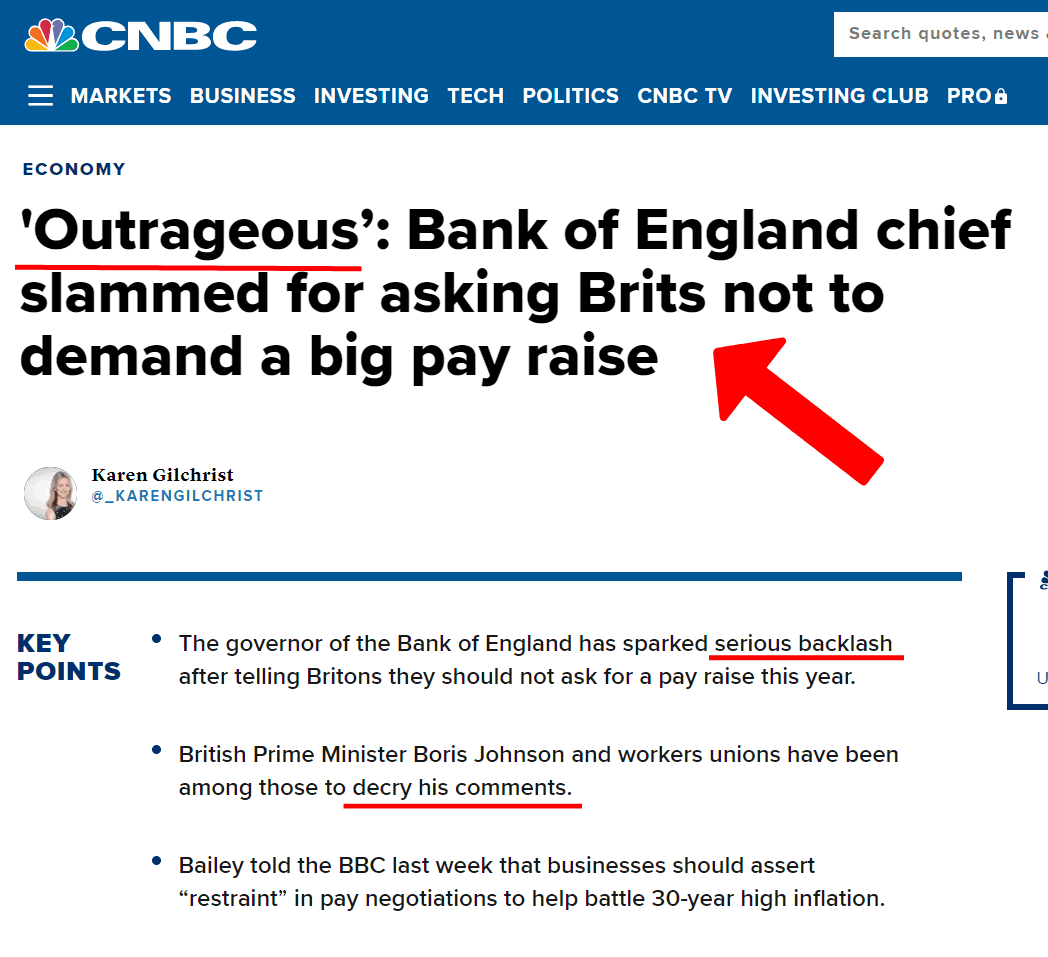
The difference is that:
- Bailey wasn’t in a position to be ‘inspirational’
- His message centered on material concerns—money and inflation
A better alternative for him would have been to:
- Shift to transformational – higher ideals of sacrifice, togetherness, and
- Lead from the front, including himself in the sacrifice
For example:
Transformational Bailey: We may be in for some challenging times with inflation. <— Sets the challenge
But we can weather it. <— ‘We’ frame & Optimistic
Business leaders ought to give the example and freeze salaries and bonuses <— Demand first from leaders
(share or leak you froze your salary) <— 💪🏼 Leading by example
And if everyone who can do his part <— 💪🏼 ‘Those who can’ is something many want to be. Nobody wants to be ‘cannot’
We can soon win inflation
Of course most bank chairmen are expected to be ‘factual’ rather than inspirational.
If this article was any helpful, our training program Power University is designed to turn good men into influential leaders