
Social Behavior as Exchange (Homans, 1958) is a nine-page essay published in the American Journal of Sociology (Vol. 63, No. 6, pp. 597–606) that became the founding document of social exchange theory, bridging principles of behavioral psychology and economics to explain social behavior.
Overview
Human interactions can be understood as exchanges of goods—both material and non-material—running on calculations based on individuals maximizing for self-interest of rewards, returns on investment, and what best moves them towards their goals.
People exchange rewarding and costly behavior, and the balance of that exchange is what determines whether the interaction continues or stops (not morality or ‘socialization’).
- Social interaction = exchange: All social behavior involves trading valuable things (status, approval, information, material goods)
- Cost/reward calculus: People seek to maximize rewards and minimize costs in their interactions
- Relationships form or break based on ROI: Behavior stabilizes when profit (reward minus cost) is maximized
- Reciprocity principle: If you give value to others, they’re pressured to give value back
- Distributive justice: People expect rewards to be proportional to costs—and will protest when they aren’t
Novelty and importance: While not the first mention of human interactions as exchanges, it’s the first testable paper, became the canonical reference for the beginning of social exchange theory, and it spawned the field (Thibaut & Kelley, 1959; Blau, 1964).
Notes
The Three Tasks of Small-Group Research
Homans identifies three necessary jobs for understanding social behavior:
- Connect lab experiments to real life: Laboratory findings must align with what happens in actual groups
- Consolidate propositions: Develop general statements that summarize empirical findings across studies
- Explain downstream from principles: Show how group behavior can be derived from more general psychological principles
Homans argues that exchange theory accomplishes all three, making it the ideal framework for understanding social dynamics.
The Exchange Paradigm
Homans starts with behavioral psychology: pigeons peck for corn. The more they get corn, the less valuable additional corn becomes (satiation). If pecking stops producing corn, they stop pecking (extinction). If pecking is costly (fatigue), they stop sooner.
Applying this to humans:
Two people interact. Each provides something valuable to the other. Each incurs costs. Each has behavioral alternatives. The problem of social science is to state propositions relating variations in values and costs to behavioral choices.
The Influence Process In Groups
Homans examines Festinger, Schachter, and colleagues’ work on group dynamics:
- Cohesiveness = value: Groups are cohesive when members find interaction rewarding
- More cohesion = more interaction: The more valuable the exchange, the more frequent the interaction
- Conformity rewards: Conformers receive social approval; deviates receive pressure, then rejection
- Value proportionality: To get valuable things from others, you must provide valuable things to them
Practical implication: Groups naturally pressure members to provide value—deviance gets punished.
Profit, Value, and Social Influence Over Individuals
People stabilize their behavior where they’re doing the best they can for themselves under the circumstances. And, we’d add at TPM, others still accept the exchange.
The Gerard experiment demonstrates this:
Subjects in groups with high “attraction” (potential for reward) shifted opinions toward the group. Those in low-attraction groups shifted toward an outsider who offered alternative rewards.
Meaning: the group’s ability to give more exerts stronger influence.
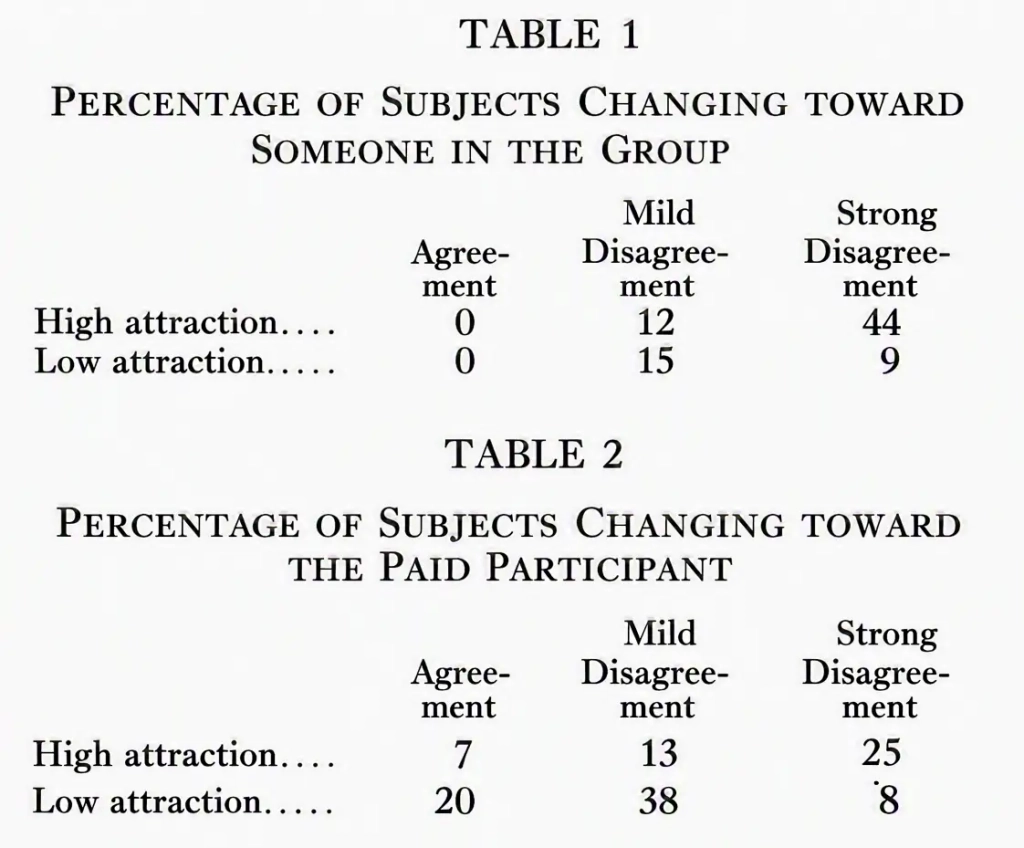
Key insight: People change behavior most when perceived profit (reward minus cost) is lowest. They stabilize when profit is maximized.
Distributive Justice
Homans observes that people expect rewards to be proportional to costs.
Example: Workers with more responsibility expect higher pay. When rewards and costs aren’t proportional, complaints follow.
People also run these calculations socially, and demand that their profit (reward minus cost) be equal to others’ profit who have similar circumstances.
But it works both ways: higher rewards also justify higher costs.
Exchange Dynamics Form Social & Status Structures
Homans concludes by examining how stable social structures emerge from exchange processes, using Peter Blau’s study of government agents.
The dynamics at play are:
- Asking for advice = costs to the asker (acknowledging inferiority)
- Frequent advice-seeking becomes too costly
- Agents balance: seek enough help to function, not so much they lose status
- Competent agents give advice ➡️ receive status-prestige in return and move higher up
- Less competent agents pair off for equal exchanges
Result: A stable hierarchy emerges from individual cost-benefit calculations.
Hence, the group structure is simply the frozen pattern of exchange processes that have reached equilibrium.
Quotes
On self-interest ‘overpowering’ ‘noblesse oblige’:
the theory of noblesse oblige, which we all subscribe to, though we all laugh at it, perhaps because the noblesse often fails to oblige
Making fun of social sciences missing the obvious realities of life for decades :):
Of all our many “approaches” to social behavior, the one that sees it as an economy is the most neglected, and yet it is the one we use every moment of our lives-except when we write sociology
Practical Applications
1. To Get, Be Able to Give (Foundation of Social Exchange)
Homans formalizes what TPM readers long know: status, respect, attraction and influence are scarce goods that must be earned through exchange.
Every interaction is a negotiation of value. You’re either giving something valuable enough to justify what you’re taking, or you’ll get denied (or, alternatively, you’re paying by being a burden, becoming disliked, and losing status and access to others).
2. ‘High Personal Value’ Is Real (& The Secret to Social Success)
Many men see social hierarchies as arbitrary or unfair. Homans shows they emerge from rational exchange processes:
- High-value men attract others
- Low-value men must offer something with investment/material exchange, or will be overlooked
This is the compensatory investment that runs parallel to social exchanges, as we explained in The Social Investment Model.
Understanding this lets you play the game consciously rather than getting played unconsciously.
3. Strategic Thinking Provides An Edge
This isn’t cold sociopathy, it’s reality. The social world runs on exchange. Those who understand it win; those who don’t, lose.
If most people exchange with others based on ROI, it follows that less calculative and more naive men are at risk of losing out.
And more effectively calculative men may possess an advantage.
Homans explicitly connects social behavior to economic reasoning, which we refer to as ‘social accounting’:
- Costs and rewards can be measured
- People optimize for profit
- Equilibrium emerges from individual optimization
Learn more in:
- Effective calculativeness
- Strategic giving (The Smart Collaborator): how to apply exchange dynamics without being exploited
- Value Signaling: how value gets communicated within an exchange
- Practical social exchange principles
Takeaways & TPM Considerations
Social Behavior as Exchange is the direct intellectual ancestor of TPM’s value-exchange strategies, vocabulary, and principles— social capital, social accounting, value-givers vs. value-takers, ROI on giving, social scalping when it comes to social exchange manipulation, etc. etc..
Homans first started giving scientific legitimacy to something TPM treats as foundational and most self-help content avoids: that reading interactions through a cost/benefit lens isn’t cynical, but simply the reality of human life.
Instead, it allows for honorable win-win by ensuring that both parties are benefiting. That’s the honorable man’s approach to winning.
For the applied version of all of this (and much more) and a full system to give you status, respect, and attraction, see:


