
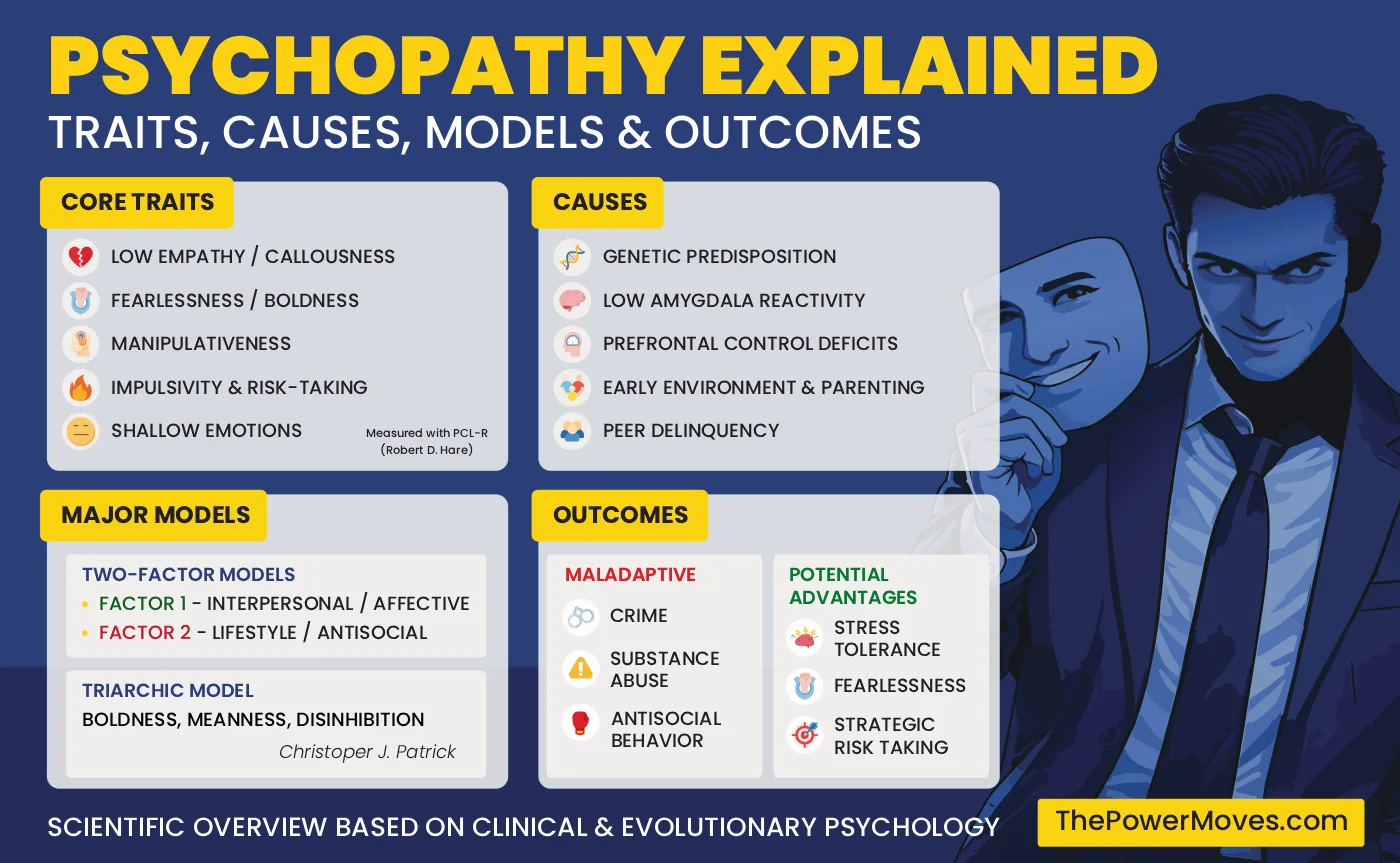
Psychopathy is one of the most studied personality constructs in psychology and forensic psychiatry, with implications for societal functioning, personal effectiveness, and safety.
This article, continuously updated with the latest findings, reviews the full scientific literature on psychopathy from multiple angles, with special attention to adaptive and successful trait combinations. It then introduces Lucio’s synthesis, examining psychopathic traits through an evolutionary lens and their potential for personal empowerment.

Part 1 — Scientific Foundations
What Psychopathy Is
Psychopathy is a multifaceted, dimensional personality construct characterized by a pattern of traits that often include low empathy, shallow affect, and impaired behavioral control.
Rather than a binary ‘all-or-nothing’ diagnosis or a fixed set of traits, contemporary research views psychopathy as a spectrum, where traits such as boldness, meanness, and disinhibition combine in varying ways to shape an individual’s psychological and social functioning.
Common traits associated with psychopathy:
- Superficial charm and social dominance
- Low empathy and shallow emotional responses
- Manipulativeness and instrumental aggression
- Reduced fear and punishment sensitivity
- Impulsivity and poor behavioral control (more associated with factor 2)
But note that psychopathy is not a static list of symptoms. Researchers increasingly view psychopathy as a heterogeneous constellation of traits, and different combinations of traits can produce different psychopathic patterns.
🙋♂️Lucio’s Take: The messy history of psychopathy research

Lucio:
Psychopathy research is a young science seeking a clearer path after a complex start.
After Cleckley’s initial accounts largely referred to factor 1, Robert Hare assumed psychopathy includes antisociality and is a ‘classical syndrome’—meaning, a cluster of features that reliably co-occur and covary.
Later research undermined the co-variance (Blonigen et al., 2010; Marcus et al., 2013), suggesting that psychopathy is a configuration of largely independent traits. Lilienfeld (2018) even questioned the validity of a unitary psychopathy construct in itself.
Then Patrick’s Triarchic model delivered ad-hoc, ‘factorially pure indices’, but today many researchers claim that Triarchic’s boldness’ shouldn’t be a core component of psychopathy.
Finally, DSM’s ‘antisocial personality disorder’ (ASPD) adds yet another construct, leaving us with many different and overlapping labels and constructs and several open questions.
Diagnostic & Assessment
The main assessment tools for psychopathy to date are:
- PCL-R (Psychopathy Checklist—Revised): Clinician-rated 20-item assessment (Hare, 2003)
- PCL:SV (Screening Version): Shorter, semi-structured version for quick triage (Hart et al., 1995)
- PPI-R (Psychopathic Personality Inventory—Revised): Self-report tool for both offender and community samples (Lilienfeld & Widows, 2005)
- TriPM (Triarchic Psychopathy Measure): Self-report scale indexing Boldness, Meanness, and Disinhibition. (Brislin et al., 2015)
Take the test ↗ - Inventory of Callous-Unemotional Traits (ICU) to assess psychopathic traits, referred to as Callous-Unemotional (CU) in youth. (Kimonis et al., 2008)
- LSRP (Levenson Self-Report Psychopathy scale): Brief self-report (Levenson et al., 1995)
Take the test ↗
Notes: PCL-R became the gold standard for forensic work, but self-report measures (PPI-R, TriPM, LSRP) addressed the PCL-R’s reliance on criminal history. Use validated versions and follow publisher guidance for administration and scoring.
Factor 1 & 2
PCL-R-based frameworks such as the three-factor model (Cooke & Michie, 2001) and the four-factor model (Neumann, Hare, & Pardini, 2015) have been proposed as alternative structures. In research, the four-factor model is widely used because it separates interpersonal, affective, lifestyle, and antisocial facets.
However, the simpler two-factor model remains common for quick overviews and broadly aligns with the PPI’s two-factor structure:
- Factor 1 (AKA ‘primary’): Covers shallow emotionality and attachment, and the interpersonal ‘mask’
- Factor 2 (AKA ‘secondar’): Reflects impulsivity, disregulation, and antisocial behavior, and it’s closer to antisocial personality disorder (ASPD)
In general, factor 1 primary psychopathy can be more adaptive.

Factors 1 and 2 derive from PCL-R, and are similar to the PPI-I Fearless Dominance (FD) & PPI-II Impulsive Antisociality (SCI)
| Factor 1 | Factor 2 |
|---|---|
| Low fear: deficit in startle potentiation, brain’s failure to “prime” for threat | Normal or hyperactivated defenses |
| Positive affect and emotional resilience. Low fear, anxiety, and depression | Negative Affect: anger, alienation, distress, stress reaction, dysphoria, suicidal ideation, neuroticism |
| Correlates with narcissism | Correlates with borderline personality disorder, ADHD, and other conditions |
| Low externalizing: largely uncorrelated to substance abuse and conscientiousness | Antisocial: aggression, externalizing proneness, substance abuse, impulsivity, low conscientiousness |
| High social power: achievement, interpersonal assertiveness, dominance, high extraversion | Low social skills: poor assertiveness, social anxiety, withdrawal, immaturity, susceptibility to peer pressure |
| Instrumental aggression: premeditated, unprovoked | Reactive aggression |
| Strong heritable component | Heritable; amplified by environmental deprivation and low SES |
Research Base: This table integrates findings from the major academic reference works on psychopathy, along with the core empirical literature
🔎 Examples: James Fallon and M.E. Thomas may be closer to factor 1. Mark Renton from the movie Trainspotting could be close to factor 2.
Affective Deficits
Affective deficits are a core component of factor 1, and this table helps you understand beyond vague umbrella descriptions such as ‘lack of conscience’:
| Affective Components | Description & manifestations |
|---|---|
| Low Empathy/ Callousness | Blunted emotional response to others’ suffering. But cognitive empathy, or understanding others’ emotions may remain intact |
| Lack of Remorse | Failure to feel regret after harming others, even when understanding the causal link. Remorse = regret for harm caused |
| Lack of Guilt | Weak self-condemnation after moral violations. Guilt = negative self-evaluation after wrongdoing |
| Shallow Affect | Limited emotional depth: reduced intensity, restricted range, and rapid emotional shifts |
| Emotional Detachment | Weak emotional bonding and attachment, often resulting in shallow relationships, disposability, and low loyalty |
Biology
Key findings from psychopathy research include:
Genetic influences
Psychopathy is moderately to highly heritable, with genetics explaining roughly 40–60% of trait variance (Blonigen et al., 2005; Viding et al., 2005).
- Both factor 1 and 2 are heritable: Factor 1’s heritability may be marginally higher (Bezdjian et al., 2011), but factor 2’s underlying disorders such as externalizing proneness and ADHD are highly heritable (Andershed & Lichtenstein, 2006).
- Stability is also partially explained by genetic factors (Loney et al., 2007; Lynam et al., 2007; Forsman et al., 2008)
- Polygenic & Interactive Genetics: Psychopathic traits arise from many small-effect genes acting additively and interactively, with both additive (32%) and non-additive (9%) influences contributing (Rhee & Waldman, 2002)

Recreated by Lucio Buffalmano, based on Hoenicka et al. 2007
Hormonal Correlates
Overall, the evidence for hormonal effects is weaker:
- Testosterone and cortisol seem weak markers: Despite the theoretical correlation, the few studies that tested the hypothesis show inconsistent results (Glenn and Raine, 2014)
- Testosterone-to-cortisol ratio may relate to psychopathic traits (Glenn et al., 2011)
Neurobiological & Psychophysiological Systems
- Amygdala-Prefrontal Dysfunction: Reduced amygdala, ventromedial, and orbitofrontal cortex volume and responsiveness impair empathy, moral reasoning, and emotional integration into decision-making (Yang et al., 2005; Marsh et al., 2008; Glenn et al., 2009).
- Impaired Paralimbic Connectivity: Weakened white matter and functional links between emotional centers (limbic system) and executive control regions (PFC) prevent emotions from effectively guiding or restraining behavior (Heinz et al., 2005; Pezawas et al., 2005).
- Blunted Physiological Fear & Stress Responses: Low resting heart rate, reduced skin conductance, lower startle potentiation, and weaker autonomic reactions during fear conditioning, contributing to Boldness (Lykken, 1957; Patrick et al., 1993).
- Reward-Focused Attention & Learning Deficits: Attention bias toward rewards over threats and impaired punishment/fear learning, reducing sensitivity to cues that discourage harmful behavior (Blair et al., 2006; Newman & Kosson, 1986).

Biosocial & Epigenetic Interaction
Both genes and environment matter, and they interact: epigenetic research shows stressors like childhood maltreatment can activate or silence genes, altering brain biology without changing DNA.
- Gene-environment potentiating effect: genetic risk combined with childhood maltreatment significantly increases the likelihood of antisocial outcomes (Caspi et al., 2002)
- Parenting matters: Harsh vs warm parenting can increase/decrease antisocial behavior and CU traits (Waller et al., 2013; Pardini et al., 2007; Pasalich et al., 2016);
- Delinquent peers predict antisocial acts, and psychopathic youth influence more than they are influenced; group settings increase risk-taking (Kerr et al., 2012; Goldweber et al., 2011; Steinberg, 2009)
- Urbanization boosts criminality, and high-crime neighborhoods particularly (Elliott et al., 1989; Foster & Brooks-Gunn, 2013)
Bottom line: There is no single cause of psychopathy, but it emerges from an interaction of genes, neurobiological differences, and environmental experiences, and each individual will have a different mix of ’causes’.
Dark Triad (Mach & Narcissism)
The recently proposed ‘D-factor’ claims that the shared core relates to maximizing one’s individual returns, even at others’ expense (Moshagen, Hilbig, and Zettler, 2018).
Here at TPM, we’d also add that both narcissism and psychopathy have a ‘weaker’ side (respectively, vulnerable narcissism and factor 2), and a ‘stronger’ one more associated with social dominance, independence, and agentic goal-pursuit.
| Trait | Motivation & Tools | Vulnerability |
|---|---|---|
| Narcissism | Admiration with self-promotion | Validation-seeking |
| Machiavellianism | Goal-achievement with strategic calculativeness | Over-cynicism |
| Psychopathy | Reward-seeking with bold or disinhibited action | Long-term instability |
Pros & Costs of Psychopathy
We focus on factor 1 as the more adaptive facet:
Advantages
- Social power: Can gain early status, and glibness can seem charismatic for positive first impressions (IF basic social skills are acquired)
- Career / Performance: Low anxiety and fearlessness help in masculine and high-stakes environments
- Psychological health: Low anxiety, stress, and depression; high emotional resilience; no ‘heartbreaks’
- Strategic advantages of low empathy: Ruthless and amoral decision-making can facilitate goal-achievement
- More sexual partners, due to dominance, boldness, and high short-term mating efforts
- High power in dating & relationships: Low attachment = low neediness; partners often invest more
Disadvantages / Potential Risks
- Long-term underperformance: Too much fearlessness without enough self-regulation is the #1 for psychopathy
- Shallow relationships: Emotional detachment often weakens bonds
- Alliances risk: Overly instrumental attitudes undermine reputation, trust, and cooperation, including in leadership
- Criminal risks: Especially when paired with disinhibition
- Lower long-term social efficacy: Low empathy and emotional depth = ‘unnatural’, sometimes even in brief interactions
Part 2 — Scientific Debates
Some of the most asked, debated, and misunderstood topics in psychopathy include:
Whether psychopathy inherently includes antisociality and criminality is debated, with recent models increasingly seeing them as possible outcomes rather than defining traits.
Robert Hare’s PCL-R has been criticized for including criminality as a constituent trait of psychopathy (Cooke and Michie, 2001; Cooke et al., 2004).
Hare’s approach also biases towards convicted psychopaths, or “blue-collar” criminals, underestimating non-criminals and more successful ‘white-collar’ psychopaths.
That being said, while psychopathy may not necessarily lead to antisociality, psychopathic traits may lower the bar for antisociality, criminality, or violence.
For example, callousness, weak moral internalization, and lack of behavioral restraint can all increase the odds of antisocial behavior.
Plus, some psychopaths may enjoy inflicting harm:
A Problematic Link Between Psychopathy & Sadism
Psychopathy is associated with several measures and outcomes related to sadism, including:
- Sadistic fantasies and paraphilias (e.g., Woodworth et al., 2013)
- Deviant sexual arousal (Barbaree et al.,1994; Quinsey et al., 1995; Serin et al.,1994)
- Higher levels of gratuitous and sadistic violence in homicides (Porter et al., 2003)
- Schadenfreude (Porter et al., 2014).
- ‘Inverted’ social rewards, with cruelty enjoyable and kindness not (Foulkes et al., 2014)
Even among violent offenders, psychopathic individuals had higher sadistic traits that non-psychpathic ones (Holt et al., 1999).
Sexual deviancy and sadism may increase the odds of antisocial and criminal behavior, especially when in conjunction with disinhibition.
Technical note: Sadism was more correlated to facet 1 and 4 in Robertson and Knight, 2014 and facet 2 in Mokros et al., 2011.
Is Psychopathy Always Impulsive?
Psychopathy as a whole, and factor 2 in particular, are related to impulsivity via several different paths, but not all individuals high in psychopathic traits are always and necessarily impulsive.
These elements that increase the odds of impulsivity, and can compound when they co-exist:
- Executive control deficit (Prefrontal Cortex, PFC) <– The main ‘missing brake’, strongly implicated in factor 2 and ADHD
- Low fear and low Behavioral Inhibition System (BIS) <– Removes the ‘brake’ of punishment anticipation (more associated with factor 1)
- Emotional dysregulation / threat reactivity <– Can trigger emotion-driven impulsivity (more related to factor 2)
- High reward approach (high BAS) <– The ‘moving towards accelerator’
Not directly tied to impulsivity, but can contribute to interpersonal aggression:
- Low empathy & attachment <– Removes the ’empathy & caring brakes’ on harming others
Technical note: triarchic model issue
Knight and Guay (2018) note the issue of clustering two different types of impulsivity: Reward-driven / goal-focused, more related to factor 1, CU-traits, and hypersexuality; and Emotion-driven, more sensitive to threats, emotional reactance, and loss of control, more related to factor 2.
Can Psychopathy Be Cured?
While for decades the dominant view was that psychopathy was untreatable, more recent research paints a more nuanced picture and provides evidence for modest treatment effects (Polaschek and Skeem, 2018).
Psychopathy itself is difficult to change, but modern interventions can reduce antisocial behavior and criminal recidivism, with promising evidence for the Risk-Need-Responsivity (RNR) model (Andrews et al., 1990).
The reductions in reconviction risk are modest but meaningful, with effect sizes around 0.15–0.34 (Andrews & Bonta, 2010). A program with an effect around 0.15 could reduce a 50% reconviction rate to roughly 35%.
Treatment is also helpful with high risk individuals and can be beneficial despite challenges to the therapy environment (Lipsey et al., 2009; Lipsey, Wilson, & Cothern, 2000).
Experimental findings also suggest that simple attentional cues can help recognize fear in others, a deficiency that has been linked to interpersonal aggression.
Popular FAQs
How is psychopathy different from sociopathy
Psychopathy is a well-studied personality construct, while sociopathy is not a formal clinical diagnosis and is used inconsistently outside of academic circles. Sociopathy is often used informally to describe individuals with antisocial behavior shaped more by environment or upbringing, a claim that may also be misleading since genetic influences matter for both factor 1 and factor 2.
For accuracy, the term psychopathy is preferred.
What’s the difference between psychopathy and antisocial personality disorder
Antisocial Personality Disorder (ASPD) is a clinical diagnosis defined in the Diagnostic and Statistical Manual of Mental Disorders (DSM). It focuses mainly on persistent antisocial and rule-breaking behavior, overlapping more with psychoapthy factor 2 than factor 1.
Psychopathy is a broader personality construct that includes interpersonal and emotional deficiencies (e.g., callousness, lack of remorse).
As a result, many individuals with psychopathy meet criteria for ASPD, but not all people with ASPD are psychopaths.
Are all psychopaths narcissists?
No. Psychopathy and Narcissistic Personality Disorder may share some traits, such as grandiosity and lack of empathy, but they are distinct constructs. Narcissism in psychopaths may also express differently, with equal grandiosity but lower motivation for admiration (Ronningstam, 1998).
And while psychopathy factor 1 is associated with narcissism, factor 2 is not.
Are psychopaths only men?
No, although psychopathy is more frequent in men, and men tend to score higher on psychopathy measures, it occurs in both men and women.
Women may show somewhat different patterns of expression, including more emotional disregulation in factor 2, more internalizing and self-direct harm (overlapping with borderline personality disorder and histrionic personality disorder), more relational aggression, but lower risk of criminal and violent outcomes.
How common is psychopathy?
Psychopathy is relatively rare in the general population. Estimates typically place the prevalence around 1%, although higher rates are observed in prisons and forensic samples. Some research suggests that subclinical psychopathic traits may be more common and can appear in competitive environments such as business, politics, and high-risk professions (Hare and Babiak, 2006).
For a quick differentiation between these commonly misunderstood constructs:
| Construct | Status | Focus & Traits |
|---|---|---|
| Psychopathy | Research personality construct | Interpersonal + emotional deficits (factor 1) and poor behavioral control (factor 2) |
| ASPD | Clinical diagnosis in Diagnostic and Statistical Manual of Mental Disorders (DSM) | Persistent rule-breaking behavior (closer to factor 2) |
| Sociopathy | Informal term | Inconsistent use |
Part 3 — Models of Functionality
Triarchic Model
The triarchic model (Patrick, Fowles, and Krueger, 2009) subdivides psychopathy into three dispositional tendencies:
- Boldness: Social dominance, emotional stability/resilience, and venturesomeness (most adaptive).
- Meanness: Deficient empathy (callousness), selfishness, and aggressive exploitation of others (facilitates manipulative or coercive strategies)
- Disinhibition: Lack of behavioral restraint, irresponsibility, and emotional volatility (contributes to risk-taking, externalizing behavior, and sometimes maladaptive outcomes)
Boldness and Disinhibition are relatively independent, whereas Meanness shows a small to medium association with Boldness and a medium to large association with Disinhibition (Hicks and Drislane, 2018).
| Component | Maps to PCL-R | Why |
|---|---|---|
| Boldness | Factor 1 (interpersonal) | Adaptive charm & social dominance, low fear |
| Meanness | Factor 1 (affective) + some Factor 2 aggression | Callousness, cruelty, lack of cooperativeness |
| Disinhibition | Factor 2 / externalizing liability | Impulsivity, poor self-control, antisociality |

Adaptiveness of Triarchic Domains
Boldness by itself may support effective functioning.
In contrast, disinhibition—closely aligned with the externalizing spectrum—appears to be the primary driver of persistent antisocial behavior and life dysfunction.
That said, at TPM we also like to look at adaptiveness in context:
| Component | Adaptive | Maladaptive |
|---|---|---|
| Boldness | Leadership, status, crisis management. ‘Pro-social psychopathy’ | Recklessness at extremes: can ignore real dangers |
| Meanness | Ruthless execution: to achieve (selfish) goals without guilt | Isolation: Destroys social capital and alliances required for long-term power; can foster mutinies |
| Disinhibition | Opportunistic Speed: Prevents “analysis paralysis”; seizes rewards in unstable environments | Self-Sabotage: stupid risks, substance abuse, and explosive outbursts (‘car without breaks’) |
The Adaptiveness of Boldness & Fearless Dominance
Technical Note: Triachic boldness is similar to ‘Fearless Dominance’ from PPI-I. Sometimes authors treat them interchangeably.
Looking at the literature, boldness may be the most adaptive aspect of psychopathy (Skeem et al., 2011; Beinning et al., 2018), including healthy psychological adjustment and inverse correlation with emotional distress (Lilienfeld, 2018).
Boldness may be the primary differentiator between psychopathy and antisocial personality disorder (Venables et al., 2014; Wall et al., 2015)
Conversely, extremely low levels of boldness are tied to elevated risk for internalizing disorders (e.g., Lynam & Miller, 2012).
We can’t yet say for sure whether boldness follows the inverted U-curve of the ‘law of balance‘ and becomes maladaptive at extremely high levels. However, we can venture that it may be better to be in the upper range than in the very low range.
Real-life evidence for the adaptiveness of boldness
- More leadership positions held (Lilienfeld et al., 2014)
- Higher representation in challenging occupations, like special military teams (Kjærgaard, 2013) and North Pole expeditions (though discussed in terms of poor outcomes, Leon & Venables, 2015).
- Strong leadership performance with higher subordinate satisfaction (and lower for meannes & disinhibition, Sanecka, 2013), US presidents’ performance (Lilienfeld et al., 2012), and positive leadership style (Lilienfeld, 2018).
- More profitable decisions in economic games (Yamagishi et al., 2014)
- Higher incomes (Benning et al., 2003) and ranks in financial occupations (Howe et al., 2014).
Boldness may be heroically prosocial
Fearless dominance is higher among first-responders and is positively, albeit weakly to moderately, associated with heroism and altruism toward strangers (Smith et al., 2013; Patton et al., 2018)
These findings provide some evidence for Lykken’s controversial statement that ‘the hero and the psychopath may be twigs on the same genetic branch’.
Deeper dive on this topic: are psychopaths and heroes the same?
🙋♂️Lucio’s Take: ‘Good psychopath’ (pop-)psychology refers to boldness
Lucio:
Boldness explains most accounts of ‘good’ or ‘prosocial’ psychopaths (ie.: Lykken, 1995; Dutton, 2012).
When referring to psychopathic heroes, soldiers, and neurosurgeons, most are referring to the effect of boldness, with little disinhibition and little or no meanness.
Technical Note: It’s debated whether boldness should even be a core psychopathic trait.
Researchers such as Lynam and Miller view Meanness (Antagonism) and Disinhibition (Low Conscientiousness) as core psychopathic traits, and boldness as more of a specifier
Not All Peace & Love: The Grey Side of Boldness
Benning (2018) and Lilienfeld state that boldness is associated with:
- Low empathy (Benning et al., 2005; Mullins-Nelson et al., 2006)
- Adult antisocial behavior (Benning et al., 2003)
- Nonverbal disciplinary infractions in prison (Patrick et al., 2006)
- High levels of narcissism (Lilienfeld, 2018)
- Self-interest pursuit of rewards and thrill-seeking, potentially mildly callous (Fowles, 2018)
However, referring to the first three, Benning also adds that ‘these relatively mild deleterious effects would be unlikely to prevent a person from attaining success.’
And we’d also add that grandiose narcissism tends to be adaptive and some healthy self-interest and calculativeness often support personal success, without requiring antisociality.
Boldness may require good parenting to not turn into meanness
Fearless temperament is a risk factor for meanness (Fowles, 2018; Pardini, 2006; Hicks et al., 2013). Fortunately, studies suggest that parenting and socialization may be more impactful for children high in interpersonal features.
Kochanska’s studies show that while gentler discipline is often sufficient to develop conscience in more sensitive and fearful children, fearless ones benefit more secure attachment and positive child-mother relationship (Kochanska, 1995, 1997; Kochanska et al., 2007). The author speculates this is a reward-based pathway that doesn’t require anxiety and fear of punishment.
Balanced, rule-based discipline seems the optimal middle ground. While permissiveness allows antisociality to flourish, over-correction triggers reactive aggression (Patterson et al., 1998 and 2000; Kochanska and Kim, 2013). Conversely, consistent, predictable consequences help bridge the empathy gap, fostering guilt and internal regulation even in fearless children (Cornell and Frick, 2007).
Caveat: Boldness is adaptive if alone
Boldness is most adaptive if on its own.
For example, Lilienfeld says:
Boldness (…) becomes malignant in the presence of other traits, especially SCI. (…) when boldness is conjoined with poor executive functioning, it may be channeled into ill-conceived risk taking, giving rise to the “poor judgment”
Prosociality follows the same logic. When paired with SCI, Fearless Dominance is more related to predatory aggression (Smith et al., 2013), sexual risk-taking (Kastner & Sellbom, 2012), and negative affect (e.g., guilt, shame) afterward (Fulton et al., 2010).
For an overview of how they may interact:
| Combination | Behavioral Results |
|---|---|
| Boldness | Facilitate success in occupations that call for bravery and emotional resilience, or leadership and persuasiveness |
| Meanness | Associated with low empathy, low social closeness, instrumental aggression, and antagonism |
| Dishinibition | Relates strongly to criterion measures indexing impulsivity, negative emotionality, substance use, delinquent/antisocial tendencies, and suicidal behavior, close to factor 2 |
| Boldness + disinhibition | Like Cleckley’s masked pathology: seemingly well adjusted and socially adept but reckless and irresponsible. Short-term rewards, disregarding the consequences. High antisocial deviance possible (‘externalizing supergroup’, Hicks and Drislane, 2018) |
| Boldness + meanness | Can be expected to express their social and emotional poise in exploitative–antagonistic ways (example: Bernard Madoff) |
| Meanness + Dishibition | Impulsive antisociality: severely aggressive externalizing behavior, ranging from psychological pressure or physical force to achieve selfish goals to sadistic acts of violence |
Table based on Benning, Venables, and Hall (2018)
3 Scientific Models of Successful Psychopathy
Models 2 and 3 may have the strongest support, and they can be complementary.
1. Subclinical Psychopathy Model
👉🏼 Successful psychopaths are milder versions of clinical psychopaths

While somewhat intuitive, attenuation alone appears insufficient.
Research shows that individuals considered “successful” often display specific traits combined with compensatory adaptive characteristics, rather than mere ‘milder psychopathy’ (Lilienfeld et al., 2015a; Lilienfeld et al., 2016).
2. Moderated Psychopathy Model
👉🏼 Environmental and individual moderators shape life outcomes
Different moderators have been proposed with strong but uneven support:
| Moderators | Evidence & Effect |
|---|---|
| Executive functioning | Strong |
| Parenting & SES | Small to moderate, smaller than lay theories assume |
| Age | Lower for psychopathic traits, high for antisocial behavior which declines across adulthood |
| Physiological traits | Strong. Successful psychopaths are more similar to healthy controls for prefrontal cortex gray matter (Yang et al., 2005), orbitofrontal cortex and amygdala volume (Yang et al., 2010), hippocampus symmetry (Raine et al., 2004). Particularly important for PFC/executive functioning |
| Intelligence | Mixed (IQ lowers antisociality: Heilbrun, 1982; Heilbrun and Heilbrun, 1985; Watts et al., 2016); (No link: Walsh et al., 2004); (IQ boosts antisociality: Johansson & Kerr, 2005; Hampton et al., 2014). IQ = lower convictions (Ishikawa, 2001). |
Not included by researchers, but power and status can also be powerful shields.
🙋🏼♂️ Technical Note: Buffalmano’s ‘Exchange Model’
The Exchange Model suggests that high social and mate value psychopaths use less coercion because they can use the more effective social exchange
3. Multiprocess Model (Dual-Process / Triarchic)
👉🏼 Psychopathy is adaptive with the right mix of underlying facets
Psychopathy is not unitary, but the composition of its underlying facets can yield adaptive or maladaptive functioning.
The triarchic model is a multiprocess model building on the conceptually close “two-process model” and “dual pathway theory” (Patrick & Bernat, 2009; Fowles & Dindo, 2009):
- Defensive fear system deficit underlying interpersonal–affective features (largely related to factor 1), and
- Executive control deficit underlying impulsive–antisocial features (largely related to factor 2, and externalizing proneness)
In this model, successful outcomes are more likely with less cognitive–executive dysfunction and more dispositional fearlessness (ie.: in triarchic terms, less disinhibition and higher boldness).
Strategic Interpretations (TPM)
Despite a tendency to equate maladaptive with antisocial, adaptive fitness is amoral.
Evolutionarily, adaptive means higher odds of survival and reproduction. In humans, it may also boost the odds of achieving goals. Either way, it’s independent of pro-social or anti-social orientation.
While we do not like or endorse antisociality at TPM and always prefer achieving goals with win-win, we also believe that to understand these dynamics it’s important to keep the two separated.
Predatory Strategy
Several scholars suggested that short-term fast consumption, cheating, and coercion can be adaptive. These approaches overlap with a ‘predation strategy’ to life.
From a social exchange point of view, predatory strategies are based on taking without giving.
This is what makes someone a ‘taker’ and Robert Hare wrote about psychopaths that ‘they all take more than they give’.
Defecting From Cooperation
Mealey proposed a sociobiological model of psychopathy of frequency-dependent social cheater strategy.
Indeed, psychopathic traits are associated with defection against coparticipants in the Prisoner’s Dilemma game (Rilling et al., 2007), particularly against people who are viewed as low in value (Gervais et al., 2013), which may suggest a particularly calculative approach to exchanges.
Possible supporting evidence comes from frequent moving, aliases use, and preference for larger cities, since they can all faciliate escaping arrest, or escaping poor reputations (Robins, 1996; Jonason, 2018; Zuo et al., 2023).
Manipulation
Manipulativeness is a core trait of psychopathy, and multiple structural equation models suggested that manipulation and callousness are the common ‘core’ of the dark triad.
In relationships, David Buss notes that dark triad men engage in more cost-inflicting and ‘game playing‘ strategies (e.g., evoking jealousy).
Suggesting a possible genetic component, interpersonal manipulativeness is related to aggression and reduced prosocial behavior in young children (Pauletti, Menon, Menon, Tobin, and Perry, 2012)
Coercion
Coercion is a form of ‘taking by force’, related to aggression and criminal behavior.
Suggesting a link between psychopathy and coercive strategies, psychopaths are notoriously over-represented in prisons and more likely to violently recidivate (Kiehl, 2011), with important links to sexual coercion as well (Harris et al., 2007).
Reviewing the literature on sexual coercion, Knight and Guay (2018) claim that rape is part of a broader propensity of antisociality (Lussier et al., 2005; Smallbone et al., 2003).
Technical note: intimate partner violence may be the exception
Douglas (2018) notes that, contrary to factor 2, factor 1’s affective deficits might ironically prevent intimate partner violence because they may not care enough, and studies show this trend (Hilton et al., 2008; Rock et al., 2013)
Sexual Strategy: Coercion, Short-Term, & Abandonment
Some scholars argue that unrestricted socio-sexual orientation and low parental investment, may form a reproduction strategy based on quantity of offspring (r-selected, Pianka, 1970).
There are several lines of evidence supporting this hypothesis.
For example, psychopaths have:
- Higher socio-sexuality, meaning more open to uncommitted sex (White et al., 2025)
- More sexual partners with less condom use (Reynolds et al., 2020)
- Higher sexuality (‘hypersexuality’, Kastner and Selbom, 2012)
- Higher likelihood to sexually coerce (‘three-path model’, Knight and Sims-Knight, 2003)
- In relationships: cheat more (Jones and Weiser, 2014), higher dissatisfaction (Weiss et al., 2016), seek make poaching (Craib et al., 2024)
- Fewer child support payments (Braver et al., 1997).
Behavioral evidence also suggests a higher mating effort, being less attractive in unadorned conditions but more attractive in adorned conditions.
Finally, neurobiological dysfunctions in emotional and moral processing may facilitate the pursuit of a more predatory strategy (Glenn & Raine, 2009).
Priming Psychopathic Sexual Strategy: Life History Strategy & Environment
Related to epigenetics, the life history strategy hypothesis (Ellis, 2009) suggests that environmental cues ‘prime’ psychopathic traits and behaviors to accelerate reproduction in harsher environments.
For example, children who grow up in harsher environments, such as high-stress or low-resource:
- Reach biological maturity earlier (Belsky et al., 1991; Harris et al., 2007)
- Have their first child at a younger age (Moore et al., 1993)
- Are more likely to have children outside of stable, long-term partnerships (Karney, 2020)
Furthermore, reminders of mortality bias individuals with low-SES backgrounds for short-term rewards over long-term investment (Griskevicius et al., 2011), suggesting that impulsivity may be an evolved tactic to seize short-term opportunities.
See more on this:
Does It Work? A Flawed Predator…
While “predator” is associated with dominance, it does not guarantee success—in nature, predators are also preyed upon, maimed, and face higher extinction risks than their prey.
When it comes to psychopathy, dishibition and poor planning often undermine a predatory strategy.
Write Porter, Woodworth, and Black (2018):
(…) On one hand, psychopathic individuals engage in strategic, premeditated acts (…) on the other, they can react in impulsive (…) ways (…) that contribute to detection, arrest, and incarceration.
In this light, individuals of this sort can be seen as “flawed predators,” frequently preying on others but unable to reliably control their behavior.
The authors also explain that premeditation can co-exist with costly impulsive aggression, the latter undermining the possible adaptiveness of the former.
Crucially, effectiveness isn’t a given in reproductive strategies either.
The few studies available provided no empirical evidence for higher reproduction, or even suggested otherwise (Marcus et al., 2011; Carter, Lyons, & Brewer, 2018).
However, the evidence is sparse for any conclusions, and different expressions of psychopathy may enjoy higher success (for a case study, see Buffalmano, 2020).
Calibration Model of Effective Psychopathy™
Effective Psychopathy™ refers not to promoting antisocial behavior, but to an adaptive profile of certain traits associated with psychopathy that boost fitness. It incorporates and calibrates functional strengths—boldness, effective grandiosity, emotional coolness, etc.—while removing maladaptive tendencies like short-term reward-seeking, criminal propensity, and externalizing tendencies.
The Calibration Model (Buffalmano, 2026) posits that since almost any trait can be adaptive or maladaptive depending on context and goals, the most functional psychopaths calibrate behavior based on the situation and their end goal.
Contextual and social calibration are central aspects of TPM’s approach. Here are some examples of how adaptiveness changes in relation to context:
| Trait | Maladaptive For… | Adaptive For… |
|---|---|---|
| Grandiosity | Reliable planning & prioritization | Interpersonal charisma and psychological resilience |
| Disinhibition | Substances & sustained success | First-movers advantages, & when rewards disappear |
| Lying | Long-term reputation & alliances | Social engineering & low-detectability scenarios |
| Callousness | Long-term cooperation & close bonds | Whenever selfish gains outweigh cooperation’s gains |
The effective psychopath may think grandiosely but turn more realistic when planning and executing.
Or he may be more ruthless and detached at work, but ‘switch off’ and be more empathic and warm to nurture cooperative alliances. If he values close relationships, he will also be kind to family and friends.
Researcher Keith Campbell proposed this approach to narcissism when he advised ‘use it publicly, not privately’ (Campbell, 2020).
As a fictional example, Vito Corleone in The Godfather maintained a loving family and strong bonds while running his organization. His son Michael tried the same by compartmentalizing work and life.
⚠️ Important reminder: psychopathy as a whole is often maladaptive, antisocial, and immoral
Psychopathic profiles are often maladaptive and associated with unsuccessful lifestyles. The TPM approach focuses on isolating and cultivating the few functional traits that can be beneficial when properly regulated. We do not endorse or recommend its predatory aspects.
Strategic Psychopathy: Developing Helpful Traits
Strategic Psychopathy™ refers to developing a collection of adaptive traits sometimes associated with psychopathy, and learning how and when to use them.
There is no one-size-fits-all because what you need depends on your goals and your starting point.
But, some general guidelines for many can be:
- Increase boldness
- Boost self-control: remove dishibition, dopamine addictions, plan and work hard (conscientiousness)
- Calibrate to situation and people for top-0.1% effectiveness
And for combining goal-achievement with life quality:
- Be honorable, especially with other quality people and close relationships
Honorable Psychopathy™
Honorable Psychopathy™ places strategic honor™ and a preference for win–win as the baseline, while still incorporating effective psychopathy for goal achievement and self-advancement
We focus on the practical ‘how to’ in our flagship course:


