

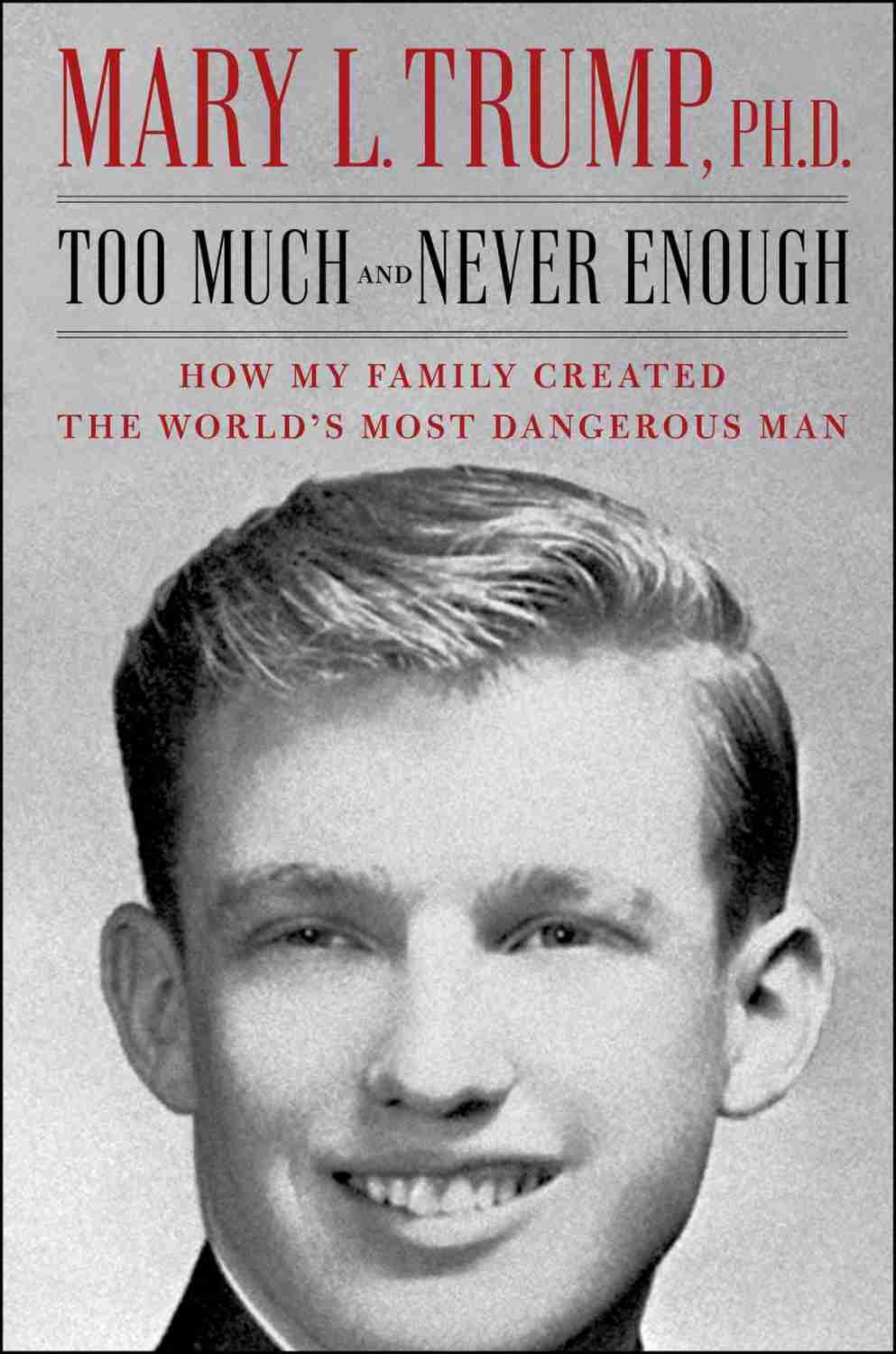
Too Much and Never Enough (2020) provides an insider view of Donald Trump, and the Trump family. The author, who is Trump’s niece, paints a dark picture of the former US president as a callous, selfish, and manipulative personality.
Exec Summary
- Donald’s father Fred Trump was a sociopath who ruined Donald’s psychological development
- Donald Trump is a narcissist at a minimum, probably a sociopath
- Trump’s re-election could mean the end of democracy
FULL SUMMARY
About the Author:
Mary Lea Trump is an American psychologist and writer. She holds a PhD in clinical psychology from the Derner Institute of Advanced Psychological and she is the niece of former US president Donald Trump
Donald’s sociopathic father ruined him
The author claims that:
- Donald’s father Fred was a sociopath
- Donald’s unsupportive mother used children for her own needs
- Donald’s mother was sick and absent for a year at a crucial developmental juncture
- Fred was annoyed by his children’s “needs”
- Donald was left (emotionally) unattended
- Donald adopted toxic coping mechanisms
- No empathy
- Care nothing about others
- Pretend to be strong so your father doesn’t hate you
These are plausible, in my opinion.
But the real question is how much they truly weighed.
And while the author implies they’re the main or even only reasons why Donald turned out the way he did, I disagree.
See the criticism section.
Fred raised children to carry legacy, not out of love
This is common among power-craving men:
Fred wasn’t interested in children at all. His oldest son and namesake received Fred’s attention simply because he was being raised to carry on Fred’s legacy.
This is in line with both sociopathy and right-wing psychology.
See more here:
This is exactly what Donald Trump did with his children:
Ivanka: He (Donald) was not the type of father who (mimicks kisses and child talk) or take them to a stroll in the park.
(…)
He did not know how to speak to them. He was able to speak to them only when they came from University when eventually was able to speak business with them
I don’t think that Donald “just wasn’t able”.
Or at least, not only.
Mostly, he wasn’t interested to.
Fred switched his “legacy-carrying” child from Freddie, to Donald.
And Donald then betrayed him by selling his company right after his death.
Fred raised Donald with a zero-sum game mindset of win-lose
Financial worth was the same as self-worth, monetary value was human value. The more Fred Trump had, the better he was. If he gave something to someone else, that person would be worth more and he less.
He would pass that attitude on to Donald in spades.
Trump is more than just “narcissist”
In the last three years, I’ve watched as countless pundits, armchair psychologists, and journalists have kept missing the mark, using phrases such as “malignant narcissism” and “narcissistic personality disorder” in
an attempt to make sense of Donald’s often bizarre and self-defeating behavior. I have no problem calling Donald a narcissist—he meets all nine criteria as outlined in the Diagnostic and Statistical Manual of Mental Disorders (DSM-5)—but the label gets us only so far.
She then goes on to list her credentials, which is a good move :).
And then her diagnosis is:
A case could be made that he also meets the criteria for antisocial personality disorder, which in its most severe form is generally considered sociopathy but can also refer to chronic criminality, arrogance, and disregard for the rights of others.
And she goes on to list more possible traits, including:
He may have a long undiagnosed learning disability that for decades has interfered with his ability to process information.
Finally, towards the end of the book she mentions the “sociopathic”:
With millions of lives at stake, he takes accusations about the federal government’s failure to provide ventilators personally, threatening to withhold funding and lifesaving equipment from states whose governors don’t pay sufficient homage to him.
(…)
The deafening silence in response to such a blatant display of sociopathic disregard for human life or the consequences for one’s actions, on the other hand, fills me with despair
Donald has no empathy
As the pandemic moved (…) and the death toll continued its rise (…) the press started to comment on Donald’s lack of empathy for those who have died and the families they leave behind. The simple fact is that Donald is fundamentally incapable of acknowledging the suffering of others.
(…) for Donald there is no value in empathy, no tangible upside to caring for other people.
What’s more shocking to me is that people didn’t realize that before the pandemic.
And that many haven’t even realized it now (writing in 2024).
The same runs through the family, says the author.
And what Fred had taught his children, ti eventually turned on him when he started his mental decline:
Fred’s remaining sons had given up all pretense of caring what their father thought or wanted.
Having served his father’s purpose, Donald now treated him with contempt, as if his mental decline were
somehow his own fault. Fred had treated his oldest son and his alcoholism the same way, so Donald’s attitude wasn’t surprising.
Donald’s need for affirmation is… Endless
His deep-seated insecurities have created in him a black hole of need that constantly requires the light of
compliments that disappears as soon as he’s soaked it in. Nothing is ever enough. This is far beyond garden-variety narcissism;
The author then links Donald’s need to weakness and ego fragility:
Donald is not simply weak, his ego is a fragile thing that must be bolstered every moment because he knows deep down that he is nothing of what he claims to be.
He knows he has never been loved. So he must draw you in if he can by getting you to assent to even the most seemingly insignificant thing:
I couldn’t agree more with her first quote.
But this second quote is not something I necessarily agree with (see criticism).
Donald used to be (somewhat) kinder, but got worse with time
Donald probably thought he was being kind.
There used to be a spark of that in him. He did once give me $100 to get my car out of impound. And after my father died, Donald was the only member of my family, other than my grandmother, who included me in anything.
But his kindness had become so warped over time—through lack of use and Fred’s discouragement—that what he considered kindness would have been practically unrecognizable to the rest of us.
Donald’s psychology makes him a poor leader in crises
This was THE best insight in the book.
Something I also fully agree with (no wonder I consider it the best insight :).
She says first about Covid:
managing the crisis in every moment doesn’t help him promote his preferred narrative that no one has ever done a better job than he has.
(…)
In Donald’s mind, even acknowledging an inevitable threat would indicate weakness. Taking responsibility would open him up to blame.
And then about the civil unrest:
The same could be said of his handling of the worst civil unrest since the assassination of Martin Luther King, Jr. This is another crisis in which it would have been so easy for Donald to triumph, but his ignorance overwhelms his ability to turn to his advantage the third national catastrophe to occur on his watch. An effective response would have entailed a call for unity, but Donald requires division. It is the only way he knows how to survive—my grandfather ensured that decades ago when he turned his children against each other.
The author focuses more on division here.
However, I belive her first point is even more correct. It’s impossible for Donald to acknowledge catastrophes because he wants a spotless presidency to declare the “best presidential term in history”.
That’s why he had a press release just to say that the Dow Jones had passed 30.000.
Anything that stands in the way of “best presidency” is a threat.
That’s why he hides it, pretends doesn’t exist, then pretends will go away soon.
Trump tried to steal all the inheritance money
he seems to have come up with a plan to betray his father and steal vast sums of money from his siblings.
(…)
draft a codicil to my grandfather’s will that would put Donald in complete control
(…)
My grandfather, who was having one of his more lucid days, sensed that something was not right (…) He angrily refused to sign
(…)
Maryanne would say years later, “We would have been penniless (…) We would have had to beg Donald if we wanted a cup of coffee.”
But was equally shocking to read was this:
Yet the siblings still got together every holiday as though nothing had happened.
And I was also surprised that the author made excuses for Donald, implying it was normal he’d so such a thing because of Fred’s parenting.
Trump is not a good businessman: it’s all a pretense
You heard the story:
Trump got 1 million loan from his father and turned it into billions.
Even Hillary Clinton repeated that during their 2016 debate.
Hillary said that to discredit Trump as a lucky son.
Little did she know that the reality was far worse.
Trump’s start was thanks to his father:
The real reason Donald’s first two projects were acquired and developed relatively smoothly was in large part because of Fred’s expertise as a developer and dealmaker.
Neither would have been possible without his contacts, influence, approval, money, knowledge, and, maybe most important, endorsement of Donald
Fred was there to prop up Donald when he was about to fail:
my grandfather sent his chauffeur with more than $3 million in cash to purchase chips at the Castle (…) The next day, my grandfather wired another $150,000 to the Castle, presumably for more chips
Fred’s empire covered Donald’s mistakes:
Far from expanding his father’s empire, everything Donald did after Trump Tower (which, along with his first project, the Grand Hyatt, could never have been accomplished without Fred’s money and influence) chipped away at the empire’s value.
By the late 1980s, the Trump Organization seemed to be in the business of losing money, as Donald
siphoned untold millions away from Trump Management in order to support the growing myth of himself as a real estate phenom and master dealmaker.
Over a lifetime, Trump got more than half a billion from his father:
While my grandfather was alive, Donald alone had received the equivalent of $413 million
(…)
That did not include the $170 million he had received through the sale of my grandfather’s empire
Even the banks propped Donald.
Why?
Because they lent Donald so much money that he was losing, that they needed him to succeed.
Says the author:
a solution had to be found that would protect Donald’s image, which, in turn, would protect the banks’ money.
(…)
His last name was the draw: without the name there would be no new gamblers or tenants or people willing to buy bonds and hence no new revenue.
(….)
the banks (…) put him on a $450,000-a-month allowance—that is, almost $5.5 million a year for having failed miserably.
Finally, Trump also bumbled the sale of Fred’s estate:
In 2004, the vast majority of the empire my grandfather had spent more than seven decades building was sold to a single buyer, Ruby Schron, for $705.6 million. The banks financing the sale for Schron had assigned a value of almost $1 billion to the properties, so in one fell swoop my uncle Donald, the master dealmaker, left almost $300 million on the table.
Selling the estate in bulk was a strategic disaster
The media is to blame for a conman’s success
The author tells us:
- Gave him a platform to attract audience
- Bought the lie of the self-made man
- Treated like a serious candidate
- Never challenged him
The media allowed Trump to become a serious candidate without properly challenging him.
An attentive media would have shown that Trump is too dumb to become POTUS:
It’s easy to sound coherent and somewhat knowledgeable when you control the narrative and are never pressed to elaborate on your premise or demonstrate that you actually understand the underlying facts.
It is an indictment (among many) of the media that none of that changed during the campaign, when exposing Donald’s lies and outrageous claims might actually have saved us from his presidency. On the few occasions he was asked about his positions and policies (which for all intents and purposes don’t really exist), he still wasn’t expected or required to make sense or demonstrate any depth of understanding.
Personally, I’d add an extra failure:
- In 2024 the media treats him as a political candidate rather than a high risk to democracy
And that includes democrat-leaning media like CNN.
Trump sacrifices truth for a good (self-serving) story
Says the author:
As usual with Donald, the story mattered more than the truth, which was easily sacrificed, especially if a lie made the story sound better.
And:
(…) and then launched into his version of my “back from the brink” redemption story.
“It was really bad for a while—and then she started doing drugs.” “Whoa,” I said, holding up my hands.
“Really?” said Melania, suddenly interested. “No, no, no. I’ve never done drugs in my life.”
(…) He was embellishing the story for effect, and he knew I knew it. “She was a total disaster,” he said, smiling more broadly.
(…)
Worse yet, Trump’s lies are often concocted to make others look bad, and make himself look good:
By conflating my dropping out of college and his hiring me to write his book (while throwing in a fictional drug addiction), he concocted a better story that somehow had him playing the role of my savior.
There was no point in setting the record straight, however; there never was with him
Good proof of that is this video:
There is no grand strategy in Trump: his ego only drives him
I hope this book will end the practice of referring to Donald’s “strategies” or “agendas,” as if he operates according to any organizing principles.
He doesn’t.
I largely agree.
Donald has great power instincts, but he’s no planner.
And his ego makes it impossible to follow other people’s plans. Even when they know better.
See as an example his lack of preparation for the presidential debate:
Sycophants to dark triads are used and thrown away
This is a pattern I’ve also noticed and tend to agree with:
Donald’s chiefs of staff are prime examples of this phenomenon.
John Kelly, at least for a while, and Mick Mulvaney, without any reservations at all, would behave the same way—until they were ousted for not being sufficiently “loyal.”
That’s how it always works with the sycophants. First they remain silent no matter what outrages are committed; then they make themselves complicit by not acting. Ultimately, they find they are expendable when Donald needs a scapegoat.
The same happened to Mike Pence, and later to Rudolph Giuliani.
See here for more:
Anthony Scaramucci, a great communicator and one of my favorite analysts, confirms the same from first-hand experience (the dialogue is me paraphrasing!):
Anthony: With Donald you go on an arch. You dislike him in the beginning, then you try to work with him because he’s the political leader, and then you realize there is no team-work with him because there is only team Trump
Donald would never be seen with his own followers
Donald’s need for affirmation is so great that he doesn’t seem to notice that the largest group of his supporters are people he wouldn’t condescend to be seen with outside of a rally
Yep, 100%.
This is why we’re often critical of followers and fans here.
And especially of narcissists’s fans.
A risk to democracy
This was written in 2020, and it may be more relevant today than it was back then:
If he is afforded a second term, it would be the end of American democracy
MORE WISDOM
Trump paid to pass his SAT test
And he paid someone to take the SATs for him:
he enlisted Joe Shapiro, a smart kid with a reputation for being a good test taker, to take his SATs for him
Donald Was Poor With Women
Donald was no natural charmer:
As the two of them were chatting, she mentioned that she had gone to a boarding school near New York Military Academy.
“Which one?” he asked.
When she told him, he looked at her for a second and then said, “I’m so disappointed that you went to that school.”
Annamaria, who was three years older than Donald, said, “Who are you to be disappointed in me?” That ended the conversation
We don’t disagree with that :).
Let people come to you
The tableau reminded me of one of my grandfather’s tactics: he always made his supplicants come to him, either at his Brooklyn office or his house in Queens, and he remained seated while they stood.
Also see our 48 Laws of Power summary and body language of power.
Careful with lies to sound charming: smart people see through them
Says the author of Donald greeting her:
when he saw me, he pointed at me with a surprised look on his face, then said, “I specifically asked for you to be here.” That was the kind of thing he often said to charm people, and he had a knack for tailoring his comment to the occasion, which was all the more impressive because I knew it wasn’t true
The power of positive thinking
The “thinking positive” movement bolstered Fred’s skirting of problems.
Says the author:
Peale was a charlatan (…)
Fred wasn’t a reader, but it was impossible not to know about Peale’s (…) The Power of Positive Thinking. The title alone was enough for Fred
(…)
Peale’s doctrine proclaimed that you need only self-confidence in order to prosper in the way God wants you to.
(….)
That view neatly confirmed what Fred already thought: he was rich because he deserved to be.
The author says that Fred was unable to empathize or deal with any personal problem in his family because problems stood in the way of his “think positive” gospel.
Don’t over-apologize with killers, they’ll respect you less
Fred hated it when his oldest son screwed up or failed to intuit what was required of him, but he hated it even more when, after being taken to task, Freddy apologized. “Sorry, Dad,” Fred would mock him. Fred wanted his oldest son to be a “killer” in his parlance (for what reason it’s impossible to say—collecting rent in Coney Island wasn’t exactly a high-risk endeavor in the 1950s)
Trump behaves dishonorably in everyday life
For example, putting people on loudspeakers with others present, without warning them:
He was usually on a call, which he’d put on speaker
(…) The person on the other end, who had no idea he or she was on speaker (…) Whenever anything outrageously sycophantic, salacious, or stupid was said, Donald smirked and pointed to the speakerphone as if to say, “What an idiot.”
Ivana was arrogant, Marla was nice
about as different from Ivana as a human being could be. Marla was down-to-earth and soft-spoken where Ivana was all flash, arrogance, and spite
I had the same feeling watching the two:
QUOTES
Very telling on Fred’s “support” as a father:
“I need to beat this, Dad. I don’t think I can do it by myself. I know I can’t.”
Instead of asking “What can I do for you?” Fred said, “What do you want from me?”
Mary Trump has a knack for dropping humor.
Here are some of them:
my name was plastered everywhere, on everything: TRUMP shampoo, TRUMP conditioner, TRUMP slippers, TRUMP shower cap, TRUMP shoe polish, TRUMP sewing kit, and TRUMP bathrobe. I opened the refrigerator, grabbed a split of TRUMP white wine, and poured it down my Trump throat so it could course through my Trump bloodstream and hit the pleasure center of my Trump brain
And a little bit later, visiting the White House, another zinger towards the quality of Trump’s products:
Each of the waiters carried a bottle of red wine and a bottle of white.
Real wine, not TRUMP wine
On Trump’s initial work for his father:
Donald’s job description seems to have included lying about his “accomplishments” and allegedly refusing to rent apartments to black people (which would become the subject of a Justice Department lawsuit accusing my grandfather and Donald of discrimination).
A funny power move when Donald didn’t want to be framed as “not visiting his mother enough”:
Mary’s been visiting me every day,” Gam said, smiling at me.
He turned to me. “Must be nice to have so much free time.”
LOL :D
CRITICISM
Unconvincing Psychological Analyses
I found the analysis of Trump’s psychological development overly speculative.
And I found it overly blamed Fred, Donald’s father, for how Donald turned out.
Let’s see more:
Cultural Determinism
For example:
In order to cope, Donald began to develop powerful but primitive defenses, marked by an increasing hostility to others and a seeming indifference to his mother’s absence and father’s neglect. The latter became a kind of learned helplessness (…) In place of those needs grew a kind of grievance and behaviors—including bullying, disrespect, and aggressiveness—that served their purpose in the moment (…) Unfortunately for Donald and everybody else on this planet, those behaviors became hardened into personality traits because (…) Fred Trump came to validate, encourage, and champion the things about Donald that rendered him essentially unlovable and that were in part the direct result of Fred’s abuse
I feel this is speculative and “socially deterministic” –“tabula rasa” approach-.
I see it this way instead: dark triads tend to have dark triad children.
And then, icing on the cake, the ‘asshole types’ also provide an ahole role model for the children.
And a bit later in the book:
Fred destroyed Donald, too, but not by snuffing him out as he did Freddy; instead, he short-circuited Donald’s ability to develop and experience the entire spectrum of human emotion.
By limiting Donald’s access to his own feelings and rendering many of them unacceptable, Fred perverted his son’s perception of the world and damaged his ability to live in it
I think this outweighs Fred’s contributions and downplays Trump’s.
Following the author’s analysis, are we expected to believe that Trump would have been an altruistic saint with a better father?
Trump was likely already wired like his father from birth.
Is Trump overcompensating for low self-esteem? Grandiose VS vulnerable narcissism
The author claims Trump overcompensated for weakness and fear.
Some passages from the book:
Donald’s reckless hyperbole and unearned confidence that hid Donald’s pathological weaknesses and insecurities
(…)
And:
Donald’s growing arrogance, in part a defense against his feelings of abandonment and an antidote to his lack of self-esteem, served as a protective cover for his deepening insecurities
I’m unconvinced with the author’s claim that Trump is insecure and has low self-esteem.
To be precise, she never directly claims it, but she takes it for granted (as per the above quotes).
Not only I disagree with it, but to me, that’s psychologizing, not a good scientific approach.
There is some evidence supporting the idea that insecurity can lead to compensatory behaviors.
That seems to be more the case with vulnerable narcissism.
Grandiose narcissists may still engage in compensatory behavior (Jordan et al., 2003).
But for them it’s less about masking low self-esteem and more about maintaining an inflated sense of self.
And I’m not convinced Trump is more of a vulnerable narcissist.
Not more than he is also a grandiose one, at least.
Indeed, to me, he is a mix of both.
Trump is afraid, still pandering to his father
To explain Trump’s narcissism and grandiosity, the author says:
the same little boy who is desperately worried that he, like his older brother, is inadequate and that he, too, will be destroyed for his inadequacy. At a very deep level, his bragging and false bravado are not directed at the audience in front of him but at his audience of one: his long-dead father.
I also see this as waaay over-reading into childhood experience.
Occam’s razor principle with TPM spin:
⚖️ If there is a simpler and unproven explanation, there is no need for a convoluted, unproven one.
And the explanation of Trump’s behavior is narcissism.
“Women’s psychology” trends VS evidence-based psychology
In general I see two approaches to psychology:
- Evidence-based
- Opinion and interpretation-based
The second tends to appeal more to women.
Besides the psychoanalytical “storytelling” I’m not too fond of, this passage also suggested me the author belongs to that second school:
NYMA also reinforced Donald’s aversion to vulnerability, which is essential for tapping into love and creativity because it can also expose us to shame, something he could not tolerate
Ehmm… What?
That feels like a leaf straight from Brene Brown’s “Daring Greatly” and all her other books.
To me, Brene’s approach is glorified, academic-coated pop psychology.
Limited Definition of “Success” Warps Trump’s Analysis
The author doesn’t differentiate between human development, human empathic bonds, and material “success”.
While in my opinion a “successful” life would include all these dimensions, material success still matters to many.
Read again the sentence above:
Fred perverted his son’s perception of the world and damaged his ability to live in it
So Trump has been made “incapable of living in the world?”.
How about being “effective” in that world?
I think Trump has been pretty darn effective and successful by many standards of Western -or human- “success”:
- Money, lots of it
- Power, lots of it
- Women, several and attractive
Doesn’t Give Trump Enough Credit
Even if you believe Trump is an egotistical wannabe despot, which I also believe he is…
You still can’t take concrete and objective achievements away.
But the author doesn’t seem to be willing to extend any credit.
For example:
Donald’s ego has been and is a fragile and inadequate barrier between him and the real world, which, thanks to his father’s money and power, he never had to negotiate by himself
Come on, even if you wanna say it was luck, friends’ help at the right time, desperate banks or whatever… He still ended up with a much larger financial empire than he inherited.
Even if you wanna say it was white rural fragility that helped his candidacy… He still won the primaries and got millions of votes.
And even if you wanna criticize his presidency.
For example, his leadership during Covid, which I agree is an absolute disgrace and dishonor. But he also did do something OK.
For example, I disagree it’s a big merit that he didn’t start any war. In truth, Trump’s personality are more likely t start wars -remember in his early presidency when he bragged of “sending an armada to North Korea”-.
But still, data at hand, he still did not start any war.
Personal Bias Shows – Several Times
For example:
Aggrandizing father’s success, minimizing others
talking about her father:
What Freddy achieved in the cockpit made him unique in the Trump family. None of Fred’s other children would accomplish so much entirely on their own
(…)
When you consider that there were no flight simulators and all the training was done in the air, the
achievement was all the more staggering
OK, he became a pilot, nice.
But still… It does sound a bit aggrandizing of his father, while minimizing the others. Especially when you consider that, even if lost it all, Donald still became a billionaire.
And then president.
Even accounting for some family help, most people would consider those accomplishments MUCH more unique than becoming a pilot.
Denies Donald may have been better in the business
For example:
Since my father’s death, Donald has suggested that “they” (meaning he and my grandfather) should have “let” Freddy do what he loved and excelled at (flying) rather than force him to do something he hated and was bad at (real estate). But there’s no evidence to suggest that my father lacked the skills to run Trump Management, just as there is none to suggest that Donald had them.
However, earlier in the book, she says:
Trying to prove he could make executive decisions, Freddy placed a window order for one of the older buildings. When Fred found out, he was furious. “You should have slapped a goddamn coat of paint on them instead of wasting my money!” he shouted while the employees looked on.
“Donald is worth ten of you. He never would have done anything so stupid.” Donald was still in high school at the time
Frankly, this all reminded me of The Godfather’s family, with Fredo being passed over for Michael.
And Fredo denying Michael was better suited for the job:
Over-blames Donald and Fred for his father’s demise
The author says or implies Fred caused her father’s demise into alcoholism.
And she says or implies it was, at times, under conscious attack.
That’s plausible.
And several of her stories are plausible and fit with MO of sociopaths like Fred, and with emotional power dynamics.
But it seems to me the author may over-blame Donald and Fred for his father’s descent into alcoholism:
The only self-made man in the family, Freddy was being slowly, inexorably dismantled.
Probably Fred played a role.
It’s plausible Donald did as well.
But… How about some ownership as well?
Even if that ownership only meant “not being able to throw off the father’s yoke”, that’s still also on him.
Also, notice the frame of “the only self-made man”. As if he was the only family star, brought down by jealousy and envy.
And just to highlight this point:
It’s never her father’s fault?
This line:
My dad’s dream of flying had been taken away from him, and he had now lost his birthright. He was no longer a husband; he barely saw his kids
No it wasn’t “taken away”.
He DRANK it away.
And no, there is no birthright to work at your father’s company if you don’t add value.
And finally, Freddy is “poor Freddy” that he can’t see the children.
But grandfather Fred was bad for prioritizing work over children?
Freddy pointed a gun at the mother of his children!
Glosses over father’s (HUGE) red flags
I understand she wants to defend her father.
But as a critical reader, I’ve seen some HUGE red flags.
For example:
Dad was aiming a rifle at her, the .22 he kept on his boat to shoot sharks—and he kept laughing.
Mom begged him to stop. He raised the gun until it was pointing at her face. She lifted her left arm higher and screamed again, more loudly. Dad seemed to find it funny. I turned and ran back to bed.
He was drunk, but still… What a toxic father and husband!
The abuse was even deeper than “drunk Freddie” though:
Despite my mother’s fear of snakes, Dad brought home a ball python one day and put the tank into the den, forcing my mother to pass by it any time she needed to do laundry, go into my brother’s room, or leave the apartment.
What a HUGE POS move!
This is pure cruelty.
If this is not abusive, well…
It seems to me, this was a house of toxicity.
But her father was not the “weak but nice exception”. If anything, he was the weak and potentially worse expression.
The author’s mother asked for a divorce -no wonder-.
And she had to change the lock because he tried to sneak back in once again.
Political Bias Shows
For example:
Donald was to my grandfather what the border wall has been for Donald: a vanity project funded at the expense of more worthy pursuits
I’d argue that, whether one agrees with strong borders or not, it’s an important political decision, rather than a vanity project.
Personally, I’d also be in favor of stronger border policing.
And talking about Trump’s victory:
Despite the fluke that was his electoral advantage and a “victory” that was at best suspect and at worst illegitimate, he never had his finger on the pulse of the zeitgeist; his bluster and shamelessness just happened to resonate with certain segments of the population
Trump may win again in 2024.
Is that also a fluke?
I agree Trump only resonates with a portion of voters and was, in a way, lucky to ride discontent and immigration blunders by the Democrats. He would also certainly lose without the Electoral College.
But still, he won the Republican ticket and he seems to know how to rally a crowd.
And most of all… How exactly is his victory “illegitimate?
Or talking about the USA and the economy:
the daily corruption he has committed since January 20, 2017, have led to the impending collapse of this once great nation’s economy, democracy, and health.
Really?
The DOW first passed 30.000 before the pandemic under Trump’s presidency.
Health was probably pretty much the same.
And USA has never been stronger.
None of that is thanks to Trump, of course.
It would have been the same, or even better.
But I find this fake catastrophism weak, and no better than Donald’s Trump approach.
Some left-leaning accusations against Trump are off
The biggest one was this for me:
I can only imagine the envy with which Donald watched Derek Chauvin’s casual cruelty and monstrous indifference as he murdered George Floyd; hands in his pockets, his insouciant gaze aimed at the camera. I can only imagine that Donald wishes it had been his knee on Floyd’s neck
I don’t believe that for a second.
It’s also illogical.
I feel confident to deny that because it doesn’t rely on believing in Trump’s goodness or empathy. But it rests on Trump’s craving for good press, not bad one.
Killing Floyd was bad press.
The “Family Must Help” Morality I Disagree With
The author sounds disapproving of how the Trump family treated her father and mother.
Part of that disapproval seems to stem from the amount of money her mother receives in alimony.
The author seems to come from this moral angle:
If you can help family, you must.
However, I disagree.
Just because one is wealthy and you’re family, it doesn’t follow that the wealthier person is supposed to help.
Justifying Trump Based On His Upbringing
Finally, and most surprisingly, the author also seems to excuse Trump for his behavior.
Even when she mentions Trump’s pettiness caused deaths when he withheld ventilators, she ends by saying “Donald isn’t really the problem after all.”
I disagree.
REVIEW
Too Much and Never Enough is a great book for those who want to learn more about the Trump’s family and its most famous representative, Donald Trump.
On the con side, there is some personal and political bias.
Plus, a good chunk of the psychological analysis rests on psychoanalytical interpretations that I found to lack substance and evidence.
On the plus side, the bias is limited in scope and depth, and mostly in favor of her father rather than against Donald.
Speaking of which, Donald Trump comes out of it as a rather dark, manipulative, and “not so bright” figure.
So the book is bound to receive politically-motivated reactions, both in its praise, and even more in its attacks.
However, given the situation and circumstances, the author provided us with a relatively balanced and factual account of the Trump’s family.
I find it an instructive read and, on a more personal note, I’m very grateful to Mary Trump for having written it.
Check the best books to read or get this book on Amazon.
Too Much and Never Enough Summary: Trump = Narcissist?

Too Much and Never Enough (2020) provides an insider view of Donald Trump, and the Trump family. The author, who is Trump's niece, paints a dark picture of the former US president as a callous, selfish, and manipulative personality.
URL: https://thepowermoves.com/too-much-and-never-enough-summary-review/
Author: Lucio Buffalmano
4.5


