

If you want to understand what’s an avoidant attachment, you are on the right article.
By the end of this post, you will know what’s an avoidant attachment, how people become avoidant, what are real-life examples of avoidant attachment, and, finally, how to overcome an avoidant attachment.
 The avoidant can love… But in her very own way, with emotional pushbacks
Contents
What is Avoidant Attachment
The Oxford Handbook of Evo Psych and Relationships defines avoidant attachment as:
Attachment avoidance is characterized by a discomfort with closeness, a chronic distrust of others, and excessive self-reliance (Brennan et al. , 1998; Gillath et al. , 2016; Karantzas et al. , 2010)
In brief, avoidants are uncomfortable with too much intimacy.
Or, sometimes, avoidants are uncomfortable with intimacy, period.
The avoidants’ attachment system works the opposite way than for a secure and anxious type: when someone gets too close, they feel the need to get away.
Avoidant Traits
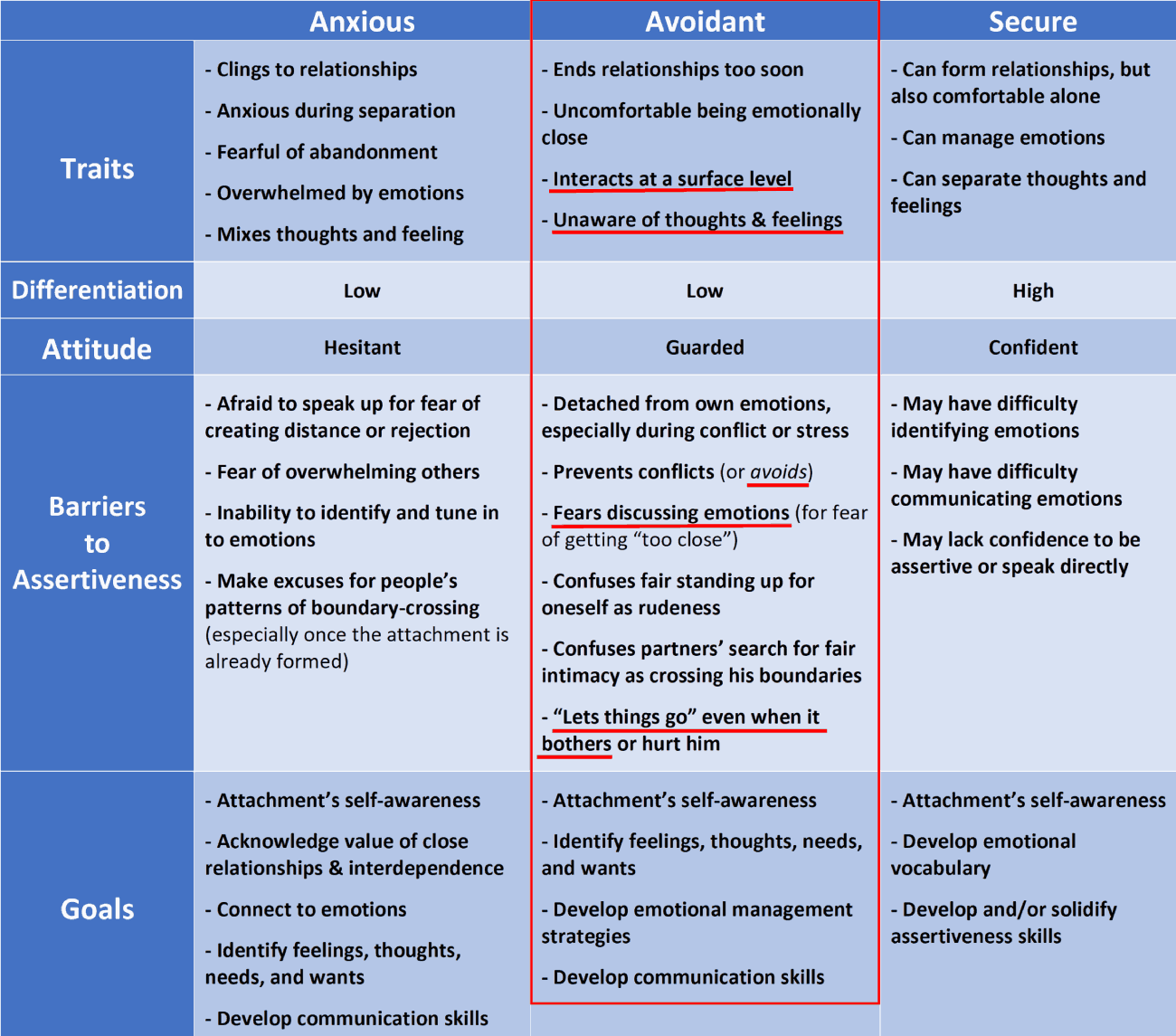
Based on Hanks, 2016
Let’s now review some typical traits of avoidant attachment personality:
1. Secretive
Avoidant individuals tend to engage in low levels of self-disclosure.
The authors of The Handbook of Relationship Initiation say it reflects their fear of dependence and lack of trust in others.
2. Braggart
Avoidant people tend to present an inflated view of themselves to others in order to appear strong and self-sufficient.
This approach often impairs, rather than promotes, the development of intimacy (Mikulincer, 1998).
3. Comfortable Wiht Impossible Relationships
Sometimes avoidant attachment types will go for long distances and other hopeless relationships.
It may be an unconscious choice to maintain their freedom and distance.
Aron, commenting on research showing that avoidant experience more unrequited love than secure types suggested it may be a way to experience love, without the relationship.
4. More Likely to Cheat
The avoidant attachment is part of the “player psychology makeup”.
Such as, seeking more short-term mates, rather than long-term pair bonds.
As part of this shorter-tern strategy, avoidants tend to enjoy sex without commitment more than other styles do, suggests psychologist Martin Seligman (2002), although that doesn’t necessarily mean they do have more sex.
When in a relationship, avoidant attachment types are more interested in individuals of the opposite sex.
This “interest” also translates to a higher incidence of infidelity among avoidants (Dewall et al. 2011).
In some studies, up to twice as much as the other attachment styles.
On the flip side, they are less likely to develop strong feelings for the affair partner (Allen, Baucon, 2004).
If you want to understand the unpleasant phenomenon of cheating a bit more also check the following
5. Potentially Dark Triads Traits
Quoting Lyons, M. (2019):
research has found that those high in psychopathy (Jonason, Lyons, & Bethell, 2014) and Machiavellianism (Brewer, Bennett, Davidson et al. , 2018) have avoidant attachment styles
The avoidant attachment style supports the psychopaths’ and Machiavellians’ preference for short-term dating and uncommitted relationships.
6. More Likely to Date Anxious Types
We spoke about the Avoidant Attachment Style in the overview of the four attachment styles.
Avoidants rarely end up in relationships with other avoidants and Amir Levine says they become somewhat less avoidant when dating a secure attachment.
It’s not uncommon for avoidants to end up with an anxious. When avoidants pair with an anxious, they form the toxic anxious attachment trap.
It’s a type of dysfunctional relationship with lots of drama and lots of up and downs. I welcome you to check the article so you will know what you need to avoid.
7. Mentally Biased Against Relationships
The literature refers to the avoidant’s biases as “deactivating strategies”.
We list them here, together with examples:
Mental Biases | Examples |
| Black & White Bias |
|
| Generalizations |
|
| Threats Bias |
|
| Unfavorable Comparisons |
|
Malice Bias |
|
8. Unassertive
Overall, avoidants tend to be lower power than secure types.
Their closeness can be mistaken for power, but it’s just a front.
Says psychologist Martin Seligman:
- Lack of confidence, especially in social situations
- Regard people with suspicion, guilty until proven innocent (bitter cynicism, not positive cynicism)
- Put greater emphasis on achievement than relationships
- Keep people and partners at arms’ distance
- They don’t disclose, they don’t tell you how they feel
And they are also worst at assertiveness, an all-important communication skill.
Are Avoidants Truly More Independent?
We all have a fascination for autonomy and independence.
It feels like total unneediness and… Power!
And it’s not totally untrue.
The APA Handbook of Personality and Social Psychology says that “Attachment-related avoidance is associated with a reduced desire for closeness and intimacy”.
However, it seems to be at least not total unnediness.
And studies prove that avoidants aren’t so independent after all.
To begin with, avoidants are as happy to be accepted by others as anyone else. And their happiness increases when they know they will be socially successful (Carvallo, 2006).
And, under highly stressful scenarios, they behave like anxious attachment style types (Levine, 2010).
On the other hand, In the case of a loss, avoidants tend to suppress or avoid attachment-related emotions. Evidence shows that in general, individuals with an avoidant attachment style adapt well to loss (Fraley &
Bonanno, 2004; Mikulincer & Shaver, 2008).
I’d venture to say that avoidants have the same basic needs, but adopted an attachment that masks those needs.
So although the need is still there, they “cover it up”, resulting in a strange mix of higher independence and lower intimacy, albeit still not 100% genuine.
Avoidant Attachment Examples
There are many examples of avoidant attachment in the movies. They make for a lot of excitement -to watch- and big emotional swings.
Check the article on the anxious-avoidant trap for a few more video examples on top of the ones here:
#1. Mr Big: Moving Away
Here’s a typical avoidant: Mr. Big from Sex and The City.
Not exactly a great relationship, right?

We back up all our videos for Power University
What makes him avoidant?
When Carrie proposes to move to Paris, he doesn’t want her to move “for him”. He feels the tightening circle of responsibility closing in on him and has to break free.
The “relationship” he wants is the avoidant utopic relationship. It’s a relationship where he can move any time he wants, wherever he wants, without considering the impact on the partner.
Carrie is right when she says that it is about them and not about work. She’s not fully correct though in believing it’s fear that prevents him from getting close.
It’s not so much fear, but more of a “reverse attachment” whereby every avoidant needs to push back to preserve their space.
Avoidands will miss their partners once they have regained distance. At this point, they will seek to reel their partners back in, only to need distance later on. And there goes the carousel again.
Note:
When Mr. Big says “I don’t wanna talk about this anymore”, that’s stonewalling behavior right there.
#2. Craving Intimacy… Only When In Need
Mr. Big again, a perfect example that avoidants also want intimacy.
But in special situations, often when they’re down in the gutter and need help up.
When in need an avoidant can look like he’s healed. But it might be just temporary.
Overcoming Avoidant Attachment
To have a happy relationship -and happy life-, you need to overcome the shortcomings of the avoidant attachment style.
Here are the steps:
1. Own It
First step, is to acknowledge it.
And it’s already something that very few men do.
Dismissing adults identified via interview methods almost always rate themselves “secure” on attachment questionnaires (Creasey & Ladd, 2005).
1.2. Keep It! There’s Nothing to Fix
Also, don’t jump to the conclusion you must “fix yourself”.
The author for one is an avoidant and is NOT trying to change it.
If you want to do the same, you can stop reading here.
Otherwise, keep doing.
1. Work Around The Limitation
Have you learned how the psychology of avoidance?
Good.
Once you become aware of your deactivating strategies, you must ask yourself whether or not your thoughts are real or if they are exaggerated by your avoidant tendencies.
Are the imperfections you start noticing real deal breakers or is it that you’re overplaying them to distance yourself?
Mental blocks also include fantasizing about sex with others and thinking she’s pathetic for being so needy.
Work around them
Once you’re aware of your mental blocks, work around them.
For example, when you feel the urge to pull away, explain what’s happening to your partner. Tell her you need time on your own… And that you will be back more energized to spend time together.
As a matter of fact, to help your partner understand, let them read this same article.
2. Associate Avoidance with Weakness
Knowing the science of avoidant attachment is also helpful.
And here’s what the science says: avoidant attachment types also need intimacy. But they repress it subconsciously.
And as we’ve seen studies show that when a big upset happens in the avoidant attachment type’s life, they become insecure.
And that’s another reason to strive for a secure attachment.
3. Drop Cool
Some avoidant attachment types think it’s cool to be an avoidant because it makes them stronger.
As we’ve seen above, it makes you weaker. And only hurts the people around you.
Here’s an example of avoidant hiding behind the mask of coolness:
Until you realize there is nothing cool in being avoidant, you will never truly emotionally mature
4. Associate A Secure Attachment to Strength
Know this:
A solid relationship with a secure emotional attachment will make you stronger and more confident.
Secure attachment types are stronger than avoidant ones, and part of it is because of the solid foundations they have with their relationship.
Instead of the quest for autonomy, look for a partner with whom to establish a secure attachment.
5. Find a Secure Partner
Secure partners have the power to make the anxious and the avoidant attachment types also more secure.
You will recognize secure types because they play little games and talk straight.
6. Drop The Idea of “The One”
Avoidant attachment types often look for mistakes in their partner as a subconscious excuse to move away. And then they tell themselves she wasn’t the one.
There’s no such as thing as “the one” who is perfect. Understand instead that you’re an active participant in making the relationship as good as it can be.
7. Get Closer Indirectly
It’s easier for avoidants to get closer if there’s a shared task in between. For example, intimacy while cooking dinner and eating together is easier than sitting on a couch and hugging without doing anything.
So you can ease your way in with shared activities.
Don’t Confuse Avoidant Attachment With…
The avoidant attachment is somewhat similar to an emotionally unavailable man and it’s what sometimes women refer to as “an ass*ole“.
But it’s neither, really.
Emotionally unavailable
While emotionally unavailable is mostly neutral and cold, avoidant are capable of intimacy… Until they subconsciously block themselves. And while emotionally unavailable stays on an even keel, the avoidant goes through cycles of missing and then pushing the partner away.
As*holes
And while as*holes tend to be confident and not care about their partners, avoidants come in all shapes and sizes.
They can be confident, but also shy and un-confident. And they can also actually care about their partner.
But still unable to provide on the intimacy level of the relationship.
SUMMARY
Avoidants are uncomfortable with intimacy and constantly need to defend their space.
They subconsciously repress their needs for intimacy and they focus on they can more easily focus on the negatives of their partners.
Avoidant attachment types make for really bad relationships, especially when coupled with an anxious attachment style.
In this article, you learned what you can do to overcome the avoidant attachment style curse.


