
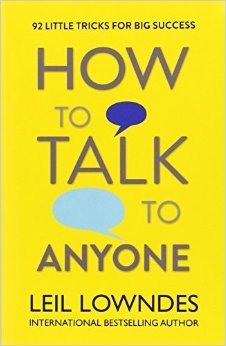
How to Talk to Anyone (1999) is a social skills book compiled as a collection of 92 conversations and social skills ‘tips’ of varying levels of sophistication, but mostly beginner-friendly.
TPM Note: Good ‘social lubrication’, but we add power to achieve status, respect, and attraction
Leil Lowndes is a master of ‘Social Lubrication’ and charm. However, ‘social polish’ and ‘liked’ is not enough for ambitious men. Power skills are needed to achieve goals (see: social vs. power skills). We’ve audited this list to separate the ‘social etiquette’ from the ‘strategic influence’.”
About the Author:
Leil Lowndes is a best-selling author and a well-known figure in the “people’s skills” circuit.
Contents
Body Language
- SMILE SLOWLY – WITH A SECOND DELAY: Don’t flash an immediate smile, it cheapens it. Instead, look at their face for a second. Pause. Soak in their persona. And then let a big, warm, responsive smile flood your face and overflow into your eyes. The split-second delay convinces people your flooding smile is genuine and only for them.
- LOOK AT THE PERSON YOU CARE ABOUT – Epoxy Eyes You can look at one person even while another person is speaking. This conveys a powerful “I care, I like you” sensation. To soften the edge you can still look at the speaker most of the time but go back to the target when the speaker has just finished a point.
- BIG BABY PIVOT (ON INTROS) When you get introduced, turn your body fully towards the new person and smile.
- ‘HELLO OLD FRIEND’ FRAME: Treat someone you’ve just met as an old friend.
My Note: this is a very good technique and will make your whole body language follow naturally. - THINK YOU’RE IMPORTANT: Visualize and imagine yourself as a very important person. That way all your verbals will fall into place automatically.
These are good tips, but ambitious men need to first understand the fundamentals of body language.
Start here:
Conversations
- PARROTING: If a convo is dying and you want to let it continue without much effort, repeat their last words.
Example:
Her “and then I went to see match and it was amazing”
You “see the match?”
Her “yes, bla bla bla”
- ASK ABOUT LAST FEW HOURS: To get a new acquaintance talking, ask about her day, preferably about the last 5-6h. She’ll love it because it’s so close to her experience.
- DON’T ASK WHAT DO YOU DO: It signals like you’re assessing their social worth and it’s embarrassing if they’re jobless. Ask “how do you spend most of your time”.
- LET THEM FINISH: Don’t jump in with “me too” which seems over-excited. Let them finish first instead, and the longer you wait to share your commonality, the more impressive it will sound. My Note: This is the opposite of what Vanessa van Edwards suggests. I say it depends. If you want to sound excited or go along with an overly excited mood, jump in. If you want to seem calmer and more powerful, wait.
- LINK TO WHAT THEY JUST SAID TO CHANGE TOPIC: Pick up something -thought, phrase, or also a single word- the speaker said. Repeat it or rephrase it and then relate it to what you want to say. Do you want to talk about a recent movie you saw, or about horseback riding but they’re talking about the weather? In your first sentence allude to rain and then connect to your desired topic.
Her: On rainy weekends, I usually go to a movie. In fact, just last week I saw one called..
You: I sure hope it doesn’t rain next Saturday because I have my next horse riding lesson..
OR
You: I pray it does rain next weekend so rather than taking the missus shopping I’ll have an excuse to stay home and work on the new rec room..
- Comm YOU Nicate with ‘YOU’ First: Start every appropriate sentence with “you”, it immediately grabs your listener’s attention.
Ie:
✅ “you look great in that suit“
rather than 🔴 “I think that suit looks great”.
Rather than 🔴 “there’s this great Italian restaurant, do you wanna try it with me?” say:
✅ There’s this great Italian restaurant, YOU will love it, wanna try it with me this evening?“.
In an email, 🔴”I really enjoyed myself at the party” becomes ✅ “You really threw a great party the other night”.
You save people the step to translate it in their head “hmmm, he says it’s great, but will I like it?”
These are good tips, but for the foundations of high-power talk that deliver status, respect, and attraction, see:
- Low-power speaking: cues of low value and low status
- Power talk: cues of high value and high status
Emotional Intelligence & Bonding
- FULL EMPATHIZERS: When someone is talking to you don’t just nod or say “uhu”, use full sentences. Such as “oh that’s a lovely thing to say
- ASK WHAT THEY’D LIKE ON THEIR TOMBSTONE: Ask what they’d like written on their tombstone (or what they love the most about them) and then tell them you appreciate them for exactly that quality they’d like engraved.
My Note: it’s easy to make this one an awkward moment. You need a bit more rapport and serious talk or it will be ‘off’. - SOUND CLOSER ON PHONE: Answer the phone with a neutral tone, and when you realize it’s a friend of yours immediately warm up ( similar to rewarding them after you got to know them). On the phone, it’s harder to convey warm feelings, so it’s a good idea to use their name as often as possible -“name shower”-
- ECHO AND MIMICK: Notice the words they use, and use the same ones. Match their speaking speed and tempo as well.
- DON’T PAT WHEN HUGGING: Patting signals distance and ‘friendliness only’, not closness or attraction
My Note: I do not pat, not even male friends. Not patting is not necessarily sexual and it’s much, much warmer. I have noticed indeed that people who pat and/or withdraw very quickly tend to be either homophobes or not very comfortable in their skin. Indeed in my experience patting too obviously sends a message of distance and discomfort.
- WHEN ACCUSED AVOID DEFENSIVENESS: Listen calmly until your accuser finishes and then say “I am glad you brought it up”. Proceed by saying “you are right” and repeat his accusation word for word. No ifs, buts, and however: those are the prefaces for excuses. Pause. Then, without defensiveness, tell your reasoning. If no rationalization, tell what you have learned. Icing on the cake, thank your accuser for the opportunity to tell him.
Empathizing Example
Lowndes calls this ’emotional prediction’, but it’s about empathizing
Example 1:
the CEO at the end of a difficult experiment tells the experimenter “glad that was over, it must have not been easy for you”.
Most people would have said, “That was difficult, I am glad it’s over”.
Example 2:
In a job interview: “I hope for you that this is the last interview; you must have had a grueling, long day”. When going out, she added, “I guess your real work starts now“.
My Note:
This works well in several environments, including in service-oriented contexts. For example, packed restaurant and the waiter is swamped. He finally gets to you with bated breath:
Him: Sorry the delay sir, what would you like to drink?
You: All good, I can see it’s super packed, you must be going crazy
Instant bond (and you may have just become his favorite patron).
For a more foundational overview on how to bond and connect, see:
Charm & Charisma
- SEE NO BLOOPERS HEAR NO BLOOPERS: Pretend nothing’s happened when someone makes a mistake.If coffee is spilled, keep talking while you drain it with a napkin. If a waiter spills your order, make it nothing.
- WAVE AT PEOPLE WHEN ENTERING A PARTY: When entering a party in a place where you don’t know anybody, just wave at the space between people and smile. Or wave at someone you think you like: people will think you are super popular and will later gravitate around you.
My Note: Hillary Clinton was using this technique and it often looked very unnatural. - SCRAMBLE THERAPY – TRY NEW THINGS: Just doing something once will give you 80% of the words and stories you need to relate to anyone who’s an expert/professional in that field
- CARRY GOOD NEWS: As The 48 Laws of Power suggests, don’t be the bearer of bad news. People associate us with what we say and talk about. Jump on good news and share good news instead
- KILLER COMPLIMENT: Search for one attractive and very unique quality they have and, at the end of the conversation, mention their name, look at them in the eyes, and deliver it.
Business Networking
- GO EARLY: if you don’t know anyone go early and you will be in a small circle of early birds by the time the party swells.
- TRACKING: Remember and then refer to people’s minor and major events in their lives.
- CREATE SAFE HAVENS: Don’t mention business when you bump into someone by accident. That’s not the right time for that and they will respect you for giving them their space.
- BUTTERCUP TO SUPERVISORS – for better service: When there’s someone whose service you value, make a compliment, ask who the supervisor is, and then send a letter-mail to the supervisor.
- LEAD THE LISTENERS – be the first to applaud: Be the first one to applaud or congratulate the person giving a speech you agree with. Lead the crowd into acceptance.
- IF YOU’RE LATE – DON’T MAKE EXCUSES walking in: If you’re late to a meeting, don’t demean yourself with an excuse as soon as you walk in but find an unflustered way to allude honestly at the problem you had later on. You will come across as sincere and secure and not obsessed with what other people think of you, two important big cats traits.
Power-Aware Tips
This is a collection from all that I’ve read from Leil Lowndes, including but not exclusively from “How to Talk to Anyone“:
- SIT TO THE RIGHT: Sit on the right side of the most powerful person in the room. Men are uncomfortable sitting where they don’t see the door and want “their woman” to be on their right while they put a friend to the left.
- HIGHEST SEATING: The highest chair is more important than being at the right of the host. An example of a businessman who used to screw down all the chairs in the meeting room except his, so he’d sit the highest.
- NOD UP – NOT DOWN: When you agree with someone you know by lowering your chin. Do the opposite, move your chin upwards instead. But be aware of blending it with warm body gestures or it can come across as arrogant (see McGregor using the Nod Up).
CONS
- Wrong about CEOs: it’s not ’emotional intelligence’ that gives you status and career
Leil Lowndes describes the CEO as if it were obvious that the top man has the highest emotional intelligence.
But that’s not true. Data shows that CEOs have lower emotional intelligence. Read ‘emotional intelligence lie‘
- All over the place “tricks” format
Lacking a focused topic it’s normal Leil Lowndes “tricks” tend to fall a bit all over the place.
And just as a note, the “little tricks” format can be dangerously misleading: if you want to get good at anything, drop the easy-fix mentality.
- Mixed bag of value
There are, of course, quite a few known and common sense “little tricks” in How to Talk to Anyone, but on the other hand, they can serve as a refresher.
Review
Leil Lowndes comes across as a skilled and charming socialite, and “How to Talk to Anyone” is an easy read with plenty of good social skills tips.
Some of the “little tricks” are common sense or not suited for high-value men -ie.: changing your answering machine’s message every day-.
Some others are not “little tricks” but fundamental elements of human relationships which would require more than a brief ‘trick explanation’.
As a matter of fact, the ‘tricks’ format may be the biggest limitation of this book because ‘tricks’ don’t develop skills, which in turn don’t deliver the outcomes we want for our readership (ie.: status, respect, attraction, and achieving goals).
Read more basics on social power:


