
The Cambridge Handbook of Evolutionary Perspectives on Sexual Psychology (2022) is Volume 1 in a three-part series. It lays the theoretical foundations for understanding human sexual behavior from an evolutionary perspective, while Volumes 2 and 3 focus on male and female adaptations, respectively.

FULL SUMMARY
About the Author:
This volume is edited by Todd K. Shackelford, a leading evolutionary psychologist and prolific researcher in human sexual behavior and conflict.
He also edited the excellent Oxford Handbook of Evolutionary Psychology and Romantic Relationships.
Each chapter is authored by a subject-matter expert, ensuring the content reflects the latest research and specialist insight in each area.
Chapter 1: Natural Selection
In this opening chapter, Sedlacek walks us through the logic of natural selection as the bedrock of evolutionary thinking. She first dismantles the myth of “nature as a conscious selector,” showing instead that selection is an inevitable consequence of three simple preconditions:
- Variation in traits among individuals;
- Heritability/inheritance of those traits;
- Differential reproductive success tied to those traits.
As long as there is variation, inheritance, and nonrandom differential reproduction, it is a logical consequence that some entities will become more numerous than others over the course of generations
From there, she explains how adaptive features—whether wings, eyes, or mating psychology—inevitably accrue over countless generations, bit by bit, through the blind but inexorable filter of what best propagates its own genetic “instructions.” Along the way, she addresses common stumbling blocks—teleology (the impulse to see purpose in every trait), genetic determinism (the false dichotomy of “nature versus nurture”), and the idea of “optimal design”—by showing that adaptations are always local solutions, tailored by past environments and constrained by historical legacies.
Also worth noting:
- Genes aren’t selected directly; they code for traits (phenotypes) shaped by environments. Sexual desire, for instance, evolved for reproductive edge, not as a standalone “lust gene.”
The Myth of ‘Survival of The Strongest’
The author also tackles common misunderstandings related to the ‘survival of the fittest’ argument, claiming that ‘fit’ only refers to fit to the environment, not necessarily in ‘healthy’ or ‘strong’.
And survival only matters as long as it increases reproduction:
(…) another misleading implication of the “survival of the fittest” mantra: the idea that survival is of paramount importance.
The truth is that survival serves reproduction. An organism’s survival ultimately means nothing to natural selection without reproductive success.
(…) natural selection only “cares” about survival insofar as it benefits reproductive success
Chapter 2: Sexual Selection
Atari brings Darwin’s second great insight—sexual selection—into sharp focus. Unlike natural selection, which prizes survival, sexual selection prizes reproductive success, often at the expense of survival. Two main engines drive it:
- Intrasexual competition (most often male–male combat using weapons like antlers or tusks);
- Intersexual choice (most often female mate choice for ornaments like peacock tails).
He traces the history of the concept—from Darwin’s bold proposal, through Victorian skepticism (Wallace’s rebuke of “fanciful female aesthetics”), to its integration into the modern synthesis—and shows how both competition and choice sculpt the dizzying variety of mating strategies, from cricket chirps to courtship dances.
Signaling Value: Hamilton Paraside vs. Zahavi’s Handicap Principle
The Hamilton–Zuk hypothesis differs from Zahavi’s handicap hypothesis in that, although both rely on males offering real signals of quality, the ornament is seen as a trait to directly display health rather than as a handicap.
According to this theory, the more strongly parasites have played a role in a species’ ancestry, the greater the pressure to signal lack of parasites.
The Hamilton–Zuk hypothesis raises a fundamental question about the signals that animals display. For this hypothesis to hold, it is necessary for males to be “honest” signalers. Put differently, for females to benefit from the signals that male ornaments provide, it is crucial that these ornaments correlate with parasite resistance (rather than only appearing to be related).
Atari states that the Hamilton–Zuk hypothesis has been received favorably, but more empirical evidence is needed.
Both the parasite and handicap theories relate to signaling mate value, but another theory of ornamentation is not related to value at all:
One important question is whether males’ ornamentation evolved simply to make them attractive to females or whether they serve as honest signals of quality.
The former argument can be traced to Fisher
In brief, these theories are not mutually exclusive, and they can all have contributed and be true at the same time.
For a deeper overview, you can also check our review of Evolutionary Psychology: An Introduction (chapter 3).
Measuring Male Intrasexual Competition Propensity: A Psychological Predisposition
The Intrasexual Competition Scale (ICS) measures how much people see same-sex interactions as competitive, especially in the context of mating.
It focuses mainly on rival derogation: envy, jealousy, and putting down same-sex rivals.
It found no average sex differences, but high scores are more likely to compare with same-sex peers, feel competitive, and act on it.
Men with high ICS scores:
- More likely to use steroids (especially with less training experience).
- More motivated by appearance enhancement (e.g., cosmetic surgery).
The ICS lacks balance and the Intrasexual Rivalry Scale (IRS) improves on this using two tactics (self-promotion + rival derogation) and adding four mating domains from the KASER model (Kindness/dependability, Attractiveness/sexuality, Status/resources, Education/intelligence).
Findings from both scales:
- No sex differences in total scores.
- Scores decline with age—younger people are more competitive.
- Higher scores in men with low SES background and women with high SES background.
- Father absence linked to higher female competitiveness and more short-term mating behaviors (flirting, makeup use, etc.).
Men who score higher:
- More status-driven and rival-sensitive.
- More likely to enhance their appeal or undercut other men.
- More active in competitive or mate-seeking environments.
Low scorers are less rival-focused, more indifferent, or long-term oriented.
Lucio’s note: enlightening and important psychological measure
It’s the first time I stumbled upon this scale, and it matches my observation. The fact that high scorers also use more steroids suggests that high scorers focus on muscle because they’re focusing on sexual competition (something I consider ineffective and in some cases point to low intrinsic self-esteem).
I consider it an important psychological measure to understand people, behavior, and mating strategies
Human Sperm Competition
- Sperm competition likely arose in response to female infidelity, considered the most plausible ancestral context (Smith, 1984).
- Data show some level of concurrent partnerships among women, especially in younger age groups—for example, 15% of British women aged 16–24 reported overlapping sexual partners in the past year (Johnson et al., 2001); similar findings were reported in the U.S. (Laumann et al., 1994), China (Yan et al., 2009), and Iran (Honarvar et al., 2016). <— 🙋🏼♂️ Lucio’s note: Surprised about China and Iran, but I still suspect modern dating is much different from ancestral dating
- While not all concurrent relationships involve double-mating, some likely do.
Evidence for male physiological adaptation:
- Men adjust sperm quantity based on perceived sperm competition risk. Fewer sperm are found after recent contact with a partner, and more sperm after a longer absence (Baker & Bellis, 1989).
- Men produce a higher percentage of motile sperm when exposed to images implying high sperm competition (e.g., 2 men + 1 woman), compared to control images (Kilgallon & Simmons, 2005).
Psychological and behavioral adaptations:
- Men show increased sexual motivation after being physically separated from their partner—possibly to counter sperm competition risk (Shackelford et al., 2002).
- Mate guarding and copulation frequency increase when female partners are more attractive (Pham et al., 2014) or spend more time around other men (Pham & Shackelford, 2013).
- Men with lower quality sperm mateguard more (tradeoff hypothesis) (Leivers, Rhodes, and Simmons 2014): men who performed fewer mate retention behaviors produced higher-quality ejaculates, having a greater concentration of sperm, a higher percentage of motile sperm, and sperm that swam less erratically. Men’s expenditure on mate retention and on the ejaculate may represent alternative routes to paternity assurance in humans <— 🙋🏼♂️ Lucio’s note: interesting, but was based on a small sample of 45 and evidence is mixed, see below
- Evidence is mixed: In conceptual replication attempts of the study by Foo et al. (2018) and Leivers et al. (2014), it was revealed that there was no relationship between ejaculate quality and (1) physical strength (DeLecce, Shackelford, Fink, & Abed, 2020) or (2) mate-retention behaviors (DeLecce, Shackelford, Zeigler-Hill, Fink, & Abed, in press)
However, findings are not all consistent:
- A study found no improvement in ejaculate quality when men imagined partner infidelity compared to a control condition (Pham et al., 2018).
- Many nonhuman sperm competition studies involve designs that are not replicable in humans (e.g., tracking fertilization success across multiple males) (Price, Dyer, & Coyne, 1999).
In evolutionary terms:
- Humans are mid-level competition, likely falling between gorillas (low sperm competition; single-male harems) and bonobos (high sperm competition; group mating) (Zuk & Simmons, 2018).
- While not under extreme pressure, humans are not free from selection related to sperm competition. Both behavioral and physiological evidence suggests moderate evolutionary relevance.
🙋🏼♂️ Lucio’s note: I tend to agree with this overview:
While there are other contexts in which sperm competition might have occurred, Smith (1984) argued that, compared with female infidelity, these contexts may not have occurred frequently enough in our evolutionary history to cause selection pressures for adaptations to sperm competition
🙋🏼♂️ Lucio’s note: I’d also argue that biology here limits the physiological response. If sperm takes months to produce, how responsive can it really be to short term stimuli right before release?
🙋♂️Lucio’s Take: Why I have doubts regarding sperm competition

Lucio:
Sperm competition is a fascinating topic. After reviewing Baker’s flawed book on the subject, newer studies and authors convinced me to reconsider and give more weight to its potential impact in humans.
Still, several important questions remain—questions that, for now, limit how much I believe sperm competition truly shaped human evolution:
- Pair bonding is a powerful evolutionary tool that reduces the need for sperm competition in the first place.
- Universal expectations for loyalty add emotional and social controls that restrict women’s freedom to “sperm shop”—especially in our evolutionary past. A woman would have to hide not just from her partner, but also from his kin, allies, and possibly the tribe as a whole.
- Female mate choice sidesteps sperm competition altogether. A woman in love wants the man she’s bonded with to father her children. And a woman confident in her judgment prefers her chosen man to be the father. Some women do pursue sex for its own sake, but the more restrained and conscious choosers still limit the scope for post-mating competition.
- Biology 1 – Timing: It can take less than an hour for sperm to reach the egg. Even if we allow for a few hours or a day, that short window places a major constraint on the opportunity for sperm to compete.
- Biology 2 – Egg bottlenecks: In fertile windows, the egg is a bigger bottleneck than sperm. Most healthy men have more than enough viable sperm to fertilize an egg. If the egg is the bottleneck, the system simply doesn’t lend itself to discrimate against sperm
Unless these points are more fully addressed, I remain cautious about assigning sperm competition a major role in human evolution. Plus, modern sperm competition may happen far more in sperm banks than ‘in nature’.
Women Have Less to Gain From Multiple Partners
And it comes down to being the ‘larger investing sex’:
This larger minimum investment decreases the reproductive value of multi-partner mating.
Hence, compared with the opposite sex, the less heavily investing sex benefits more from seeking numerous sexual partners, whereas the more heavily investing sex benefits more from enhancing its capacity to support offspring.
In simpler words, for humans it means that if a woman has already found a guy whom she believes to be of high mate value, it doesn’t make sense to add 3 more random sexual partners, especially after she may already be pregnant or already caring for an infant.
🙋🏼♂️ Lucio’s note:
If we dig deeper, she may still gain somewhat with sperm selection, or by keeping backup options. But the general point is valid, and sperm selection is contentious, of smaller added value, and this strategy also entails much higher risks.
Chapter 3: Inclusive Fitness Theory
Fitzgerald and Lorentz introduce us to Hamilton’s revolutionary insight: organisms may propagate their genes not only through direct reproduction, but also by helping kin who share those genes.
They unpack the math of Hamilton’s rule (rB > C), illustrating how altruistic behaviors—warning calls, cooperative breeding, even self-sacrifice—can evolve when the genetic payoff in relatives outweighs the cost to oneself.
Common Confusions
Inclusive fitness theory is often misinterpreted in 3 key ways, leading to confusion about how natural selection works on genes related to social behavior:
- Misinterpreting “r” as “percentage of total genes shared” between two individuals.
In reality, r is the probability that the recipient of an altruistic act carries the same gene that caused the altruist’s behavior (Hamilton, 1964). - Conflacting Inclusive Fitness with Kin Selection and altruism
Many assume inclusive fitness only covers kin-based altruism. But inclusive fitness includes mechanisms like jealousy or parent–offspring conflict that aren’t purely cooperative (Park, 2007; Dawkins, 1979; Buss, 2015). - Misusing Hamilton’s Rule to predict behavior
People often wrongly apply Hamilton’s rule (c < br) to predict individual behavior. But the rule describes when a gene will be selected by evolution—not whether someone will act altruistically. It’s a gene-level equation, not a psychological theory (Hamilton, 1964; Buss, 2015; Park, 2007; Dawkins, 1979).
Interesting notes:
- People are more likely to rescue their romantic partner when they have a biological offspring together than when they only have adopted children or no children together – even when statistically controlling for emotional closeness between the altruist and recipient (Fitzgerald et al., 2010) – indicating that the probability of genetic inheritance may influence altruistic decision making among kin
- Mothers become more tolerant of investing resources in offspring as they age (Beaulieu & Bugental, 2008), suggesting that parents may wish to hoard resources for future reproductive opportunities (Schlomer, Del Giudice, & Ellis, 2011)
- Older mothers also provide more physical and verbal affection to their young children than younger mothers do (Bornstein & Putnick, 2007).
- Male sexual jealousy decreases when the other man is a sibling, but it was the opposite for women
Chapter 4: Adaptive Problems in the Domain of Human Sexuality
Asao maps out the landscape of the “adaptive problems” our ancestors faced in mating—and hence the selection pressures that shaped our sexual psychology.
- The most costly reproduction, the choosier mate selection: The more costly producing an offspring is – in terms of time, metabolic expenditure, and other resources – the more selective an animal should be when choosing a mate
- Parental investment is a trade‐off with mating effort: offspring survival versus mating effort
- Disease risk vs multiple partners, balancing the rewards of variety against pathogen exposure.
Chapter 5: Adaptations, By‐products, and Spandrels
Flegr tours the taxonomy of traits in evolutionary biology:
- Adaptations, which exist because they solved specific problems;
- Exaptations, traits that evolved for one function but were later co-opted for another.
Technically, all adaptations are exaptations because evolution doesn’t start from scratch - Postadaptations: traits that were once adaptive in past conditions but have lost their original fitness benefit due to environmental or lifestyle changes; they may remain as vestiges or have reduced function today.
- Exaptations, traits that evolved for one function but were later co-opted for another.
- By‐products, neutral leftovers that hitchhiked on adaptive traits;
- Spandrels, incidental architectural features with no direct function.
- Rudiments and atavisms, traits inherited from ancestors—rudiments appear in all individuals but may no longer function (e.g., human appendix), while atavisms occur rarely due to special allele combinations (e.g., human tails); these may have been adaptive in ancestors but often lack function now (Flegr, 2025).
And something I particularly agree with:
“Just‐so‐story” pitfall: assuming every trait is an adaptation—and offers a rigorous checklist (complexity, efficiency, heritable variation, costs) to distinguish genuine adaptations from evolutionary side effects.
The Savanna Principle May Be Wrong
The savanna principle suggests humans evolved mainly in African savannas, shaping our mind and body.
But this idea might be wrong for two main reasons:
- Savannas may just preserve fossils better than tropical forests, so fossils mostly come from savannas even if humans lived elsewhere more.
- Species adapt quickly only right after they form (as per genetic theory), then become “frozen” and change little despite environmental shifts. Since our closest relatives live in tropical forests, it’s likely humans originated there and adapted mostly to forests, not savannas.
If so, many traits we think fit savanna life are actually exaptations (traits evolved for other reasons) or postadaptations (traits that no longer fit our current environments) (Heerwagen & Orians, 1993; Tooby & Cosmides, 1990; Roberts et al., 2016).
Group Selection: From Reviled, to Back In Vogue
Group selection then fell out of favor after Maynard Smith and Williams showed that individual selection is usually stronger.
But in the 1980s new models showed group selection can matter, especially in species with frequent group extinctions and reformations (Alexander & Borgia, 1978; Shanahan, 1997).
Some traits may have evolved mainly through group rather than individual selection (D. S. Wilson & Sober, 1994).
Some traits and connected social dynamics that may have evolved this way:
- Altruism within groups: Helping behaviors that benefit others at a personal cost.
- Group cooperation and coordination: Behaviors that improve group success but may reduce individual gain.
- Punishment of defectors or cheaters: Sacrificing to maintain group norms.
- In-group loyalty and out-group hostility: Traits that benefit the group in intergroup competition.
Example: A jackdaw gives a warning call to alert others of a predator. This helps the group but puts the caller at risk.
Stability-Based Sorting (SBS) vs Natural Selection
Stability-Based Sorting (SBS) is an evolutionary process where only the most stable things stick around—whether or not they reproduce.
Contrary to natural selection, which only works on traits passed to offspring, SBS doesn’t need inheritance or reproduction.
If something is stable and long-lasting, it stays; if it’s unstable, it disappears.
The author claims that SBS can produce ‘safety catches’ that may not increase individual fitness, but that protect the species in the long term-for example, decreasing reproduction when resources become scarce.
All surviving species in the long run would carry these SBS, say the author.
🙋🏼♂️ Lucio’s note: still can’t see how this would work
It’s a novel and bright idea I had never thought of or read about. It sounds plausible and deep, potentially holding the keys to long-term survival (including for humans).
I’m still wrapping my head around it, and I’m not sure how it could work in practice. It seems a case of ‘good for the group’ vs ‘good for the selfish individual’.
In the author’s example, when resources become scarce, selfish players wouldn’t be eliminated if they aren’t already carrying SBS and they would out-reproduce the SBS-carrying individuals and quickly take over (and lead the species extinct).
I suppose the SBS may evolve ‘randomly’ and lie dormant. But here’s the step I don’t get: how would it spread across every single individual?
Chapter 6: Evolved Psychological Mechanisms: Properties and Evidence, Misconceptions and Mismatches
Pearson and von Hippel lay out what makes a psychological adaptation:
- Domain‐specificity—specialized “if‐then” decision rules for ancestral challenges;
- Computational complexity—processing inputs (cues) into outputs (behaviors) with clear design features;
- Cross‐cultural robustness—present across societies unless modern environments mask them;
- Developmental sequencing—emerging at ages when they became functional ancestrally.
They tackle misconceptions—like confusing general intelligence with evolved modules—and explore how mismatches between ancestral and modern environments (e.g., contraceptives, social media) can hijack once‐adaptive mechanisms, leading to disordered outcomes.
Interesting notes:
- Error Management Theory (EMT; Haselton & Buss, 2000): we may have evolved to favor the least costly error via a collection of biases in our perception and cognition
- Humans cooperate more than any other species: Although cooperation is widespread in nature, human cooperation exceeds that of all other species in the scale and range of cooperative activities (Melis & Semmann, 2010)
- We believe there’s more competition than there truly is: Internet and social media can lead us to believe we have more competitors than we do in reality, causing our jealousy mechanisms to misfire beyond adaptive utility <— Lucio’s note: the same is true for mating options though, and we may believe we have more options than we truly have
Chapter 7: Parental Investment Theory
Pazhoohi deconstructs Trivers’ landmark insight: because eggs cost more than sperm, females typically invest more per offspring, leading to sex‐differentiated mating strategies.
Key predictions in humans include:
- Women’s greater choosiness as part of the high‐investment sex (usually females);
- Mate‐value assessment weighting cues to genetic and investment potential (e.g., resources, fidelity).
- Men’s greater competition as part of the low‐investment sex (usually males);
He reviews empirical tests—from human speed‐dating studies to courtship in fish—showing broad cross‐species support.
Chapter 8: Parent–Offspring Conflict
Salmon and Hehman explore how mothers and their offspring can have divergent genetic interests: each child benefits from more resources than the mother can afford to give to all her young.
They detail the “weaning conflict”, sibling rivalry, and even genomic imprinting—where maternal and paternal gene copies are differentially expressed to tilt resource allocation. They also examine human evidence: breast‐feeding duration, sleep arrangements, and parent‐child bargaining over food and attention.
- Genetic imprinting: Paternally inherited genes influence infant behavior in ways that increase demands on the mother, and maternally inherited genes influence infant behavior in ways that reduce demands on the mother
- Weaning conflict: Offspring want to nurse longer than is optimal for the mother’s future reproduction, leading to resistance and conflict during weaning.
- Sibling rivalry: Siblings compete for parental attention and resources, often using crying, aggression, or manipulative behavior.
- Different mate choice criteria for parents/children: parents prefer attractiveness for their partners, but resource holdings and family background for their offspring. Whereas offspring often focus more on attractiveness and sense of humor (Apostolou, 2008a, 2008b, 2011a; Buunk, Park, & Dubbs, 2008; Perilloux, Fleischman, & Buss, 2011).
Parents may prefer more resources to keep more for themselves and their other offspring, and benefit from stronger networks - Different mate strategies preferences, with parents accepting short-term strategies more for themselves than for their children, and especially daughters (Apostolou, 2009)
Chapter 9: Theory and Evidence for Reciprocal Altruism
Takano and Ichinose revisit Trivers’ proposal that nonkin can evolve cooperation through repeated interactions and the shadow of the future.
They explain the math of iterated games (Tit‐for‐Tat, Grim Trigger) and how reputational information, punishment, and social networks stabilize reciprocity.
The 5 Drivers of Cooperation
Five theoretical mechanisms for the evolution of cooperation have been proposed (Nowak, 2006):
- kin selection
- direct reciprocity
- multilevel selection
- indirect reciprocity
- network (spatial) reciprocity
Theoretical and experimental studies have provided evidence for these mechanisms (Rand & Nowak, 2013).
In another review, we prepared this overview, adding a few other sub-drivers that have also been proposed:
| Theory | Impact | Explanation |
|---|---|---|
| Kin selection (inclusive fitness) | Very high | Altruism toward genetic relatives evolves when helping kin (rB > C) still propagates shared genes. |
| Direct reciprocity | Very high | In repeated interactions, helping others pays off because they’ll return the favor later. |
| Misdirected kin selection | Speculatively high | Cooperative behavior triggered by evolved kin-detection mechanisms (e.g., familiarity, similarity, proximity, emotional closeness), evolved in small kin-based tribes but triggers even without genetic relatedness |
| Indirect reciprocity (reputation) | High | Acts of helping build a good reputation, which attracts aid from third parties. |
| Network (spatial) reciprocity | High | Emergent property. Cooperators cluster together in networks or colonies and collectively outcompete isolated defectors. |
| Multi‑level selection (group) | Moderate | Groups of cooperators outperform groups of defectors, so cooperative traits spread with the winning groups/coalitions. |
| Enforcement (punishment) | Moderate | Emergent cultural byproduct. Punishing or excluding defectors imposes costs on cheats, stabilizing cooperative behavior. |
| Parochial/Ingroup altruism | Moderate/low | Preferential help for in‑group members, often paired with hostility toward outsiders. |
| Green‑beard effects | Low | Rare “tagged” genes recognize and favor copies of themselves, leading to targeted cooperation. |
| Partner choice | Low | Cooperative partners are favored over selfish ones. ‘Cooperative’ signaling is a consequence. Its strong effect on long-term dating is offset by short-term mating and forced copulation |
Two Strategies to Assess Others
Two main strategies for assessing reputation are:
- Image scoring: people assign reputation based on visible cooperative or defective actions. It’s cognitively simple and common in experimental settings (Milinski et al., 2001).
- Standing strategy: considers context—e.g., defecting against a defector doesn’t lower one’s reputation. It’s more nuanced but requires more memory, so less often used in practice (Milinski et al., 2001).
Chapter 10: Life History Theory and Mating Strategies
Figueredo and Peñaherrera‐Aguirre introduce life history theory: organisms face trade‐offs among growth, reproduction, and maintenance.
They apply the fast–slow continuum to human mating:
- Fast strategies (early reproduction, short‐term mating, high offspring number) often emerge in harsh, unpredictable environments;
- Slow strategies (delayed reproduction, long‐term bonds, high parental investment) thrive under stable, resource‐rich conditions.
They highlight links to risk‐taking, impulsivity, attachment styles, and illustrate cross‐cultural and individual‐difference evidence.
However, there is a limit to Life History (LH) influence. It strongly influences, but doesn’t fully determine, specific mating strategies like promiscuity or precocity, so treating them as interchangeable is a mistake.
The Dark Core of Dark Triads
In a more detailed examination of the lower-order facets of the dark triad, it was found that there were two more specific components that could be analytically extracted, jointly labeled the dark core, that accounted for much of the substantive content of the latent higher-order common factor underlying the dark triad, and that these were reducible to the traits manipulation and callousness.
Chapter 11: Sperm Competition Theory
DeLecce examines post‐copulatory sexual selection from the sperm and fertilization point of view.
She reviews male and female adaptations and current theories and evidence.
Humans show mild sperm competition adaptations—testis size, ejaculate volume—suggesting ancestral tendencies toward polygynandry.
Potential supporting evidence for sperm competition:
- Double mating increases with ‘experience’: For women reporting fewer than fifty lifetime copulations, 17.5 percent reported having double mated at least once. This percentage increases steeply with sexual experience: 71.8 percent of women reporting more than 1,000 lifetime copulations reported double-mating at least once Baker and Bellis (1995).
- 13% of American college women copulated with two different men in 24h: Gallup, Burch, and Mitchell (2006) found that 13.4 percent of a sample of American college women copulated with two men within a twenty-four-hour period at least once, and 8.3 percent copulated with two men simultaneously at least once.
- Sperm competition scenarios are among the top female fantasies: Price and Miller (1984) found that sexual fantasies involving sperm competition (multiple men simultaneously and sex with someone who’s not the partner) were among the top ten most popular fantasies. <— 🙋🏼♂️ Lucio’s note: this was an interesting piece of evidence. However, fantasies don’t translate 1:1 to reality and, hence, to evolutionary forces
- Cuckoldry may suggest sperm competition: A meta-analysis of thirty-two published studies from Western cultures documented that 3.1 percent of children are genetically unrelated to their social father (Voracek, Haubner, & Fisher, 2008). However, non-Western samples may face higher cuckoldry rates, like 48 percent of in indigenous Himba (Scelza et al., 2020).
29.8 percent of men with low paternity confidence (e.g., those disputing paternity), compared to 1.7 percent of men with high paternity confidence, are genetically unrelated to their child (Anderson, 2006) <— 🙋🏼♂️ Lucio’s note: Cuckoldry may be an area of sperm competition, but not necessarily. 3.1% is not an extreme rate. And Women who prefer the partner/affair partner may purposefully avoid sex with the non-preferred partner during fertile windows, or use protection, thus actively avoiding sperm competition. - Men evolved preferences for choosing ‘low sperm competition partners’: the author claims that men’s evolved preferences to avoid high sperm competition risk women for long-term is is a genetic indicator of moderate sperm competition exist in men as well <— 🙋🏼♂️ Lucio’s note: this is not a ‘genetic indicator’, it’s a possible indicator for which other theories offer more encompassing ultimate explanations, such as that a low risk woman is a low risk for cuckoldry, which may include sperm competition, but is not the same as sperm competition
Interesting Notes:
- Little link between markers of mate value and sperm quality: A recent meta-analysis found little connection between sperm and markers of phenotypic quality like intelligence, attractiveness, voice pitch, and masculinity (often measured by finger length ratio) (Jeffery et al., 2016). The author advises to standardize methodologies for measuring both phenotypic traits and ejaculate quality
🙋🏼♂️ Lucio’s note: Female partner’s choice is not sperm competition
Writes the author:
The IPC proclivity model proposes that women manipulate the time between their IPCs and their EPCs. Gallup et al. (2006) found that 64.1 percent of women delayed indefinitely an IPC following an EPC and suggested that women may be actively avoiding sperm competition (…) Either possibility (female avoidance of sperm competition or female manipulation of male precedence) provides further evidence of an evolutionary history of sperm competition in humans.
I disagree: one is about sperm competition, the other is about female choice.
If women delay indefinitely, they’ve already chosen their favorite man, and actively minimize, or outright avoid sperm competition.
🙋🏼♂️ Lucio’s recap: the evidence didn’t convince me about the centrality of sperm competition
Little of the proposed evidence seemed to directly back sperm competition, and some of it only suggested the possibility of sperm competition.
To the authors, I’d also suggest a stronger speculative wording for some of the supporting evidence. Including the ‘cunnilingus to smell opponents’ semen’ series that was an interesting interpretation, but that felt highly speculative to me.
Chapter 12: Sexual Conflict Theory
Candolin surveys the tug‐of‐war between male and female reproductive interests.
She explains how male persistence can override female choice (harassment, deception), and how females evolve resistance strategies (choosing deceptive males against, signaling unavailability).
This evolutionary arms race fuels ever‐escalating displays, manipulation, and counter‐manipulation, from water striders’ genital shields to human “peacocking” and mate‐guarding.
Sexual conflict, over time and with the constant male vs female coevolution increases the odds of speciation.
Key Concepts
- Definition: Sexual conflict occurs when the evolutionary interests of males and females diverge (Arnqvist & Rowe, 2005; Chapman, Arnqvist, Bangham, & Rowe, 2003; Hosken, Archer, & Mank, 2019; Parker, 2006)
- Why it occurs: This divergence arises from the fact that males and females are genetically different and therefore have different optima for many traits (Lessells, 2006)
- When it occurs: When the ideal optima cannot be achieved for each sex, a conflict situation arises. This occurs during reproduction when the two sexes interact and the fitness of one sex depends on both its own traits and strategies and that of its partner
- Example: conflict over mating rate, with males attempting to mate with as many females as possible, while females are more choosy and reject most mating attempts (Andersson, 1994)
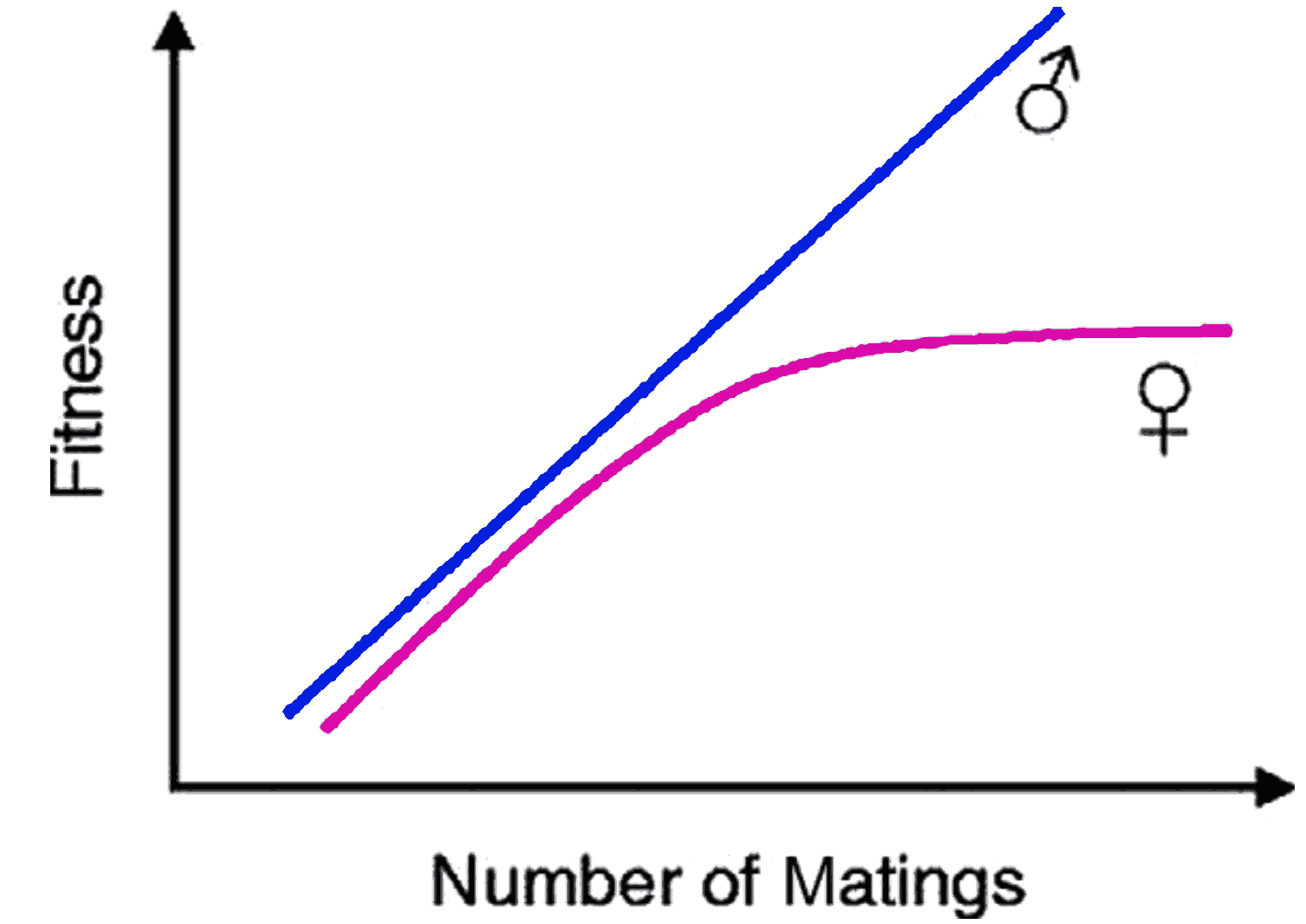
The Bateman gradients for males and females. Women have lowers potential reproductive rate compared to men. Men can increase their reproductive rate and fitness by mating with more women (as they can rapidly produce many sperm) while women are restricted by the time it takes to produce each egg. Thus, women reach a threshold when more matings will not increase the number of offspring produced.
We used to believe mating was monogamous and fully cooperative…
Originally, mating was seen as cooperative, based on monogamy and shared reproductive interests (Darwin, 1871).
In the 1970s, Trivers highlighted differing parental investment interests, and Parker expanded on the evolutionary roots of sexual conflict.
In the 1990s, Holland & Rice introduced sexually antagonistic coevolution, sparking experimental research.
Molecular studies later confirmed frequent extra-pair copulations and partner-harming reproductive traits, solidifying sexual conflict as a central concept in evolutionary biology.
Today, the theory of sexual conflict is widely accepted and cooperation is seen as only one extreme along a gradient from mostly cooperation to mostly conflict between the sexes.
Two Types of Sexual Conflict:
- Intralocus Sexual Conflict: Same gene, affecting males and females differently (typically morphological, physiological, or hormonal)
Occurs when the same genes influence traits in both sexes but optimal trait values differ for males and females (e.g: increases male fitness but might reduce female fitness, and vice versa). This creates a genetic “tug-of-war” that limits how well each sex can evolve toward its fitness optimum, reaching a compromise- 👉🏼 Sex-limited gene expression may sidestep the compromise adn bot sexes volve traits toward their phenotypic fitness optima (Cox & Calsbeek, 2009; Ellegren & Parsch, 2007; Rice, 1984)
- Example: red bill coloration improves male zebra finch mating success but harms female viability (Price & Burley, 1994).
- Interlocus Sexual Conflict: Different genes in males vs. females (often behavioral like mate guarding, female evasion, extra pair copulation, etc.)
Arises from direct male–female interactions where traits that benefit one sex harm the other, leading to antagonistic coevolution (an evolutionary arms race)- Example: male seminal proteins that suppress female remating vs. female resistance traits (Chapman, 2006; Holland & Rice, 1998).
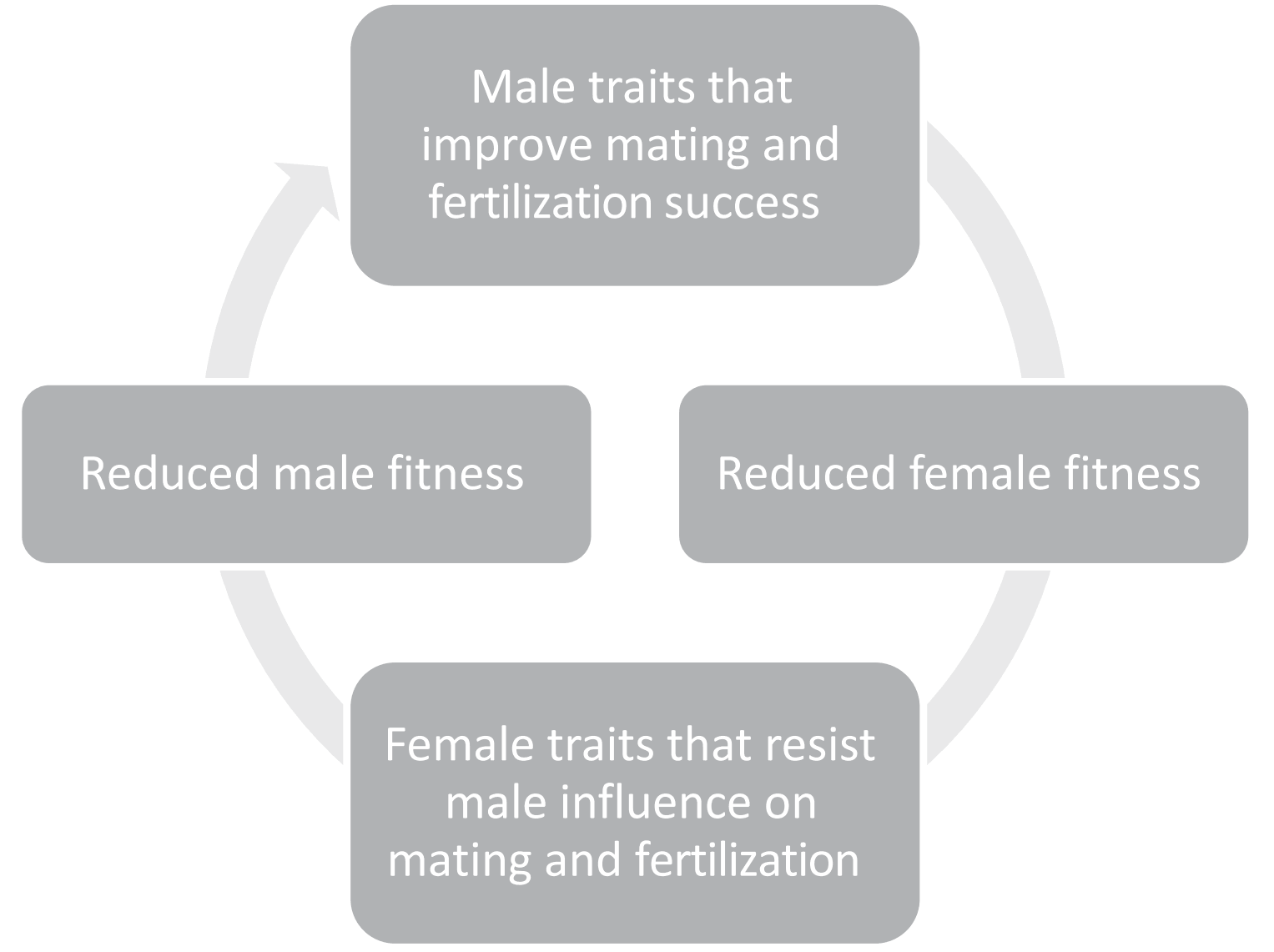
Sexual conflict drives an evolutionary arms race: males evolve traits to boost fertilization success, females counter to avoid unwanted mates, leading to ongoing coevolution.
Battlegrounds of Sexual Conflict
- Male persistence vs. female resistance over mating decisions. Males evolve tactics to overcome female reluctance—like harassment, forced copulation, sneaky mating, or exploiting sensory biases—while females evolve ways to avoid or resist these tactics.
- Male tactics to win fertilization inside the female. Males may guard mates, use toxic seminal fluid, insert mating plugs, or physically harm females to prevent remating. Females counter with cryptic choice: ejecting sperm, selective storage, or immune rejection.
- Males chemically alter female behavior or fertility. Seminal proteins can reduce female receptivity or fecundity. Females may evolve resistance to these manipulations, creating a molecular arms race.
- Parents battle over who invests more in offspring. Since care is costly, each sex tries to offload effort onto the other. This results in manipulative behaviors like hormone deposition, care withholding, or even destruction of the partner’s other broods.
- Ongoing conflict through offspring investment. Females may abort offspring from undesirable males. Males may commit infanticide to induce females to reproduce again. Conflict persists even after mating is “over.”
Sexual Conflict is Unlikely to Be Fully Resolved
Interlocus sexual conflict could be resolved if the evolutionary fitness interests of the two sexes become aligned. This requires monogamy, with the two partners entirely dependent on each other. However, strict monogamy is uncommon and perfect alignment of interests is thus unlikely to be achieved in most mating systems.
Intralocus conflict can be resolved when males and females evolve distinct genetic controls over shared traits, such as sex-specific gene expression or dominance.
For example, Atlantic salmon use sex-dependent dominance to mature differently. However, interlocus conflict and genetic correlations can limit this resolution, so how often sexual conflict is fully resolved in nature remains unclear.
The direction of sexual conflict also depends on the environment, which shapes the intensity of sexual conflict.
Factors like temperature, food, density, or habitat complexity modulate costs of mating, male harm, or female resistance—altering the evolutionary dynamics of conflict.
Chapter 13: Cross‐Species Comparisons
Escobar, Arcediano, Bell, and Truax champion the value of comparing sexual psychology across taxa.
By examining mating systems in birds, fishes, and mammals, they tease apart which features of human mating are uniquely human versus shared ancestral traits.
They show, for instance, that pair‐bonding, sexual size dimorphism, and cooperative breeding each co‐vary with ecological variables.
Chapter 14: Cross‐Cultural Methods in Sexual Psychology
Butovskaya addresses the challenges and rewards of studying sexuality across human cultures. She outlines methods—from ethnographic observation to standardized surveys (e.g., the Sexual Strategies Scale)—and discusses sampling, translation, and ethical considerations. By pooling data from over 50 societies, cross‐cultural work isolates universal features of sexual psychology (e.g., jealousy triggers) from cultural inventions (e.g., arranged marriage norms).
- Passionate love is typical of individualistic societies: Whereas passionate love (intense and arousing) is emphasized in individualistic cultures, companionate love (tender and affective) is praised in collectivistic cultures (Feybesse & Hatfield, 2019)
- Eastern cultures emphasize financial prospects (Thomas et al., 2020, p. 17)
- Collectivistic societies had higher levels of marital satisfaction, providing evidence for collectivistic values as favorable for a satisfactory marriage (Dobrowolska et al., 2020)
- Passion is highest in short relationships, but commitment is highest in longer relationships: Level of passion was highest for the shortest relationship duration, and lowest for the longest duration. Up to one year couples had lower commitment, which gradually increased with duration (Sorokowski et al., 2021, p. 112)
- Even height preferences are culturally flexible: in societies with free mate choice, people tend to prefer taller men (and this preference aligns with actual partner height), while in more polygynous or arranged-marriage societies, this preference is weaker or absent, showing height preferences vary with social and cultural context (Fink, Neave, Brewer, & Pawlowski, 2007; Pawlowski, 2003; Sorokowski & Butovskaya, 2012; Sorokowski et al., 2015; Stulp et al., 2013).
Read more in ‘exceptions and dating success‘
In general, the author rightly claims that we need more intercultural studies, and some more surprises may be in store.
For example, while Western men could assess grip strength from gait, Maasai people found physically stronger walkers to be weaker (Fink et al., 2017a, 2017b, 2019).
Chapter 15: Behavioral Genetics
Luoto and Woodley of Menie delve into genetics of sexual traits—mate preferences, sociosexual orientation, sexual orientation. Using twin, adoption, and GWAS studies, they estimate substantial heritabilities (often 30–50%) on mating‐related traits.
They also discuss gene–environment interplay, and highlight that genetic influence does not imply immutability.
- Love and pair bonding are parts of a broad reproductive strategy of long-term attachment, influenced by basic reward circuitry and genetic factors (Acevedo et al., 2020; Bode & Kushnick, 2021; Luoto et al., 2019a)
Top 10 Replicated Findings From Behavioral Genetics
1. Most psychological traits are partly genetic.
Genes significantly influence traits like personality, intelligence, and mental health.
2. No trait is 100% genetic.
Even traits with high heritability—like height or executive function—are still shaped by environment.
3. Many small genetic effects matter.
Traits are influenced by many genes, each with a small impact.
4. Links between traits are often genetic.
When traits go together (e.g. anxiety and depression), it’s often because they share genetic roots.
5. Intelligence becomes more heritable with age.
Genes play a larger role in intelligence as people grow up (the Wilson effect), but this may reverse in old age.
6. Long-term stability is mostly genetic.
When traits stay the same over time, it’s mostly due to the same genes continuing to have an effect.
7. Even environments are partly genetic.
People shape their environments in ways that reflect their genetic tendencies (e.g. choosing stimulating settings).
8. Genes influence how we interact with environments.
We don’t just passively receive experiences—we seek out or create environments that match our genetic inclinations.
9. Siblings experience different environments.
The most influential environmental effects are unique to each individual, even in the same family.
10. Mental disorders are extreme versions of normal traits.
Disorders aren’t categorically different—they reflect the extreme ends of the same genetic influences seen in everyone.
Chapter 16: Sex Differences and Sex Similarities
Engelbrecht and Edlund synthesize decades of research on male–female psychological differences.
They emphasize both overlapping distributions (e.g., general intelligence) and moderate, replicable gaps (e.g., spatial rotation favors males; empathy favors females).
To summarize the authors’ take:
Are men and women more similar than they are different?
The answer is, in some ways, yes. The common challenges of mating and reproduction have created mutual preferences for (mostly) monogamous mating, and partners who are healthy, kind, and intelligent.
(…) However, there are clear and obvious differences in sexual psychology arising from the different stakes held in the reproductive process by men and women.
Noteworthy Findings
- Femininity is associated with lower desired partners: men’s and women’s scores on femininity were associated with lower numbers of desired partners (Tate, 2011)
- Testosterone plus personality are both associated with number of desired partners: levels of testosterone are associated with men’s and women’s desires for the number of sexual partners desired as well as measures of personality (Puts et al., 2015)
- New relationships and partner choices are emerging
- People still prefer monogamy, but new relationships are emerging: Consensual nonmonogamy (and polyamory in particular) allows participants to engage in multiple sexual and/or romantic relationships simultaneously, representing a more ethical approach to pluralistic mating strategies (Mogilski, Memering, Welling, & Shackelford, 2017).
- Coparenting: while only for gay in the past, a small number of straight men and women now opt for this family model as well, and the mate selection may be more based on parenting qualities
- Sperm donation: Research on selection criteria for donor sperm already suggests differing mate preferences when reproduction is the only thing on the table. Whyte and Torgler (2015) noted that women rate psychological qualities such as character highly, even beyond physical characteristics like attractiveness. Resources are less important, and similarity of looks matters more to younger mothers than older ones
- ❓ Fertile women are more attracted to sexier men, whereas women who are in the nonfertile phase of their cycle are particularly attracted to men who show signs of being good fathers. This happens entirely within the context of the relative value of the mate that the woman has as a primary partner (if their partner is high quality, they are especially attracted to them during the luteal phase; Shimoda, Campbell, & Barton, 2018) <— 🙋🏼♂️ Lucio’s note: caution here, based on the latest Oxford Handbook these findings related to dual sexuality and ovulatory shift are mixed and the effects rather mild
Women’s Preferences Don’t Change Much With Equality
The author says that sex differences in mate preferences don’t seem to be influenced by economic and cultural conditions, and points to availability and preference for resources as an example:
For instance, Wood and Eagly (2002) have suggested that women’s preferences for resources are driven by their own relative inability to obtain resources themselves.
This approach would suggest that the difference between men and women would disappear once society did not consistently have women earning less than men. However, recent research (Zhang et al., 2019) debunked this explanation by showing that there were no meaningful differences between samples collected in countries with high and low levels of gender equality
However, little later, the author acknowledges that it does make at least some difference:
Increased equality and economic opportunities for women has an effect on this (Eagly & Wood, 1999), but a regression analysis by Zentner and Eagly (2015) suggests that women would need to earn far more than men in a society for the difference in preference to be eliminated.
I’d note that the difference doesn’t need to be eliminated to have a major impact.
And I’d be careful here to distinguish preference vs. behavior:
🙋🏼♂️ Lucio’s note: preference doesn’t always translate into behavior. Distributed resources still likely have important impacts
Of course the preference remains that of the handsome, wealthy, dominant, but deeply in love with her.
But I’d argue that even if the preference doesn’t go away, the behavior changes. Smaller need for resources may still change dating dynamics and behavior.
For example, we may see more women as breadwinners, more women with younger and attractive but poorer men, and fewer women who ‘mate switch’ based on resources
🙋🏼♂️ Lucio’s Overview: Studies on Men vs Women’s Receptivity to Casual Sex
Drawing both from this handbook and from previous handbooks, here’s a summary and overview:
- Clark & Hatfield (1989): huge gender differences
Found a large sex difference in receptivity to casual sex—75% of men agreed to sex with a stranger vs. 0% of women. Equal numbers agreed to a date. Interpreted through Parental Investment Theory: men gain more from multiple partners, while women face higher reproductive costs. - Voracek et al. (2005): smaller difference
Partial replication in Germany with older participants and more varied public settings. Women were more receptive than in the original study, suggesting that context (age, culture, location) can moderate the sex difference—though men were still more receptive overall. - Baranowski & Hecht (2015): addressing safety concerns lead to an even smaller difference still
Replicated the effect in a more naturalistic, party-like setting. Women were significantly more willing to agree to casual sex when the setting felt safer, but men continued to be more likely to accept all types of offers. - Schützwohl et al. (2009): requestor’s attractiveness makes a difference
Found that the requestor’s attractiveness significantly influenced receptivity, especially for women. Men’s already-high baseline left less room for change, while women’s responses varied more with partner traits. - Edlund et al. (2021): requestor’s attractiveness makes a difference 2
Confirmed that attractiveness had the strongest effect on women’s willingness. Sexual orientation didn’t significantly alter receptivity. Again, men remained more consistently open to casual sex.
These findings, combined with hormonal and evolutionary evidence (e.g., testosterone levels, Parental Investment Theory, and the Sexy Son Hypothesis), support the conclusion that men are generally more open to casual sex, but that this difference is flexible and moderated by context, safety, and partner quality.
Chapter 17: Individual Differences in Sexual Psychology
Figueredo and Salmon show that variation in mating psychology is not just between sexes but within them.
Some individuals adopt more unrestricted, short‐term mating strategies; others favor restricted, committed approaches.
They link this variation to personality (Big Five traits), life history (fast–slow), attachment styles, and environmental cues—illustrating how plasticity and strategy diversity are themselves evolved adaptations.
Life History And Deception
Variation in life history (LH) strategies plays a key role in individual differences in sexual psychology.
Cognitive sexual schemata range from convergent-interest strategies, where males see their reproductive interests as aligned with females’, to divergent-interest strategies, where these interests are viewed as conflicting (Malamuth, 1996).
Slow LH strategists are convergent-interest schemata favoring long-term relationships and cooperative biparental care, while fast LH strategists lean toward divergent-interest schemata, which are less compatible with long-term parenting (Malamuth, 1998).
In simpler words, this means that short-term fast life history strategies are inherently less long-term cooperative. It’s not a stretch to think they may be more antagonistic, win-lose and potentially predatory and deceptive.
Figueredo and Jacobs (2010) expanded this model to social behavior, suggesting slow LH strategists prefer mutualistic social strategies based on reciprocal altruism with kin, nonkin, romantic partners, and offspring. These slow LH strategists favor stable, long-term cooperative relationships typical of predictable environments.
Fast LH strategists adopt antagonistic social strategies (Brumbach, Figueredo, & Ellis, 2009; Brumbach, Walsh, & Figueredo, 2007; Ellis, Figueredo, Brumbach, & Schlomer, 2009).
Mate Value
Mate value refers to traits that make individuals attractive as partners (e.g., physical attractiveness, resources, parenting ability, status).
People with higher mate value tend to secure higher-value partners, especially in long-term relationships (Buss, 2002; Schmitt, 2003).
In short-term mating, the dynamics are different:
- Lower mate value women can sometimes access higher mate value men for casual sex.
- But lower mate value men are often excluded entirely from short-term mating opportunities (Van Straaten et al., 2009).
People tend to adjust their mating strategies based on their own perceived mate value (Kirkpatrick & Ellis, 2006). For example, attractive women show stronger preferences for masculine and high-status traits in men, especially in long-term contexts (Feinberg et al., 2006; Buss & Shackelford, 2008).
For females and short-term mating, the evidence is mixed:
- Some studies find no clear link between a woman’s mate value and her pursuit of short-term sex (Mikach & Bailey, 1999).
- ⁉️ Others show that physically attractive women (e.g., with ideal waist-to-hip ratios) are more likely to engage in unrestricted sociosexual behavior (Brewer & Archer, 2007). <— 🙋🏼♂️ Lucio’s note: I’ve seen other sources claim that lower mate value women engaged in more casual sex while higher mate value women pair up with high status men, which makes more logical sense. I only read the abstract of that study, but there may be a mixup. The study referred to facial attractiveness, and the unrestricted sociosexuality was inferred by the raters, which isn’t enough to claim that attractive women are more unrestricted. I’d encourage the authors to double-check that
Perceived mate value also plays a role:
- Women who experience rejection lower their standards and become less choosy. <— 🙋🏼♂️ Lucio’s note: this means more unrestricted and open to casual sex
- Conversely, being accepted boosts a woman’s self-assessed mate value and makes her more likely to pursue high mate value men and seek long-term commitment (Reeve et al., 2017). <— 🙋🏼♂️ Lucio’s note: same here, confirms the trend I was expecting
Mate value also influences sexual behavior:
- High mate value men report more sexual partners, earlier sexual debut, and greater success in short-term mating (Landolt et al., 1995; Clark, 2006; Perusse, 1993).
- High-status or wealthy men tend to marry younger, more attractive women—a pattern seen both historically and today (Betzig, 1992; Conroy-Beam & Buss, 2019).
- Low-status men, by contrast, struggle more in both long- and short-term mating markets and often need to lower their standards.
Additionally, mate value affects mate retention:
- High mate value men use more benefit-providing strategies (e.g., affection, gifts) and fewer cost-inflicting ones (e.g., jealousy, control) to retain partners (Miner et al., 2009).
For more practical takeaways, also check our articles:
- Mate value: a practical overview
- Mate value environmental contingencies (& related mate value ‘hacks’)
- Sexual market value: dynamics of dating
Dark Triad, Psychopathy, & Coercion
Life history (LH) theory helps explain the dark side of sexual behavior.
Individuals with a fast LH strategy—linked to traits like psychopathy and the Dark Triad—tend to pursue exploitative and coercive short-term sexual strategies.
Indeed, research has suggested that coercive sexuality is a fundamental component of psychopathy (e.g., Harris, Rice, Hilton, Lalumière, & Quinsey, 2007).
In fact, the best predictor of sexual coercion was predicted by this higher-order Dark Triad factor.
Sociosexuality Components
Sociosexuality was originally viewed as a single dimension (casual vs. committed), but newer research divides it into two separate orientations: short-term and long-term.
These two orientations are somewhat independent but have also been combined into a single higher-order factor to predict behaviors like partner violence and aggression.
Slow LH strategists (those who invest more in long-term planning and relationships) are generally less oriented toward short-term mating and more toward long-term mating. However, newer data suggest that slow LH individuals may integrate both short- and long-term mating strategies more flexibly.
This means that for slow LH individuals, these strategies are less mutually exclusive, allowing for greater adaptability in their mating behavior.
Chapter 18: Experimental Methods in Sexual Psychology
Fitzgerald and Thompson close Volume 1 with a practical guide to experimental design in sexual psychology.
Interesting findings:
- Anxiously attached individuals perceived ambiguous partner behavior to indicate infidelity
- Avoidant individuals perceived these ambiguous behaviors as less likely to indicate infidelity
SHARPEST INSIGHTS
These are the insights that struck us the most.
We use the authors’ quotes and research, but the titles and interpretations are our own—and may not reflect the authors’ intent.
Credit for the insight goes to them; blame for the interpretation is on us.
Culture of Honors Develop to Control Women’s Sexuality
Atari, citing Shackelford (2005), writes:
behaviors defined as indicators of a culture of honor, such as male aggression to punish sexual transgressions, might be the output of psychological mechanisms that evolved in response to the adaptive problem of mate retention
Supporting this idea, Atari et al. (2020) found that in Iran – a classic “culture of honor” – values around honor strongly correlate with both protective and punitive mate retention behaviors. These values emphasize men’s duty to guard female kin and punish women’s sexual transgressions, sometimes even by targeting the women themselves.
🙋🏼♂️ Lucio’s note: I considered cultures of honors in this light even before I got deeper into evolutionary psychology: sexual control, and status-promotion.
But the sexual part is likely stronger than the respect/status part.
Similar evidence comes from more female repressive customs like forcing women to use a veil.
Writes Butovskaya:
The study by Pazhoohi and Kingstone in twenty-five countries demonstrates that veiling promotes sexual
fidelity in women (Pazhoohi & Kingstone, 2020).
Veiling is a male mateguarding strategy used to secure male reproductive success.
Men support veiling more than women, and this male mate-guarding strategy was more evident in harsher environments, with higher mortality rates, where paternal care may be more important for infant survival.
However, veiling is not always and necessarily imposed.
Continues Butovskaya:
(…) although Islamic men are more supportive of veiling than are women, in general both sexes are more likely to support the veiling tradition when their reproductive interests are more male-centric (i.e., sons are more desirable) (Blake et al., 2018).
Short-Term & Uncommitted Mating Is Inherently More Conflictual
Candolin only indirectly suggests so when she writes that monogamy best merges the interests of both sexes:
Interlocus sexual conflict could be resolved if the evolutionary fitness interests of the two sexes become aligned. This requires monogamy, with the two partners entirely dependent on each other. However, strict monogamy is uncommon and perfect alignment of interests is thus unlikely to be achieved in most mating systems.
However, it seems a logical next step to me that uncommitted and short-term sex has a larger scope for conflicting interests and, potentially, for manipulation and deception.
Dads vs. Cads (relationship types vs players)
Evolutionary game theory models, inspired by Hawk–Dove dynamics, describe two male mating strategies: “Dads,” who provide parental care, and “Cads,” who do not (Maynard Smith, 1982; Alger et al., 2020).
These strategies coexist in dynamic equilibrium influenced by ecological conditions that favor or disfavor paternal provisioning.
Empirical support for these categories comes from social perceptions, where “Dads” and “Cads” correspond to “Proper” and “Dark” heroes in British Romantic literature, with women preferring “Proper” heroes for long-term and “Dark” heroes for short-term relationships (Kruger, Fisher, & Jobling, 2003).
The models assume that tendencies toward these phenotypes are genetically determined, though this is a theoretical assumption, not an empirical finding.
Research shows men generally score higher on the Sociosexual Orientation Inventory (SOI) than women, reflecting greater average openness to casual sex, though there is substantial variation within each sex (Clark, 2006; Schmitt, 2005).
Both genetic and environmental factors influence sociosexuality. A twin study found sociosexuality to be moderately heritable (about 49%) with a significant role for unique environmental influences (Bailey et al., 2000).
Additionally, unrestricted sociosexuality correlates genetically with sexual coercion (Westerlund et al., 2010). Dark Triad personality traits (narcissism, psychopathy, Machiavellianism), linked to short-term, exploitative mating strategies, also show genetic and environmental influences (Jonason et al., 2009; Schermer & Jones, 2020).
🙋🏼♂️ Lucio’s note: the ‘cad approach’ may come with a specific set of psychological and behavioral adaptations
Including avoidant attachment style, Cooldige effect and higher dominance motivation.
Also see our article on ‘cad psychology‘:
For more practical applications, see our articles:
Sociosexual Orientation: One Can Be High In Both Casual Sex and Relationship Motivations
In chapter 10 Figueredo and Peñaherrera‐Aguirre explain the evolution of sociosexual orientation measurements.
The Sociosexual Orientation Inventory (SOI) originally measured openness to casual sex as a single trait (Gangestad & Simpson, 1990), but later research split it into two dimensions: short-term mating (STM) and long-term mating (LTM) orientations (Jackson & Kirkpatrick, 2007).
Though these two tend to correlate negatively (around r = –0.30), studies show they have distinct patterns of association with other traits—supporting their partial independence (Simpson et al., 2004).
Some researchers recombine STM and LTM into a single factor when predicting broad outcomes like partner violence (Figueredo et al., 2018), while others keep them separate to explore more specific traits like emotional intelligence or executive function (Figueredo et al., 2012).
Father Absence Promotes Fast Life Strategies (Casual Sex)
It’s been proposed that girls raised without their biological father tend to mature sexually earlier, start having sex sooner, have more partners, and get pregnant at a younger age than those with present fathers (Anderson, 2015; Ellis et al., 2003; Quinlan, 2003; Salmon, Townsend, & Hehman, 2016).
A 2014 meta-analysis confirmed that father absence is linked to earlier puberty (Webster, Graber, Gesselman, Crosier, & Schember, 2014).
More recent research suggests that it’s not just presence or absence, but also the quality and amount of paternal investment matters in shaping girls’ sexual development and behavior (DelPriore, Schlomer, & Ellis, 2017; Ellis et al., 2012).
And a role for behavioral genetics has also been proposed (Mustanski, Viken, Kaprio, Pulkkinen, & Rose, 2004; Schlomer & Cho, 2017), with mathematical models suggesting genetic confounding (Barbaro, Boutwell, Barnes, & Shackelford, 2017).
However, ultimately, father presence or absence does seem to make a big difference:
However, in an empirical test of the genetic confounding hypothesis (i.e., gene–environment correlations cause spurious relationships between father absence and females’ age at menarche and first birth), Gaydosh, Belsky, Domingue, Boardman, and Harris (2017) used molecular-genetic data and found that father absence and polygenic scores independently predicted reproductive timing. This suggests that (at least for females) father absence, as an index of stressful childhood environments, explains unique variance in sexual behaviors beyond genetic inheritance.
There Is A Link Between IPV & Cuckoldry
This may be an uncomfortable finding and obviously it doesn’t justify violence in any way, and we must be careful not ‘victim blame’ with it.
But cuckoldry, whether real or imagined, seems to be an important element of intimate partner violence and forced copulation:
Men who report sexually coercing their regular partner also report greater suspicion of her extra-pair copulation (EPC), and women who report a greater likelihood of pursuing EPCs also report that their regular partner is more sexually coercive (Arnocky, Sunderani, Gomes, & Vaillancourt, 2015; Goetz & Shackelford, 2006, 2009).
Among men convicted of physically assaulting their regular partner, those who performed forced intimate partner copulation (IPCs) – relative to those who did not perform forced IPCs – experienced greater cuckoldry risk events prior to the assault (Camilleri & Quinsey, 2009). Men at greater objective sperm competition risk are more likely to perform forced IPCs, but only those men who perceive a greater likelihood of their partner’s EPC (McKibbin, Starratt, Shackelford, & Goetz, 2011; reviewed in Goetz, Shackelford, & Camilleri, 2008).
QUOTES
On survival meaning nothing from an evolutionary point of view if without reproduction:
if an animal lives but does not reproduce, it may as well not have bothered, at least from an evolutionary standpoint
On humans losing to tardigrates unless we’re careful:
the human brain has enabled one species of apes to conquer the Earth and possibly also other parts of the solar system or the universe. However, the same brain has allowed the ape to construct hydrogen bombs that could destroy a large part of the Earth’s biosphere, including its own species. Due to SBS, the winners of the evolutionary battle could be resilient, undemanding organisms without such “progressive” brains (e.g., tardigrades), and such organisms might prevail on the Earth and most planets in the universe.
On pop psychology books:
One of the most popular “pop” psychology books of all time, Men Are from Mars, Women Are from Venus (Gray, 1992), focused on differences between men (…)
Looking at selected pop psychology books and ancient civilizations is not the best way to understand the differences and similarities between men and women – instead, we need to turn to scientific evidence
REVIEW
The Cambridge Handbook of Evolutionary Perspectives on Sexual Psychology serves as a solid and research-driven foundation for the follow-up volumes.
It offers a valuable introduction to the evolutionary study of sexual behavior and conflict.
While a few areas could benefit from refinement—such as clearer acknowledgment of ongoing debates (e.g., sperm competition, ovulatory shifts), and some closer alignment between cited studies and the interpretations—these are minor in the context of the book’s overall quality.
From an editing perspective and ease of learning, some chapters may be streamlined by reducing overlap across topics or condensing them into a single chapter (eg.: sperm competition, dark triad/life history strategies).
That said, this is an authoritative textbook tackling a complex subject, and it succeeds in laying the groundwork for the adaptations explored in volumes 2 and 3.
I came away with new insights and I could improve several articles on our site as a result—that’s always the biggest compliment I can pay to any resource.
I’m grateful to the editors and contributors 🙏🏼, and I look forward to delving into volumes 2 and volume 3.
Check the best evolutionary psychology books or get this book on Amazon.


