Why is The 48 Laws of Power so popular—and why has it stayed famous for decades, despite its flaws?
While the book is an undeniable masterpiece of storytelling and provides a necessary wake-up call to the reality of power, it also suffers from questionable morality, weak evidence, and limited real-world effectiveness.
In this guide, I break down the real psychological, marketing, and audience-fit reasons behind the book’s massive success. We’ll look beyond the hype to understand what actually drives the popularity of The 48 Laws of Power.
Let’s dive in.
👉🏼 For our broad overview on the book, see: 48 Laws of Power guide
Intro
Some time ago, I was asked why The 48 Laws of Power is so popular in The Power Moves community:

Asker: Why do people hype this book so much (despite) how impractical it is in terms of real-life implementation
It’s a great question.
To be fair, as the asker also acknowledges, The 48 Laws is one of the best ‘gateway’ books ever written. It shatters the ‘nice guy’ delusion like few other books do, which is a mandatory first step for any high achiever.
Yet, it’s not nearly as effective in delivering skills, mindsets, and real-life outcomes.
Why is it so popular, then?
This is why The 48 Laws became and remained so popular:
1. Authority-Hijacking: Messianic Laws, Dogmatic Absolutes, & Historical Name Dropping
Robert Greene is a brilliant writer, and the 48 Laws of Power is as captivating as it is engineered for signaling authority with:
- Messianic ‘laws’
- Dogmatic absolutes
- Categorical imperatives
- Historical name-dropping
- Aesthetics of book cover & content
Let’s review them:
Laws Format Signal Highest, Quasy-Divine Authority
The “laws” format is memorable and psychologically effective for signaling unquestionable authority, similar to inescapable physics laws like ‘law of gravity’.
There may also be an element of the human psyche tapped by the format of ‘lists of laws’, similar to religious commandments: sacred, immutable… And a clear path to salvation.
Also read:
- Teacher frames
- Authority signaling: Andrew Huberman case study
Categorical Imperatives
Categorical imperatives support the ‘laws format’ to signal the highest confidence.
High confidence can enhance credibility in certain audiences because people assume competence from confidence (Schnaubert et al., 2021; Cialdini, 1984).
In the book, just between the laws’ titles and the initial descriptions, the words ‘always’ and ‘never’ appear twenty-six times.
This is illusion of certainty can come at the cost of accuracy. Despite often being less correct, simplistic dogmas often outsell more nuanced but more correct principles:
| Dogma (what sells) | Principles, models & calibration (what’s true) |
|---|---|
| Say less than necessary | Babble hypothesis: Speaking time correlates with leadership emergence and social influence (MacLaren, 2020), but if you have leverage you can use silence to signal power |
| Never Appear Too Perfect | Pratfall effect: a mistake can increase liking (Aronson, 1966) and prevent ‘frenemies‘, but appearing perfect can awe followers and discourage opponents |
| Let Others Do the Work, but Always Take the Credit | Social Exchange Theory: Credit stealing may work with powerless followers or in short-term contexts, but as a ‘take’ it costs in engagement, talent retention, and long-term output |
The ‘real’ principles are not catchy and memorable. On the upside, once understood, they allow for more effective calibration and yield better results.
Historical Name Dropping

Ancient quotes and references of people you’ve never heard of are powerful ‘persuasion power moves’.
They serve as:
- Authority-borrowing from arcane ancient thinkers
- Frame the author as higher authority than the reader whenever the readers never heard of the source (covert power move, ie. ‘I know more than you’)
When readers tacitly accept that frame, they will automatically trust the ‘more knowledgeable source’.
Of course, quoting ancient Roman authors is unrelated to expertise in advanced social and power dynamics—but few make that connection.
2. Marketing Positioning: Dark Psychology Manual on “How to Be Bad (& Win)”
Most self-help ignores power dynamics and provided the book with the perfect backdrop of ‘politically correct but weak half-truths’.
Of the few books that dealt with power dynamics, none ever used an offensive-only perspective.
That provided a blue-ocean market for a bold contrarian play that positions itself as a power-focused, politically incorrect, ‘harsh but true’ manual on ‘how to be bad (and win)’.
Greene delivered it.
Read more:
- Dark psychology: what it truly is (and what isn’t)
- Naive self-help
The ‘Anti Too-Nice-Guy’ Positioning
The 48 Laws is the polar opposite, and cure, of men’s fear: the ‘too nice guy’ that’s taken advantage of, and fails in life.
Where the nice guy is powerless, The 48 Laws promises a guide for unapologetic dominance—’bad’ but effective (or so suggests the marketing positioning).
Greene followed his law of ‘Enter Action with Boldness’ and went all in with a purely offensive manual.
With great prose, valid insights, and the authority-building tactics above, it was a shark-level entrance that conquered this new market.
Note: marketing positioning ≠ ‘truth’ and ≠ results
The book was a needed ‘over-correction’ from standard self-help, providing a much-needed rupture and wake-up call.
Yet, some ‘laws’ are scientifically disproven. And offensive tactics alone under-deliver in a social species where personal value and smart cooperation are foundational to success.
More Evil, More Sales: Antifragile Against Criticism
Given the positioning as ‘evil but true’, critics pointing to the amorality of the laws only helped its sales.
The critics self-framed as ‘too nice guy’, and the wannabe power-players flocked to buy and proselytize.
This is why people hype it up. Praise sub-communicates high power, and criticism sub-communicates low-power ‘too nice guy’.
| Public review | 📣 Sub-communication |
|---|---|
| 🗨️ The 48 Laws of Power is amazing | 📣 🟰 I’m a power player, I deal with reality to achieve goals |
| 🗨️ The 48 Laws of Power sucks | 📣 🟰 I’m a too nice guy, I can’t stomach reality |
This dynamic may have discouraged some critics from speaking up — a pattern consistent with the spiral of silence described in sociology (Noelle-Neumann, 1974).
The Prison Ban Marketing Hack
No book is as far from being ‘banned’ as a best-seller available at your local bookstore.
Yet, The 48 Laws of Power marketing benefited from some US state prisons banning it, gaining extra reputation as a ‘dangerous’ book, an offensive weapon to keep hidden from predators.
Although some laws may handicap an unsophisticated reader as much as they could help, that was the best marketing gift it could get. It cemented its position as a forbidden fruit. And forbidden fruits are supremely seductive, as Greene himself would have written.
3. From Niche Appeal to Mass Market: Power Signaling
As per Moore’s take (1991) on the Diffusion of Innovations Theory, to ‘cross the chasm’ from early adopters to mass market, one has to dominate a niche first, and then move to the majority with a well-rounded product.
That’s what The 48 Laws of Power did.
In certain environments, value signaling isn’t about projecting “goodness,” but about projecting ruthlessness, cunning, and dominance to gain status. This is why rap culture, in particular, embraced Greene’s work—the biggest dominant force in the contrarian space of ‘book for bad guys’.
It wasn’t necessarily as an endorsement of how well it worked, but a Machiavellian signal.
🙋♂️Lucio’s Take: Feminist power-signaling parallel

Lucio:
Similarly, I’ve seen women conspicuously display a copy of ‘Why Men Love Bitches‘, a book advocating for women’s empowered dating.
The book doesn’t necessarily help them date better, and it may even decrease the odds of finding a high-quality partner, but it serves as power-signaling (and self-signaling).
In my experience, at least for women, it’s sometimes hurt people who swing to the more dominant/antagonist side. That signals neediness and relationship failure, rather than power and independence.
Tipping Point & Social Proof
The antifragile marketing and a product designed for easy consumption (point #4) pushed the book past the tipping point of the mass market, where many uncritically ‘join the social bandwagon’ (Leibenstein, 1950).
4. Cognitive Targeting: The ‘IQ Sweetspot’ (Best-Seller Quality Tradeoff™)
The Best-Seller Quality Tradeoff™ is the phenomenon where achieving mass-market success forces authors to simplify, generalize, or entertain at the expense of depth, nuance, and calibration. It posits a necessary trade-off between realistic complexity and the narrative simplicity required to appeal to the majority (the ‘fat portion’ of the distribution curve).
The 48 Laws is both masterfully written and written to be a best-seller.
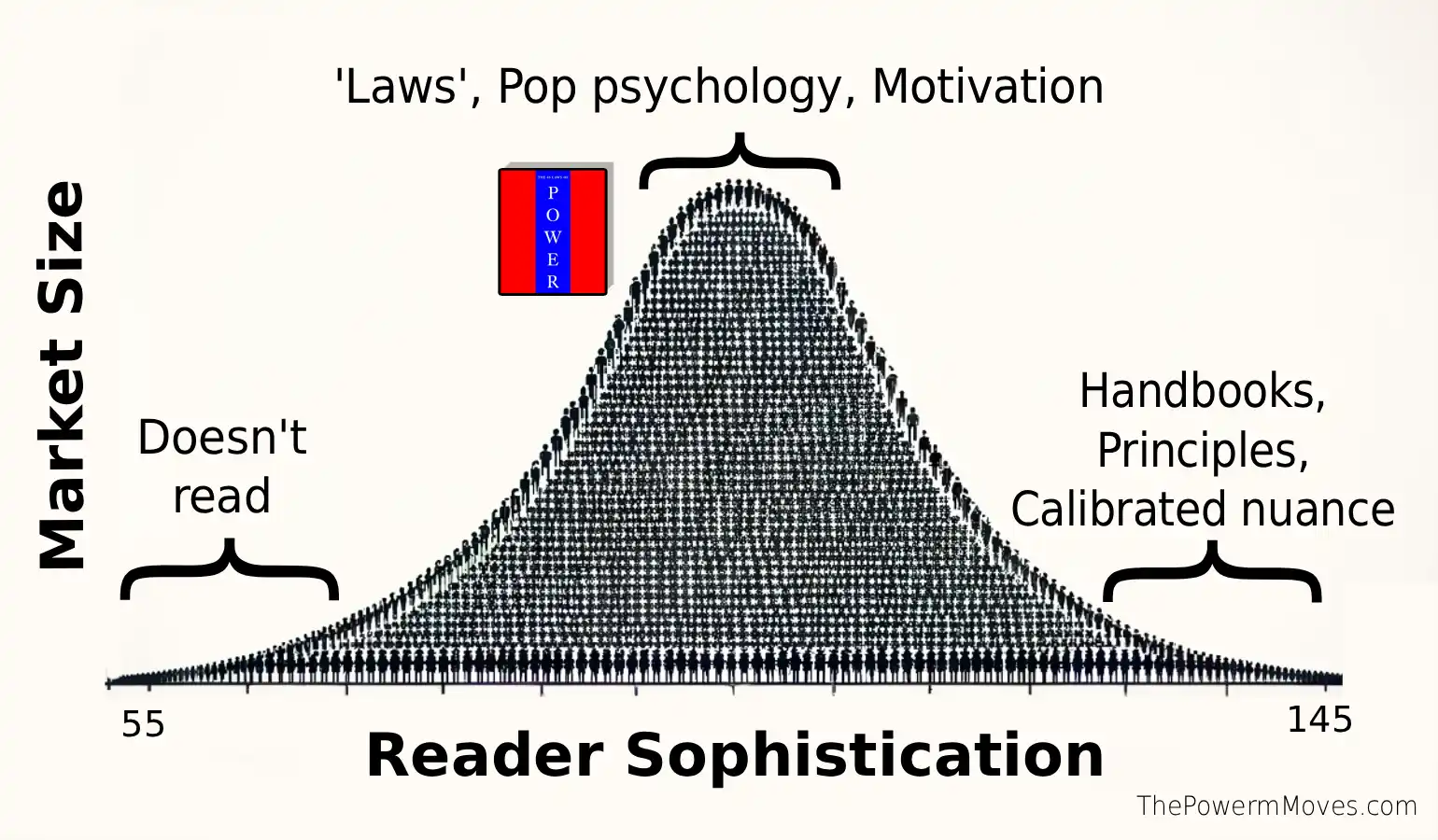
The 48 Laws’ ease of consumption well satisfies the larger middle of the bell curve.
For example:
Captivating Storytelling
The stories are certainly useful to understand the concept, but they prioritize entertainment value over analytical soundness.
Memorability Over Applicability
The laws seldom map onto deeper underlying power principles, but they’re memorable.
Same for the advice: it’s at times insightful for many, yet simple, prioritizing memorability over applicability (some may even say it’s simplistic).
Scannability
The page layouts are approachable and easy to scan, with different fonts, colors, and large spaces:

The layout is approachable even to those who don’t read much
Law of Power #49: Target average folks to ‘Create a Cult-like Following’
While The 48 Laws is incredibly helpful to awaken many readers to power dynamics, it takes a further step of sophistication to realize that the book itself is a series of ‘persuasion power moves’ (the ‘quality-popularity tradeoff™’).
Conquering Market Entrance: Dark Psychology & ‘Hacks’ Appeal
It’s most profitable to sell to beginners because few reach mastery, but everyone starts.
That’s what The 48 Laws does.
This younger crowd often starts with more approachable resources that require less cognitive investment, and The 48 Laws of Power provides the perfect book-level entry point. A ‘real’ book, yet simple and entertaining enough to read (or at least start).
Sometimes this demographic is also swayed by a ‘hack approach’ to ‘dark psychology’. And Greene’s laws deliver.
| Simplistic offense | Strategic nuance |
|---|---|
| Crush Your Enemies Totally | Historically, leaders who crushed enemies removed a competitor, while some of those who wounded fostered revenge-seeking. However, crushing can be more costly than wounding, and ruthless-signaling may isolate, so the best strategy is contextual |
| Keep Others in Suspended Terror: Cultivate an Air of Unpredictability | Terror can boost compliance with disempowered followers. It works less well with more empowered followers, boosting the chances of brain drain and organized rebellion. Choose accordingly |
FAQs
Why is The 48 Laws of Power so popular?
The book’s popularity stems from its bold contrarian positioning, some valid insights, and entertaining narrative.
By framing itself as an “evil but true” manual, it appeals to people tired of “politically correct” self-help. It uses authority-hijacking—through the format of “laws” and historical anecdotes—to create an illusion of absolute certainty in the more nuanced world of social and power dynamics.
Why is The 48 Laws of Power still popular after so many years?
It has benefited from the Lindy Effect: the longer something stays relevant, the longer it is likely to stay relevant.
It has become a classic and almost a “cultural rite of passage” for many young men interested in personal success, goal achievement, and strategic power dynamics.
Why do people follow 48 Laws of Power?
Few people consistently follow the laws; it is difficult to apply them verbatim in most modern social contexts while remaining an effective operator.
More often, readers who were initially too naive find it beneficial as a first revelation of power dynamics they were not consciously aware of—a useful first step toward higher power awareness.
A few more cynical readers instead may follow it more closely because it validates their overly cynical worldview.
Finally, some people who promote it publicly use it to signal their Machiavellian persona. For them, it is less a guide to follow and more a brand that signals their personality.
Why is The 48 Laws of Power controversial?
The 48 Laws of Power is controversial because it takes a contrarian approach to self-help, focusing narrowly on power and offering tactics that are reputationally and relationally high-risk and often perceived as predatory.
Controversy has been a major driver of the book’s marketing success: after gaining cult niche status and word-of-mouth promotion, it became one of the first mainstream guides to openly advocate manipulation, turning moral outrage into a powerful growth engine.
Moving Beyond the ‘Laws’
Despite our critical approach, The 48 Laws of Power is a compelling introduction to the ‘dark side’ of human nature. Its popularity is well-earned as a cultural reset against “too-nice-guy” self-help.
We greatly respect Robert Greene and his work—TPM aligns philosophically with his work and with many of his insights, and we generally applaud and endorse his work.
At the same time, as we’ve seen, its “dogmatic laws” often underdeliver for smart and ambitious men who seek more empirically grounded and advanced resources.
If you prefer books, you can explore our “books better than The 48 Laws of Power” or the “best books on power” list.
And if you want to go straight to a deeper training ground that delivers status, respect, and attraction, Power University builds on these principles with an advanced, multimedia, and calibrated approach to power dynamics.