

Toxic people don’t come with a sticker on their forehead.
Most of them instead hide their toxicity.
In this article, we focus on the most general category of toxic people: takers.
At the most general level, takers take from you, and make you worse off.
The “taking” can be anything:
- Material
- Emotional
- Status and power
- Etc. etc.

When you know what to look for… It’s easy
Here’s how to spot them:
1. Run your bottom line calculation: are you better or worse off?
This is what it comes down to.
Including:
1.2. Materially
Are you materially worse or better off with them?
1.3. Psychologically
Do you feel better or worse engaging with them and being in their company?
2. Check your intuition: how do you feel about them?
Ask yourself:
How do I feel this person?
Ask yourself the same if they weren’t family, or old friends.
And ask yourself the same if moving on would be easy.
Then:
Do I feel better about myself with them?
Glad to be in their company, happy to know them or work with them?
And:
If you had to score them from 1 to10 on the “quality of character” scale, how would you rate them?
⚠️ You may have yet to develop that “feel”.
So don’t jump to conclusions based on your analysis yet.
🔜Power University helps you develop that feel.
3. Look at their other relationships
Including past relationships.
Toxic people can be strategic.
They start friendly, nice and giving.
But the more you can look at their full spectrum of relationships, the more the truth emerges.
3.2. look for taking in all areas of life
Not just relationships, but all faces of life.
Sometimes there is a taker personality that applies to any context.
For example:
- Accepting influence, and willingness to change one’s mind
- Openness to compromise, as part of decision-making give and take
4. See how they behave when they CAN take
Power has a thing for taking out the worst from people.
But, as Brian Klaas aptly noted, not ALL people.
Mostly, from those with a poor character.
So look how they behave when they CAN take easily.
5. Listen how they talk about givers and takers
For example:
- Do they mock givers?
- Do they condone or condemn takers?
Some takers think givers are gullible.
They’re proud of being the opposite.
🔎 Trump Example:
Hillary: he paid zero federal taxes
Trump: that makes me smart
Attention:
It’s not about the action of minimizing taxes.
Any good, rational, driven man would maximize his taxes -and we’d advise as much-.
It’s about the spirit and mindset.
For example, compare how Warren Buffett goes about it.
Buffett does the same. But instead of calling himself “smart”, he says that rich men like him should pay more taxes.
6. Note what they take pride on
Some takers take pride in taking.
See this real-life example here:
See Power University

We keep some of Lucio’s private life examples for Power University
7. See what they think is “optimal behavior”
Some takers believe taking is the only rational choice.
They don’t see the possibility of win-win.
Or feel any pleasure in giving.
🔎 Example:
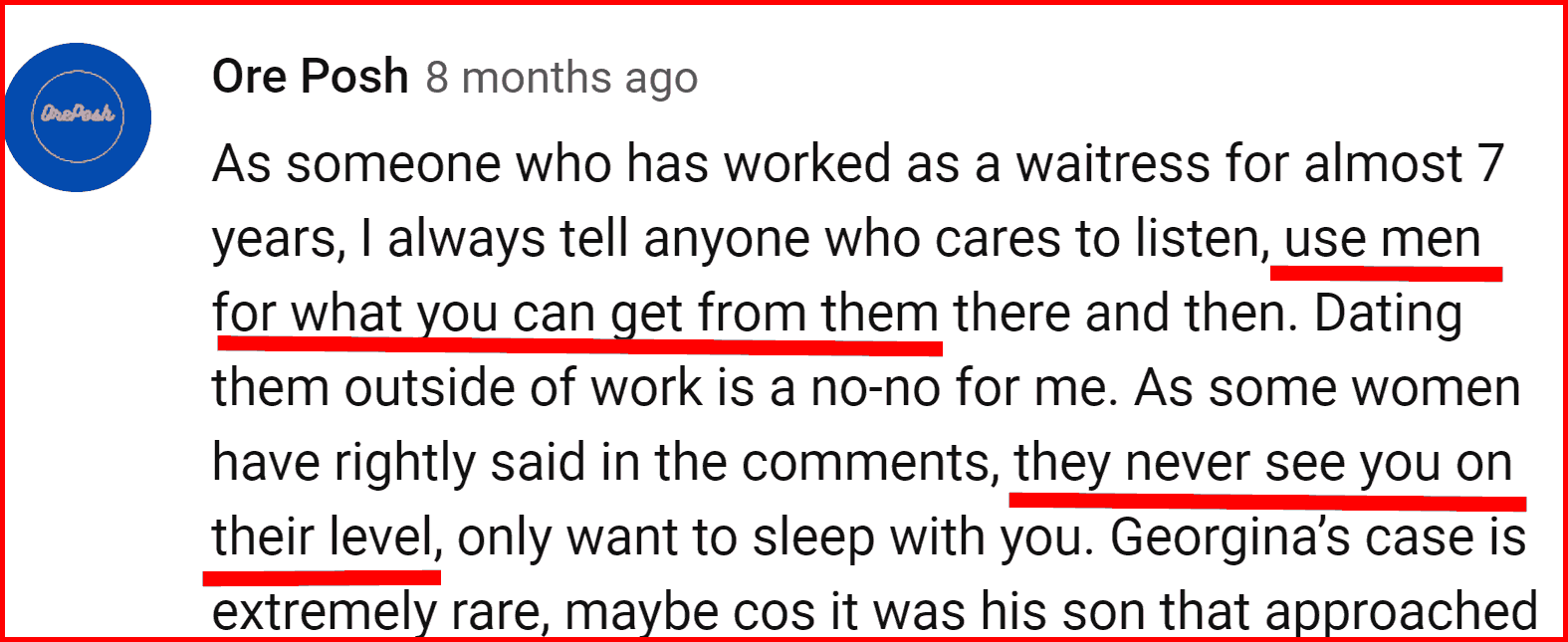
Her: use men for what you can get from them. They never see at your level
The mindset of the jaded and inveterate hooker.
Sometimes, the saying “a hoe cannot be turned into a housewife” is true.
⛏️ Read more in “hookers’ psychology”.
For example:
- Naive people had it coming
- Cheating is part of life, you must know better
- If you don’t take first, they’ll take from you
Look for suspiciously strong or out-of-place virtue-signaling
Including:
- Condemning takers and scammers. Sometimes, they’re just jealous someone else is doing all the taking
- Negative projections. Accusing you or others of cheating. That’s because they would cheat in the same circumstances
- Out-of-place defensiveness. For example “I’m not like that, I’m a good person” when you had simply asked a question
8. See what they find funny
Many takers find humor about taking advantage of others funny.
For example, stupid people or “marks” who fall for someone’s manipulation -or their own manipulation-.
Example:
9. Look for overly strategic approaches to relationships and exchanges
For example:
- Overly nice when they need something
- Giving right before they ask something
- Giving, texting or chasing you when they need social support
- Fawning toward the bosses or higher-status folks
What they advise others to do:
- ⛏️ Example in Power University
9.2. Look for signs of OVER-competitiveness
A competitive spirit is healthy and important to advance in life.
But look for over-competitiveness.
And in areas where over-competition is out of place.
- Friendships
- Old relationships (who’s “winning now”)
- Situations without pay-offs
🔎 Example: Putin’s dog is stronger and faster than Bush’s
Bush told the “dog story” more than once:
Putin: (my dog is bigger, faster, stronger, than yours)
Bush realized Putin wasn’t pursuing win-win when he said his dog was bigger, faster and stronger.
Bush had a great read.
It was a red flag of over-competing because: what’s the value in “who has the stronger dog”?
10. Any “taker vocabulary”?
Or overly aggressive.
For example:
- Robbing / stealing
- Ruining
- Attacking, when reaching out to a leads’ list in sales
- Punishing & smashing for sex and hookups
A deeper analysis on mis-using takers’ vocabulary:
- ⛏️ PUA Tom Torero: taker’s vocabulary in dating/PUA
Or look how Ali’s former (poor) boss spoke to his coaching client:
Him: I want you to remove as many steps to get them to the cheese in the trap 🪤
Does that sound like someone who wants to grow a business by providing value? 🤦♂️
11. Look for dark triad signs
Dark triads are more likely to take.
Research on social media found these signals for narcissism/taking:
- Self-promoting, self-absorbed, self-important statuses
- Boastful and arrogant quotes
- Many friends/connections (the author says “racking up superficial connections to brag and ask favors”)
- Vainer, flattering pictures of themselves
Another study for CEOs:
- More first-person singular pronouns. Since takers tend to be self-absorbed, they tend to use more first-person singular pronouns like I, me, mine, my, and myself—
- Large salary gap between them and other senior leadership
- Bigger pictures of themselves, as shown in annual reports
Guess which one is the taker:

- ⛏️ Missing early red flags of aggressive, disempowering, potentially dark triad traits
- ⛏️ Chris Voss gives off some high-functioning dark-triad vibes. Quicker video overview here.
12. Look for signs of general poor character
Poor behavior in one area often stems from a poor character.
So look for:
- Manipulative tendencies
- Gaslighting tendencies, and gaslighting typical behavior
- Manipulation tactics
- Power moves
- Microaggressions
- Undermining
- Focus on power over relationships
Etc. etc.
13. Test them. See how they respond
Testing is a skill on its own, and more later.
But as a quick example, a little “shit test” I once asked a girl I was dating:
Me: would you like the last ravioli?
Her: (nodding, without even looking)
Small yellow flag.
I’d have said “go for it” or “let’s share it”.
Toxic People Are Takers
Almost anyone can be a taker or giver in some situations.
However, it’s NOT just situational.
Psychologist Adam Grant shows that a generalized approach to giving or taking is a stable personality trait.
It goes on a spectrum:

It’s a spectrum between givers and takers
Grant estimated that 60% of people are matchers and takers and givers make up 20% each.
Using Takers
Generally, you don’t want close relationships with takers.
But in business, you could make it work.
For example, if your interests align, you may work with an effective taker.
Or some small-timing takers can be duped into believing they’re taking and winning… While they’re not.
Some small-timer takers for example may steal office supplies. Or surf the web in the office for overtime pay. But since you pay them little, it can still be a net positive for you.
So we can say the general advice is to only have transactional relationships with takers as long as you’re gaining.
Also see:


