Low confidence in conversations is common among what we call here “good men”.
That’s a problem because when you give too much power away in conversation you lose status, respect, and attraction.
Others reject your leadership and authority -even if you’re knowledgeable-.
Research also indicates that using ‘powerless forms of speech’ can prevent you from being persuasive.
That’s why it’s best to remove all signals of low confidence from your conversations.
Luckily, we know how to do that because we helped thousands of good men do the same.
Let’s start with an overview from research:
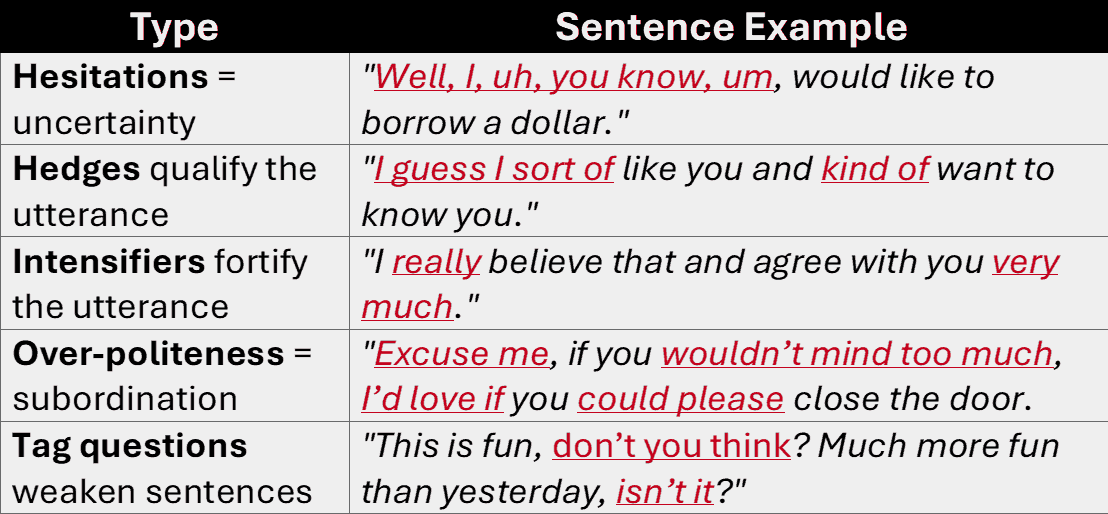
And now let’s dig deeper with TPM’s wisdom:
1. Nervousness
General principle:
⚖️ Confident men are comfortable in social settings, while unconfident ones display signs of social anxiety
Luckily, it doesn’t matter how you feel.
As long as you remove the signs of social anxiety, you’ll look confident.
And, little by little, also grow confident.
1.2. Filler Words
Big boss: Speak as you might to a young child. It wasn’t brain that got me here, I can assure you that
Junior: Well, ehm…
👉🏼 Avoid tail filler words
Pay attention to filler words at the end of sentences 🔜
Careful With Over-Using…
- “I mean”: an example here, notice “come on” used defensively
- “You know what I mean”
- “I’m like… “
- “And then I was like… ” / “and then he went like…”
1.3. Upward Inflection (Upspeak)
Rising in pitch or volume similar to a question
Her: Annie (upspeak), this is Becca (upspeak) my friend from work (upspeak)
1.4. Trailing Off
To progressively get quieter, without finishing the sentence
Low-status guy: Yeah, yeah, french fries, “pomme frittes” ehehe, and that kind, that kind of stuff.. (trails off and looks at the leader)
♟️ Cut short, without trailing
People trail off after realizing they spoke too long and/or are going nowhere.
Resist the urge. In the example above: keep the volume up, then add “Anyway, on to you guys (gesture towards the boss)“.
2. Defensiveness
General principle:
⚖️ Confidence advances, submissiveness backtracks and defends
In confident conversations, we saw that dominant men lead, ask questions, take the judge role, control the frame, and, potentially, interrupt and attack.
Well, unconfident men do the opposite.
They relinquish any control and justify and defend.
2.2. Over-Justifying
Cop: You know it’s a 50km/h zone don’t you
Submissive: (long face, low gaze)
Cop: Then why did you speed <— Overstepping. He has no right to shame you
Submissive: I didn’t see the sign and I didn’t realize, I thought I was going slower…
⚠️ Submissive implies guilt
Misplaced submissiveness makes you look slimy AND guilty
Other options:
- 🐍 Don’t self-snitch and don’t admit
- 🦅 Own it Ie.: “I just sped officer”
🛠️ 🎓 Remove “Because” To Retain Power
“Because + explanation” feels like you’re justifying to others.
🔎 Example:
Asker: Why would you think that?
Low power: Because… (provides a reason/justification) <—- Expends effort while the asker judges
But:
Asker: Why would you think that?
High power: Why would I NOT think that
2.3. Over-Minimizing
- I just meant
- I wanted to add this little thing
- I only want to clarify that…
Imagine a person speaking like that at a meeting.
Do you think he’d sound confident and authoritative, the type of man to advance at work?
Not really.
2.4. Bowing to Social Pressure
Owner: Free apps!
Group: (glares)
Owner: I got free apps
Group: (glares)
Owner: What? (Opens up his arms) <— 📣🟰 “What did I do wrong”
👆🏼♟️ Approach it like they‘re off
🧠 = I’m giving you a gift, you have no reason to be a dick
🗨️ “What the hell is wrong with you guys”
3. Running For Cover
A good use of covers is crucial in life.
However, when they’re unneeded or when you overdo it, they reek of weaknesses.
3.2. Virtue Signaling Cover
Him: If he doesn’t want the child, he should not be forced to pay. Not that I would ever fight it, but… <— It’s weak because it’s clear he opposes it (and he’d rather fight it in court)
3.3. “I’m Joking” Cover
Him: (mischevious joke) Nono, I’m joking <— Worst of both worlds. As*hole intent, with too nice guy fear
🙋🏼♂️Guy I knew also did this for perfectly acceptable jokes 🦃.
⛏️ Read more here.
3.4. “I Obey” & “I’m Not Allowed” Frames
- “they said I could do it”
- “I was told”
- “they allowed me”
They all sub-communicate “powerless flunky”.
🛠️ 🐍 Strategic “offloading”
Use higher authorities to deliver negative news without paying the price. 🔜
For more on conversational influence, see the basics of conversational frame control:
4. Indecisiveness
The Routledge Handbook on Persuasion refers to a class of ‘hesitant’ language as ‘powerless language’.
Here they are:
4.2. Beating Around The Bush
General principle:
⚖️ Empowered men are direct, disempowered men are indirect
Examples 🔜
4.3. Flip-flopping
Waitress: You all done here sir?
Him: Ahhhh... (she takes it away) yeah, yeah <— He only decides after the waitress decided for him
Her: Oh, you don’t wanna finish that?
Him: (looks back towards the dish) no, yeah, nonono, I’m fine
(…)
Her: the establishment owes him a sneaker
Him: (looks at her) right, right. Well, I mean, I guess, you know…
♟️🛠️ Pause, think, decide
When unsure, keep the status quo (ie.: leave the dish)
Also read:
5. Over-conforming
General principle:
⚖️ High-status men shape the world around them, while low-status ones conform
5.2. Confirming What Others Said
Leader: what do you think Tim?
Low-status: I agree with what you guys said <— WHAT, exactly?
🛠️ 🎓 High-power option for “nothing to add”
Say:
- I’m not informed enough to add valuable insight
- (pause 2 seconds) I agree with what X said
- I don’t have a strong opinion on this
- I think it’s too difficult to say. I’d rather pick any option and improve as we go with the market’s feedback
🛠️👉🏼If it’s teamwork, add that you’re eager to get going with the action.
5.3. Backchanneling Confirmation
- Aha
- Uh-huh
- Mm-hmm
- Got it
- Understood
- Right right
General principle:
⚖️ Moderate backchanneling increases interpersonal bond👍🏼 but excessive backchanneling disempowers
Over-doing it sub-communicates “flunky taking in orders”.
🛠️👉🏼 PRO-Tip: Switch “aha” for neutral “yeah” and “got it” or a high power “makes sense”
6. Insecurity
6.2. Ask Permission For Your Rights
Imagine a meeting among colleagues:
Colleague 1: (chips in)
Colleague 2: (chips in)
Colleague 3: Yeah, can I share my opinion <— You’re equals, no need to ask
But remember that, as for most low-power expressions, context and situation make all the difference.
Politeness as a high-status and credible man can enhance a speaker’s credibility (Bradac and Mulac, 1984).
For more, see:
- Power protection to learn when and how to respect others
- Social calibration, to lean when and how to calibrate
6.3. Over-Discounting
To lower expectations:
- This may sound silly, but…
- (…) Sorry I’m just rambling aloud
- I hope this is not completely stupid…
Lowering expectations is a great strategy when used appropriately.
Not when over-used 📽️.
General principle:
⚖️ Fragility is afraid of failing and looking bad, confidence isn’t

Her: I didn’t have a good look for today, I hope you don’t mind
Her: (…) I’m looking like a zombie
♟️👉🏼 Notice my strategic responses.
But I was also respecting her less and less
➖ 🎓 Confident men can do this to gain trust and grab attention
As for most things, there are exceptions. A smart use of ‘hedges’ can enhance persuasiveness (Durik et al., 2008).
If you’re already a credible speaker, you share openly when it’s “just an (uninformed) opinion”. And a pre-amble of “just sharing a crazy idea” can be a fantastic attention grabber.
6.4. Weak Attacks
Anger without conviction, intensity, or power is weak:
Frank: What are you talking about now, come on you listen to me ah <—- “Come on” pleads. And “ah” is a reinforcing tail filler words. Both signal weakenss
♟️ If your anger doesn’t intimidate, don’t get angry.
⚖️ Anger that doesn’t affect others disempowers you.
⛏️ Example of weak pushbackOld example (author’s exclusive videos in PU)
🙋♂️ “Empty yelling” loses you respect

Lucio: My boss yelled, “Do you think we’re a joke?” after I left before his meeting the day before. I said no, but his weak yelling confirmed he was a joke of a leader.
Also read:
7. Fawning
General principle:
⚖️ Leaders pursue goals, lower-status men pursue leaders
7.2. U-Turning
Genera principle:
⚖️ Empowered men Low-power followers speak based on what the leader says
Low-status: They suck, they’ll never win
Leader: Actually, they bought some strong players, they’re quite good this year
Low-status: Yeah, I didn’t really mean “never”, and…
🛠️ PRO-Tip: Contradict them
As both a test and power move. Great for dating
7.3. Approval-Seeking (Rushing In)
Ie.:
You: I thought it was terrible that you…
Submissive: (emotional) Nooo, I didn’t mean it that way, what I meant was <—- Rushes to clarify/justify and get in your good graces again
⬆️ I had that exchange with an ex.
7.4. Parroting The Leader
Leader: Mark you did great with X, it was…
Subordinate: Mark did fantastic, my favorite was X <— What a concidence, just what the leader highlighted
🙋♂️ Fawners Disgust Me
Lucio: Fawining is weak, petty, and fake.
I may use fawners for short-term support, but never rely on them. Turncoating is their MO and will be the next leader’s bitches.
More 🔜
8. Over-reactive & Unmasculine
- Over emotional
- Over-expressiveness
⛏️ Charlie example of exaggerated facial expressions - Over-excited & high-pitched
⛏️ F1 commentator sounds effeminate
⛏️ Shaun share his SWAT experience with too high energy and a victim frame. Franzese shares the same story, calmly and with a cool guy self-frame - Mimicking women’s voices or behavior
⛏️ Charlie mimics woman’s voice
6.2. Reacting More Than Others
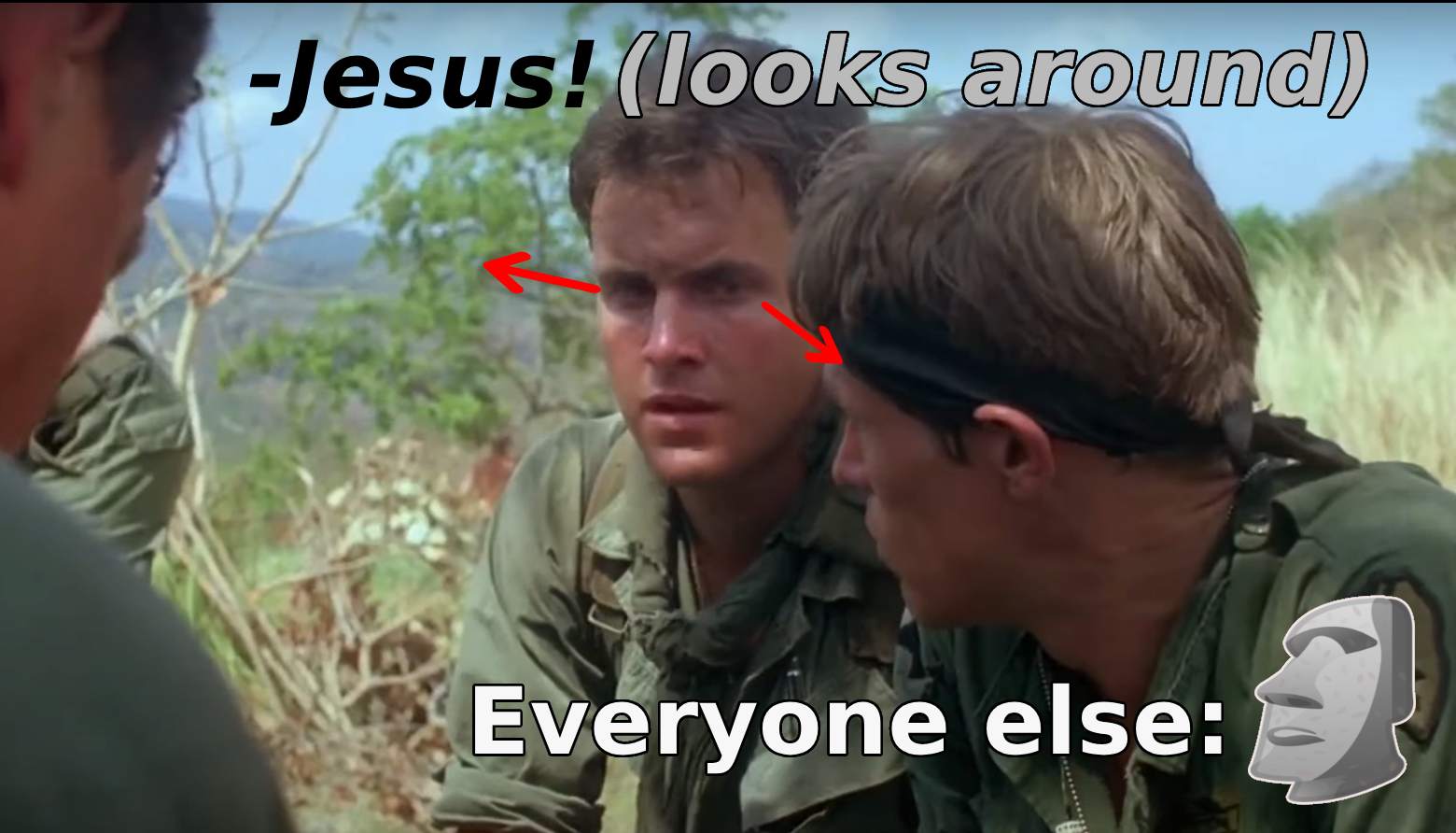
Guy 1: Blew a whole fucking platoon to pieces. Bad shit
Guy 2: Yeah, they got two lieutenants and captain
Guy 3: Jesus (looks around) <— 📣🟰 “I’m the virgin novice”
♟️ ⚖️ Always err on the side of under-reaction
📽️ Video here.
6.3. Losing Your Girl’s Respect With Over-reaction
Him: (laughs, “my God” intonation, emotional word salad)
She: (silent and disappointed)
⬆️♟️ Let her start the “sensitive topic”
Or rause it strategically so you don’t look overly affected.
🛠️ Ie.: ask her what she thought about it.
PRO Tip: Focus on present
Avoid past & hypotethicals. Dwelling on what you can’t change is lower value. Winners focus on present, future, and action.
⛏️ More examples (PU alumni only)
Learn More
Or see a preview of our flagship course:
The full and more advanced version is available in Power University