From social exchange theory, the main practical laws for social success are:

Giving and hoping to get is naive. Smart giving and ensuring a return work best to achieve goals
1. To get what you want, give others what they want
Asking without giving is the equivalent of a social overdraft.
Your request is likely to be denied for “insufficient social funds” (“socially imbalanced requests”). If instead, you give what others want, you are far more likely to get what you also want (“socially balanced requests”).
1.2. Offer visible, universal, concrete value
If you’re unsure about what others value, go for what’s universal, visible, and practical.
What’s valuable for you might not be valuable for someone else.
This is often the case with “high opacity“ currencies.
Such as currencies whose value is not immediately visible.
For example, a great book can change a life.
But until people read it, it’s just a (valueless) block of paper.
🔎 Case study: offer a lunch, rather than a book
Ali is an awesome guy.
He wrote a book and, just like any good author would, he valued his book very highly.
He applied solid power dynamics principles, so he also knew his book had great content.
But the receivers didn’t know that.
A book is high opacity.
In that case, offering lunch was probably far more valuable -and effective-.
Lunch is a highly visible form of value.
It’s easier for most people to appreciate. That means it’s far more effective to increase your social credit.
Which, in turn, makes it far more likely you’ll get what you want.
2. Be high value
If there was one life hack, it’s this:
Become high value.

People with lots of value to give are like walking moneybags. Everyone wants them.
Everything in life gets easier as a value-man.
Even what are thought of as completely different skills like persuasion and leadership.
Most people are far more willing to follow high-value men.
See:
- How to become a high-value man
- Power University, the full course to become a top 1% man
3. Signal value
Signal value, and present yourself as a giver.
How?
Most men simply brag.
That’s still better than meek, self-effacing submissiveness.
Bragging occasionally works, especially when the target already agrees with the bragging.
But usually signals disempowering neediness.
You’re trying to gain their approval, which empowers others, and disempowers you.
How do you do it, then?
Well, this is where advanced social skills come into play.
Covert bragging in a way that it doesn’t even seem like you’re displaying your value is an art.
Luckily, on TPM we turned into a science.
For example, you can:
- Tell stories that hint at your deeper qualities
- Bait others to ask you questions (or bait them to compliment you)
- Share your achievements with a focus on the struggle
P.S.
Manipulation and social scalping are approaches to increasing the value of your offering (but we don’t generally advise them).
🔎 Example: how to avoid bragging
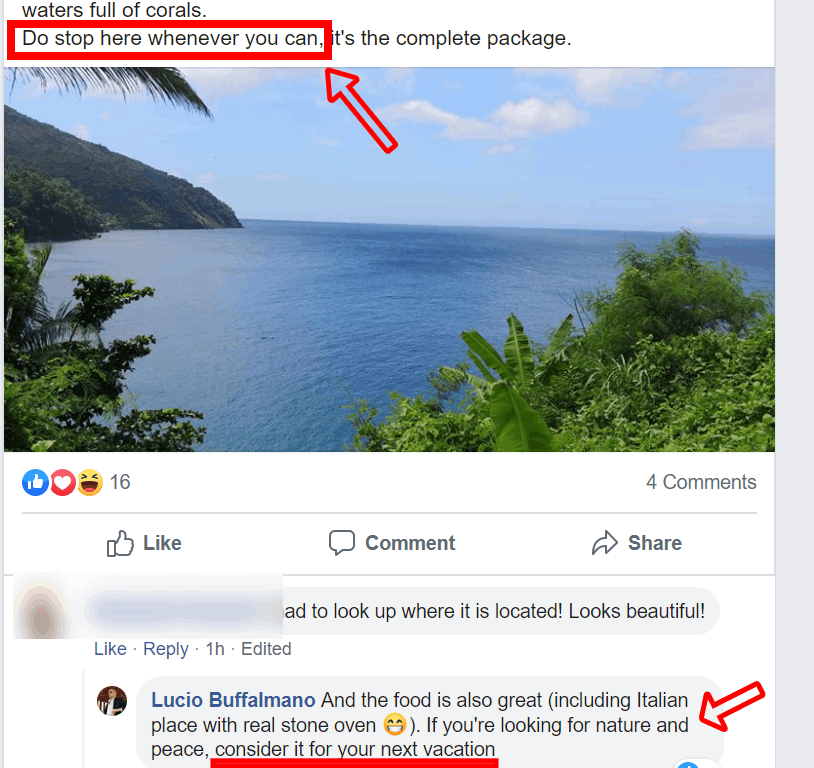
I loved that view and wanted to share it. But I knew it would feel braggart. So I framed it as “here’s me sharing advice on where to visit”. That frame pulls people up. It sub-communicates that they can travel there, and can appreciate it as well
Full analysis here.
Also, read:
PRO Tip: never tell people “I know my value”
It makes you come across as an entitled status inflater.
This is what it sub-communicate:
I know and I set my value, not YOU, so independently of what you think, you must put a lot of effort for me
That’s a covert, one-up power-move.
It’s annoying for high-quality people who are aware of power dynamics (and most high-value folks are).
See more:
- “I know my value”: the keywords of bad entitlement
And also see:
- Overcoming entitled mentality: overly-entitled mentality in social exchanges is to demand (far) more than one gives, and smart folks see through that
4. Never present yourself as low-value
Since nobody wants to transact, befriend, or date value-takers, value-takers struggle to develop and/or maintain relationships.
That’s why a positive reputation is so helpful.
A good reputation is like a personal recommendation preceding you and saying “this guy is an honest value-giver”.
And that’s why some psychopath value takers are constantly on the move: they must escape their negative social account balances.
4.2. Never present yourself as a taker: examples
Here are some common “takers expressions”:
Value taker: “When are you free for a coffee? So I can pick your brain on that business I want to start”
High-value man interpretation: if I hear “pick your brain” once again, I’m gonna lose it. Why would I want to sit around for coffee, and expend effort to explain things, while you take as much as you can without giving?
Value taker: “can you leave me a good review?”
High-quality man interpretation: how about you earn your good review by giving great value? I’m an honest reviewer, don’t corner me into this BS to take my power and freedom away.
Value taker: “Matt told me you’re having a housewarming party tonight, is it still on?
High-value man interpretation: you got nothing to do, and want to tag along. But if I wanted you here, I would have invited you myself.
Value taker: “Please, please, please… “
High-value man interpretation: begging is all you’ve got to offer?
Notice all the above are requests for value from people with no social capital, who give nothing back.
Sometimes just a little fix could make them more balanced.
For example, the guy who wants to pick your brain could invite you to lunch.
Lunch is a small token, of course, but more than the monetary value it shows that the inviter gets it and shows respect and consideration for your time and knowledge.
5. To connect with higher-value folks, make up the difference
The ‘Law of Compensatory Investment‘ postulates that higher-value people don’t want to associate with lower-value people unless they make up the difference.
For example:
- Future giving
- Loyalty
- Gratitude
- Enhance their reputation
- Talk well about them
- Positive review to their business
- Token gifts
- Invest: make it easy for them
- Travel to meet them
- Work around their time
- 🎓 Strategically display inconvenience
Ie.: Arrive early, say ‘It’s easy from X station‘, where ‘X station’ is far
- Eagerness to learn and support
High-value people want other high-value folks who can give back.
Or, at least, people who are willing to work to make up that difference.
High-value folks stand to lose the most from takers.
That’s why high-value people are cautious, wary, and guarded.
And, often, high-value people loathe value-takers.
That’s why you must avoid framing yourself as just another taker.
They have enough of those vying for their time.
You must show that you can also give something.
Also, you can show loyalty or gratitude, and that you are willing to pay them back somehow in the future (“promissory social notes”).
5.2 When you have nothing concrete: give gratitude (at least)
This is what high-value people dislike the most:
High value people dislike the most those who give nothing, ask for value, and act as if it was due to them.
If you need something from someone, it’s OK.
But seek to give something back.
Except for dating, this is also where accepting -and showing- a subservient role can help.
You make the receiver feel high in power, which can make them more well-disposed towards you.
Gratitude also helps a lot because:
- It shows you understand social dynamics
- It makes the receiver feel good
- Works as a promissory note of future support: for the receiver, it’s like making an ally
- It shows you are willing to give something and rebalance the relationship
This is crucial to understand because this is what keeps many low-value individuals stuck in low-value mode.
Low-value takers don’t understand that high-value people don’t want to mingle with low-value people who don’t make an effort to rebalance the relationship.
The principle is:
⚖️ Social capital draws others in and gives you leverage. Social debt repels them
Social capital combined with your own returns make for win-win relationships, the gold standard of social exchanges.
Value-neutral relationships can also last but do not thrive.
And win-lose relationships (value-taking for the other party) either end soon, or turn toxic and must be kept in place with coercion and/or manipulation.

Relationships with a good balance of give & take where they both gain are stable, good relationships
6.2 Ask when you have most leverage
- Climb out of debt before asking
Ie.: Apologize, make it up to them… Then ask- ⚠️ Give before the ask <— Don’t make it too obvious. A swift ask after a strategic give feels manipulative 🦃
Ie.: Share something personal before asking something personal
- ⚠️ Give before the ask <— Don’t make it too obvious. A swift ask after a strategic give feels manipulative 🦃
- Negotiate at your highest leverage
- Ask after a high point
Ie.: Propose to meet again after you make her laugh
7. For mass popularity: focus on currencies everyone wants…

LoL skills give you status among gamers. Not bad. But same effort to learn social skills and playing an instrument to join a band would yield higher real-world benefits
Some forms of values, everyone wants.
Some others, very few.
So it’s more effective to work on “hard currencies” that everyone appreciates.
Such as:
- Confidence
- Social skills -that must include social power dynamics and high-power behavior–
- Wealth
- Personality
- Looks
There is an exception, though.
… Unless you can become world-class (The Halo Effect of Peak Performers)
Why?
Because top performers gain power.
Take software developers, for example.
Boring and “not cool” to almost anyone outside of the field.
But if you’re a wiz of coding, a popular hacker, or become a CTO, that changes the game.
With top-dog status, you also acquire riches, status, and power.
And those are hard currencies with sought-after, real-world benefits.
Also, read:
8. Be a SMART value giver
Adam Grant’s research supports our strategy, showing that giver types were the biggest winners and losers:
❌ Giving randomly 🟰 losers
✅ Giving to other givers 🟰 winners
The winners gave to good characters, or to those who gave back—other givers, or “matches”.

👉 People concerned BOTH for others and themselves were most successful
So don’t forget the other side of the coin.
The more you bring, the more you can ask for.
But “ask for” is crucial.
Giving entitles you to ask.
Sometimes you must do so assertively.
Some others times, strategically.
TPM turns men into high-power, high-value enlightened collaborators.
The most important real-life applications of the social exchange theory :
- Focus on what you bring to the table.
- Focus on what they bring to the table to make it fair to yourself and worth your time
- Assess your relationships: are they balanced or are you gaining from them?
- Fix imbalances: imbalances hide emotional manipulation, a negative judge role, or a toxic relationship based on addiction, rather than win-win (see for example Norwood, 1985).
- Tend to win-win: win-win folks are a true social treasure. Keep and care about them.
Read more:
- Value and availability: important concepts for effective socialization
- Foundational steps of self-development
- Basic strategies for power
8.2. Expect and demand repayment after you’ve given
Principle of Social Exchange Inflation™:
The value of a give is highest before the exchange, drops sharply once given, and continues to decay over time—along with the receiver’s sense of gratitude, obligation, and likelihood of repayment.
Worst yet, while gratitude decreases over time, sometimes resentment grows over time as people hate being reminded of their debt.
Some people may avoid you, or even find excuses to provoke a fight, just to have an excuse to not repay and talk to you again.
To avoid this issue, agree on repayment terms before giving.
If your giving doesn’t require repaying, monitor gratitude. If people don’t repay at all, stop giving.
In social situations, ignore and be curt to peers who took without giving. If you reach out or show warmth you’re chasing and rewarding bad behavior.
They must ‘make you whole’ to regain your respect.
➖ Exceptions apply: always put goals and strategy first
Pretending friendliness sub-communicates that their taking was below you. Or if it’s a higher-status person, maintaining access to them can provide you with different benefits.
9. Last 10%: use advanced strategies & techniques for top 10% results
These 10 laws are the basics.
And the basics will give you… Good results.
For the last 20%, you need something more:
{ “@context”: “https://schema.org”, “@type”: “DefinedTerm”, “@id”: “https://thepowermoves.com/dictionary-of-power/#social-exchange-inflation”, “name”: “Social Exchange Inflation”, “description”: “A principle in social exchange theory stating that the value of a give peaks before the exchange, drops once given, and decays over time—along with the receiver’s sense of gratitude, obligation, and likelihood of repayment, sometimes giving way to avoidance or resentment.”, “inDefinedTermSet”: “https://thepowermoves.com/dictionary-of-power/”, “url”: “https://thepowermoves.com/social-exchange-theory-practical-applications/”, “author”: { “@type”: “Person”, “name”: “Lucio Buffalmano”, “url”: “https://thepowermoves.com/lucio-buffalmano/” } }