

Whether you’re meeting someone new or navigating a group setting knowing how to make a good first impression is a fundamental life skill.
At The Power Moves, we taught thousands of men to decode power dynamics for social confidence and life success.
In this article, you’ll discover practical handshake tips, body language first impression strategies, and social confidence tips to master introductions like a pro.
Let’s dive in.

Let Them See You Cool
Research shows that first impressions matter, and last.
And a good first impression begins when they first see you, before you even say hi.
So:
- Dress well
- Adopt cool body language poses
- Look busy or chill, never bored
👉🏼 Tip: Avoid burying your nose on the phone while waiting.
See:
2. Approach Others High-Power & High-Warm
High power gives you respect, while high warmth gives you friends and allies.
We explain the tactics in other articles, but knowing how to make a good first impression starts with the right mindset:
- I’m a great guy
- I expect good interactions
- I start with the best foot forward
- … But it’s on them to show me they deserve more
That last one prevents you fall prey of takers and toxic people.
🔎 Example:

Brad Pitt: (slight tight-lipped smile, deep and neutral voice, nodding up) Thanks Charlie
⬆️ You can be friendlier than Pitt
Pitt prioritizes power over friendliness. As long as you’re a respect-worthy man, you can be warmer, talk more, and also nod down—without overdoing it.
👉🏼 Nod slowly for extra power in your body language first impression.
Also read:
- Mastering power and warmth for maximizing status and relationships
3. Extend Your Arm After Eye Contact, Within 2 Meters
One of our top handshake tips:
Make eye contact before introducing yourself and extending your arm.
If you don’t, the frame is that you’re looking for them, while they ignore you. You want them and chase them, and they don’t care.
That frames you as lower status, and you don’t want that.
If he hasn’t noticed you and you want to approach, raise your hand and shake once he acknowledges you.
🔎 Example:


Lower status: (Approaches unacknowledged, leans in, palms up, bowing, nods, exits) <— Extending too far in advance is too warm, over-extending signals over-deference, and approaching unacknowledged suggests chasing.
4. Firm Handshake, 2 Pumps, Eye Contact, & Smile
The handshake per se is simple.
For a strong body language first impression you only need:
- Firm handshake, two pumps in the West
- Eye contact—while avoiding looking down
- Smile to add warmth
Some people look down to locate their hands.
But if you overdo it, it can still look submissive, even if you don’t intend it to.
🔎 Example:

⬆️ Low power handshake
Looks down too much, too long sits un-masculine, clasps Trump’s hand too weakly
Compare now:
⬆️ Much better, but you can loosen the arm grip
Too strong clasp on the arm, but it’s only because he came prepared this time. Overall, still much better
👉🏼 Tip: Use peripheral vision or a quick glance to spot his hand and avoid staring down—one of our favorite handshake tips.
More?
⛏️ Two examples of back-to-back introductions: one low-confidence looking down, and one eye-confidence making eye contact with a taller man.
5. Lead & Control The Conversation (If Appropriate)
Signaling value early on is crucial, and the best way of doing it is with sub-communication and behavior.
Here are good ways to lead and signal social confidence:
- Initiate the introduction
- Add one power move if they initiate, like placing your other hand on the arm or wrist
- Ask the first question
- Control topic transitions
- Control the ending move, end it yourself, or add someone else to your group
⚠️ Calibrate: let them lead if they’re legitimate leaders
Don’t try to over-power legitimate leaders or higher-ranking people like bosses, mentors, event hosts, etc. Display power and gain their respect, but respect them too by not threatening their legitimate leadership.
Learn more about calibration:
🔎 Example
I was recording approaches for Seduction University when someone greeted me as if we were friends.
I wanted to gain more control without being cold, a key skill in how to make a good first impression:
Taking The Lead: High-Power, High-Warmth
🔊 (Exclusive real-life example from Power University)🔊
Him: Lucio?
Me: (warm tone and expression) Hey, hi man! Who are you <— Straight talk
Him: Joe <— Gained the intel I wanted
Me: Oh Joe, nice meeting you man <— Leading the intro
(…)
Me: How are you doing man <— Keeps leading
Also read:
6. Grab The Spotlight If It’s A Group Interaction
Some social confidence tips to stand out in a group:
- Walk to the front
To avoid over-powering the hosts, say: “I move here so we can better see each other“.
🙋🏼♂️ My experience: hosts treated me as an equal and several people came to me after that, including women.
- Speak louder than most
No need to yell, but most people speak too quietly to be well-heard by all.
- Crack a joke if possible
No need to over-sweat it, but if something witty comes up, it sub-communicates social confidence with high power and warmth.
- Present yourself interestingly
For example, share an interesting tidbit of information:
🙋♂️Lucio’s Take: Grab attention and display confidence

🔊 (audio file in our program) 🔊
Me:
Name is Lucio <— Instead of ‘my name is… ‘: grabs attention by breaking expectations
I help good men become life winners <— Intriguing
And I achieved my goal of… <— Everyone’s interested in goal achievements
10k in under 1h <— Shares information relevant to a group of runners
Result:
Several people approached me later about both my job and timed runs. More than one said I sounded ‘confident’—probably volume and body language since tonality can further improve.
Self-defense
Domineering men often start with a power move, but you can counter it.
To defend:
1. Prevent it
Use high-power body language and social status strategies to set the tone before you even introduce yourself.
2. Prepare: See It Coming
The odds of handshake power moves rise with:
- Scowls
- Puffed out chests
- Loudness
- Attention craving
🔎 Example
Trump’s pose right after he shoved a prime minister:
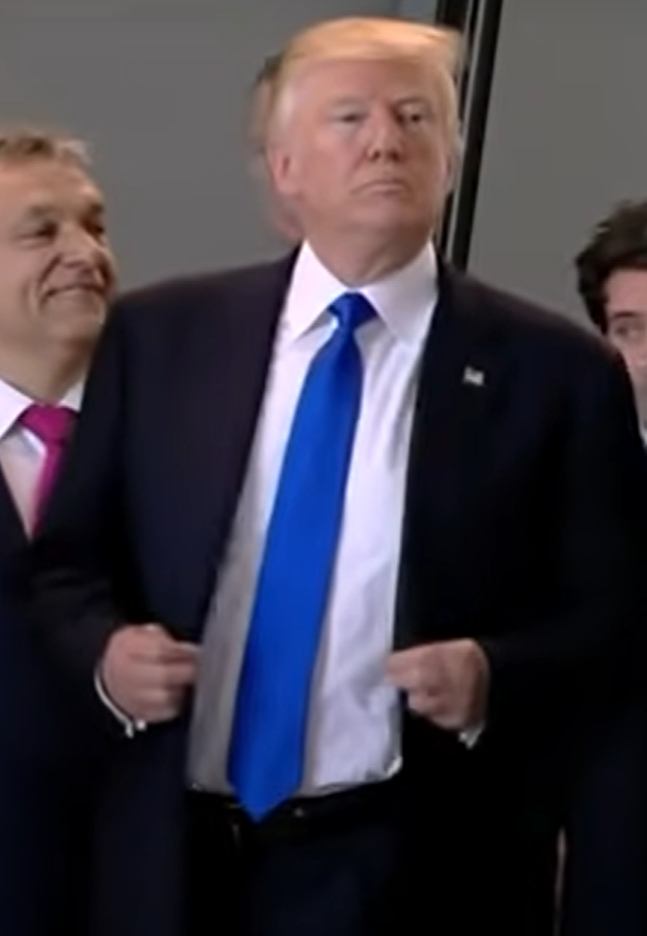
Sub-communication All eyes on me, I’ll out-dominate people standing in the way
Solutions:
- Don’t go to them first <— Expect to be semi-ignored and used as a ‘social peg’ if you do!
- Lower warmth, increase power
- Get ready for power moves
3. Defend Against Power Moves
Including these handshake tips to stay in control:
- Palm down upper hand
Solutions:- Offer a different handshake like fistbump or high-five
- Offer a vertical hand instead of taking a palm down
- Rotate his hand vertical, adding ‘Let’s keep the handshake neutral’
- Patting your hand
Solution:- Pat him back on the arm or shoulder
- Yank and pull, a Trump’s staple
Solutions:- Get physically closer
- Plant your feet or put one in front of you
- Place a controlling hand on their arm (see Trudeau above)
These always work too:
- Display disapproval
⛏️ Abe with Trump
- Surface the power move with a comment or joke
Ie.:
- “Bro, easy with the squeeze”
- After a yank: “Dude, are you trying to take me home or something” <— 🙋🏼♂️ This was my winning move in a real-life scenario. The whole group laughed, and the jerk turned submissive
- Touch him
- Cup his hand
⛏️ Video + analysis - Touch his elbow
- Place a hand on his forearm
- Cup his hand
- Intense stare like Macron did <— Balance! Macron was confrontational and pushed Trump into revenge mode, here


5. Fix Wrong Names
Deliberate mispronunciation and demanding perfect pronunciation are power moves that can lower your status.
Handle it like this:
- Correct wrong pronunciation a couple of times, then move on.
🙋🏼♂️I sometimes move on with a smile and say ‘Close enough’
- Try to get their name right once or twice. Then move on. Say ‘We’ll get it with time’
Don’t over-try: it’s high effort and expands your failures
🔎 Example
A dominant response for people who over-insist:
Her: (teaches pronunciation with teacher frame)
Him: (doesn’t try and calls the toast) <— If he kept trying he’d follow her lead and over-invest, losing power and status. Instead, he leads
Learn more:
5.2. Reject Their Nickname of Choice
Most nicknames are dismissive.
Assertiveness works well by simply telling people you prefer your real name.
An option I like is to display more power and self-respect with something like “Why would I want a name that’s not mine“.
If it’s your boss, you can power-protect saying that ‘it would diminish you with your colleagues and make it harder for you to do your job’.
6. Defuse The “Giver/Taker” Frame
Example in business networking:
Him: How can I help you? <— 📣🟰 I’m the value giver, you need me
You: Thank you for saying that, maybe we can both help each other, let’s see
Learn more about these foundational dynamics in:
7. Disempowering Openers
Principles to maintain control:
- Guard personal information early on, unless you decide to share
- Make it an exchange, never let others grill you
- Reject power moves including tasks, challenges, or
🔎 Examples:
- Personal questions
- “How much you make” ➡️ “Too early to ask that”
- “What’s your job” ➡️ “Why are you asking”
- Overly direct
- “Who are you” ➡️ “A guy”
- “What are you selling” ➡️ “What makes you think I’m selling anything”
👉🏼 Calibrate the dominance: deflect to maintain rapport, but feel free to be blunter if you can (ie.: ‘none of your business’)
Learn more:
⛏️ How to handle direct questions while keeping rapport: examples
⛏️ Strategy over dominance to enforce boundaries with high-value men, while still preserving rapport
🔎 Example: The Tasking Colleague
John shares this example in a hospital setting:
- Colleague had to report about a patient <— You’re “power up”
- He tasked me to call on his available time <— He must deliver the info, not task you to chase at his convenience
- I tasked him back to report ‘at his convenience’ <— Resets the correct dynamics
- He called, and he’s much nicer -even submissive <— As it should be
John adds that if he complied, the relationship would be set as convenient to him. And he’s right.
Early power dynamics ‘cement’ fast and set the frame for future exchanges—and for the relationship.
Learn more in:
💪🏼 Power Move: Look Away To Display Disapproval
Eye contact sub-communicates base-level confidence, but also consideration.
Deliberate looking away displays disapproval and superiority.
🔎 Example:

♟️ Calibrate it!
Zero eye contact = high disrespect. A good balance is a tight lip smile, little eye contact, without angling your face away.
Learn More: Master Social Success
That’s the blueprint for owning your introductions and beyond—small moves that add up to big wins in status and respect.
If you’re ready to take it further, Power University is where it all comes together.
It’s our flagship program designed to transform good guys into high-quality men—equipping you with the tools to project unshakable confidence, earn respect effortlessly, and spark attraction without even trying.
The journey from first impressions to lasting impact starts with Power University.


