
Competence is the practical ability to produce reliable results in a domain, and it’s one of the two main bedrocks of success.
At TPM, competence is a foundational pillar of men’s empowerment because competence strongly translates to leverage, and competent men tend to gain respect, status, and attraction.
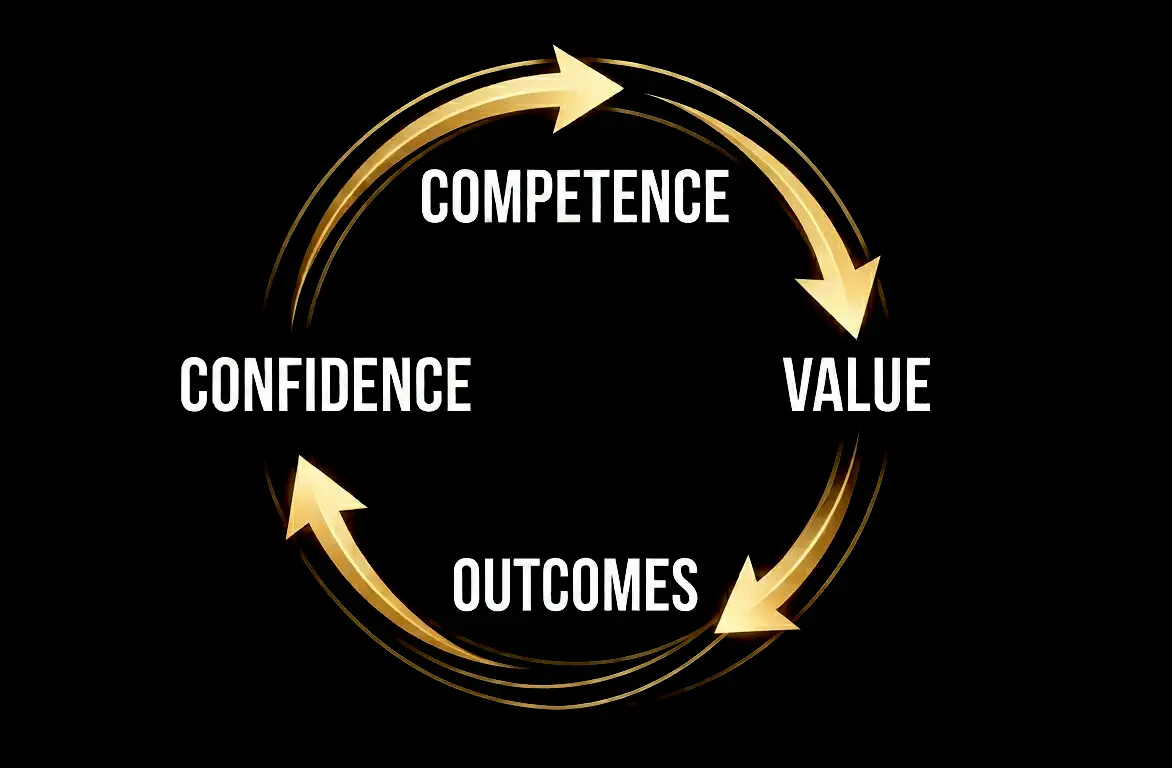
The Competence Loop: Competence is one of the foundations that boosts value, delivers outcomes, and boosts mental power with a positive ‘outside-in’ feedback loop
Competence-Value Amplification Model™
The Competence–Value Amplification Model™ states that outcomes are largely determined by competence and personal value, while strategies serve to present, amplify, or at times misrepresent the underlying reality.
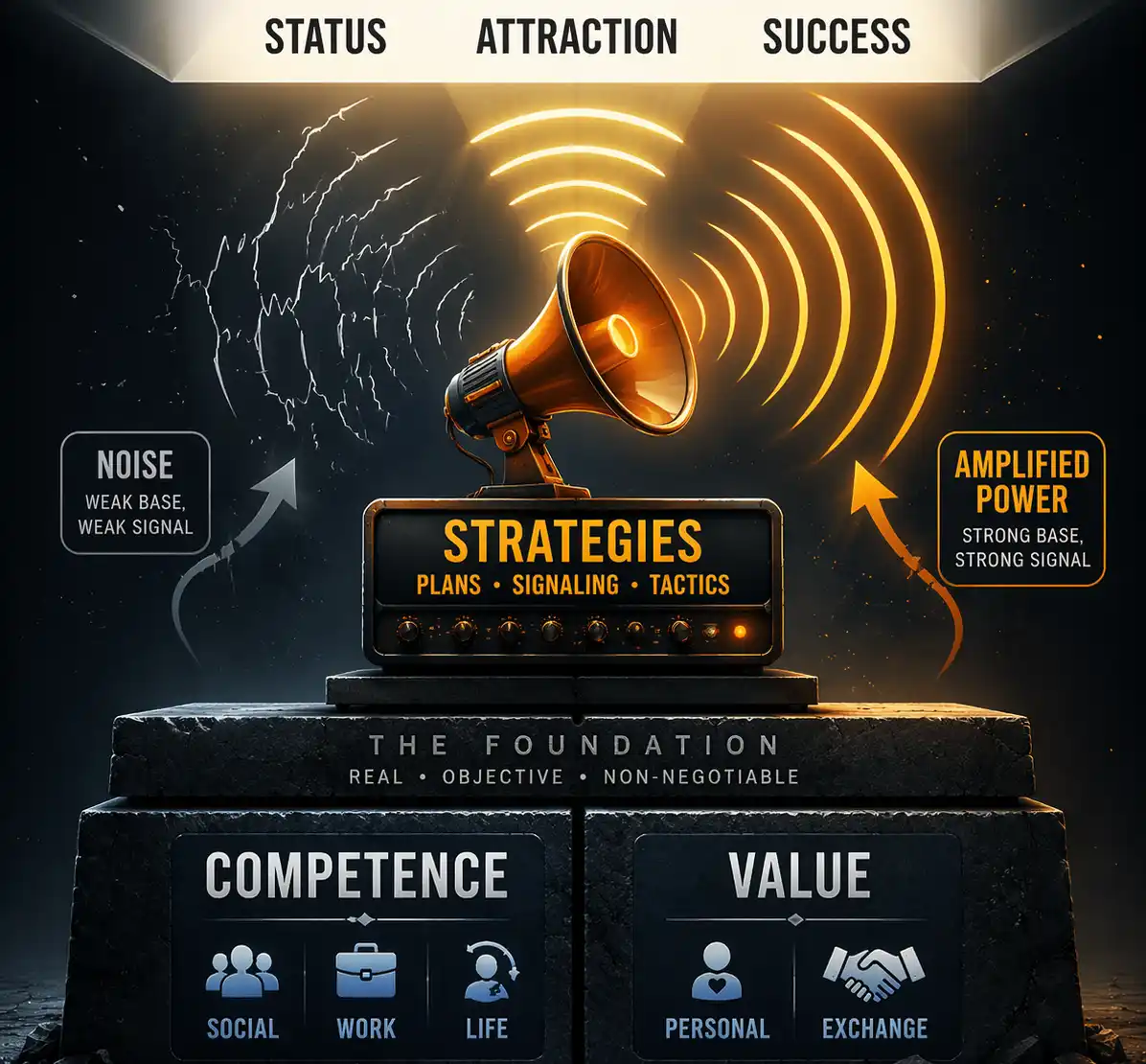
Strong fundamentals produce even stronger outcomes with good strategies and signaling; Amplying weak fundamentals instead undermines you.
Value, competence, and strategies are distinct, yet they overlap and reinforce each other.
Competence is technically a form of value, and can be offered and leveraged in social exchanges to demand value back, either in the form of financial compensation or status (and often both, see Blau, 1964). They’re also connected in the sense that improving one usually improves all the others.
But to give you an idea, consider these three different examples:
| Context | Strategies | Foundations (Competence & Value) |
|---|---|---|
| Entrepreneur seeking capital & team | Pitching, persuasion, social networking, negotiation tactics | Leadership competence; product or idea quality; execution ability; ownership/equity position |
| Dating, seeking a partner | Approach many, hide interest, signal value, plan the date | Dating competence (leadership, positive dominance, etc.); attractiveness; provisioning ability (his overall ‘SMV‘) |
| Scializing, seeking friends | Mirror, relate, ask deeper questions | Power & social skills (power/warmth); confidence; status (job, income, etc.) |
When we talk about value and competence being ‘fundamental’ and ‘deeper’, it doesn’t mean that strategies ‘matter less’. Value-signaling, self-promotion, and various social strategies are competencies in their own right, and are critical elements of the ‘outcome chain’.
In fact, most men sell themselves short by failing to showcase their true value properly.
However, strategic competence alone struggles to substitute underlying competence and value, and especially so in the longer run.
Instead, the more objective levels of underlying competence and personal value can set a ceiling and constrain the effectiveness of any strategy. Especially so for men who prefer an honorable approach and don’t want to lie and manipulate.
Instead, the higher your competence and more objective personal value, the more successful your strategies will be.
Be competent and high-value enough, and even basic strategies will work
The Limitations of ‘Hacks-Seeking’
This model clarifies a common misconception among many beginners who seek an edge, without addressing the foundations.
Some beginners are attracted to various tactics from ‘dark psychology‘, showy ‘power moves‘, or ‘laws of power‘ that are often surface-level tactics, sometimes high manipulation and Machiavellianism (see ‘why 48 Laws don’t work‘). But they still don’t get results because they skip the foundations of personal value and social competence (including social power and positive dominance).
Beginners don’t lose because of tactics. They lose because they lack value.
In truth, all the tactics in the world will at best build a castle in the sand if you don’t back it up with competence and personal value. That castle will collapse as soon as it’s stress-tested by life or others (P.S.: many men looking into ‘how to pass shit tests‘ would also be better off working on competence and value. Tests only happen when value/competence are uncertain).
Strong leaders and ‘alpha male types‘ don’t rely on tricks. They’re actually high-value, competent, and confident.

Power built on hacks, ‘power moves’, etc. collapses under stress. Power built on real competence and value delivers outcomes that last
The Science of Competence
Roughly listed from most important for real-life outcomes:
1. Real-Life Competence: The Ultimate Goal (Conscious Competence Matrix)
Real-life competence is what matters most to achieve most life and socially relevant goals. This is because gaining status, respect, and attraction requires effective and real-time behavior.
One of the most common questions we get is how to come up with the right response in real time.
What most don’t realize is that by analyzing interactions, they are already one or two steps ahead of most men.
With continued analysis and exposure, real-time competence follows.
This framework is widely used in training and performance development and maps four stages of skill acquisition:
- Unconscious Incompetence: You are clueless, and you don’t even know it <— Where many men stand for power dynamics
- Conscious Incompetence: You realize exactly how bad you are <— This is where the ego takes a hit, and many prefer denying instead of doubling down
- Conscious Competence: You can understand or execute, but with cognitive load and focus <— At this level, you’re not yet fully ‘real-life effective’ because the right move only becomes obvious later, upon reflection
- Subconscious Competence (Mastery): The skill is fully myelinated and automatic <— You’re ‘real-time effective’, gaining status, respect and attraction as a simple consequence of ‘who you are’

TPM Takeaway: Embrace Incompetence as Opportunity and Consciously Work on ‘Subconscious Mastery’
Once your hard skills are on autopilot, you read the room’s power dynamics subconsciously, freeing up mental bandwidth to strategize and achieve goals, while looking confident and ‘natural’
2. Competence = ‘Rewiring’ (Myelin and Neuroplasticity)
Your brain builds competence by creating and reinforcing neural patterns.
Each time you perform a behavior, the same circuits activate (or “fire”). With correct repetition, those circuits become faster and more efficient through processes like synaptic strengthening and, over time, increased myelination.
In simple terms: the more you practice something correctly, the more your brain optimizes that pattern for speed and accuracy, and the more the skill becomes ingrained and automatic.
TPM Takeaway: Learn From the Best, Use Deliberate Practice, and Coaching
The brain doesn’t always reward effort—it reinforces patterns. Learn and repeat the wrong thing, and you get better at being wrong. Masters ensure the information you get works. Deliberate practice improves performance by targeting weaknesses and plateaus with expert feedback.
3. Focus on Experience to Learn Patterns (Cognitive Load Theory & “Schemas”)
Research shows that working memory has a very limited capacity and can only process a small amount of novel information at once.
To overcome this limitation, experts develop schemas—structured knowledge representations stored in long-term memory that compress and organize information into meaningful patterns. Schemas reduce cognitive load by allowing complex information to be processed as single units rather than many separate elements.
- Real-time competence is pattern recognition that reduces cognitive load and enables fast, automatic decisions under pressure.
Expert performance is largely automated pattern recognition, not conscious reasoning.
TPM Takeaway: Train Experience-Based Recognition Looking For Outcomes
Outcomes are always the final objective, and sometimes you want performances on first attempts. However, whenever possible, try to get more reps first. People try to “perform well” too early. Experts first build pattern recognition speed.
🙋♂️Lucio’s Take: Mastery is in the experience that develops patterns

Lucio:
Experience is a crucial pillar for TPM because experience builds patterns from real-life exposure and experience.
Experts can select more effective strategies and spot red flags based on the patterns they’ve seen.
For example, if they know that kind and supportive women tend to do X, then Y behavior is a red flag even in the absence of an obvious red flag.
And they can advise for or against a certain approach based on
However, IQ and analysis remain foundational for mastery. IQ learns patterns faster and better connects the missing dots to develop more complex schemas (and avoid jumping to conclusions from limited exposure).
Analysis helps fix the inherent limits of repeated exposure (eg.: the rarity of certain events and contexts coupled with humans’ relatively short life span).
4. Competence = Confidence: Bandura’s Self-Efficacy Theory
In psychology, self-efficacy is your belief in your own ability to succeed in specific situations. Bandura’s work suggests the most powerful source of self-efficacy is mastery experience—overcoming challenges and succeeding.
TPM Takeaway: Build Confidence With Competence & Improving Results
Skip affirmations, pop-psychology, and self-help myths. Whenever possible, build confidence with competence.
Over time, that evidence compounds into a stable internal belief: “I got this.”
5. The Dunning-Kruger Reality Check
The Dunning–Kruger effect is a cognitive bias in which people with low ability tend to overestimate their competence, largely because they lack the skills needed to accurately evaluate their own performance.
TPM Takeaway: Judge Yourself Based on Results
If you can achieve your goals and gain respect, status, and attraction, you’re at a good level. If not, you’re not yet fully ‘life competent’, and you have room for growth
How to learn & become competent
The great news is that competence can be increased. As a matter of fact, while personal value is slightly more tied to genetics, most people can massively boost their competence. So in this section, we will review how to become more competent.
We differentiate here between more practical skills, and learning.
For both of them, we recommend:
- Pick something you’re naturally good at because genetic predisposition matters
- Pick something you enjoy or something you would do anyway. It makes hard work much easier
How to Develop Skills
| What to Do | Why It Works |
|---|---|
| Define the skill as performance, not knowledge | Forces measurable outputs and ties practice to real competence |
| Break the skill into trainable subunits | Isolating weak components improves the system faster than repeating the whole skill |
| Use deliberate practice loops with fast feedback cycles | Rapid feedback is one of the strongest accelerators of learning speed |
| Use retrieval practice | Strengthens durable competence more than passive review |
| Space practice over time | Improves long-term retention and consolidation (spaced repetition effect) |
| Interleave related skills | Improves transfer and adaptability across varied conditions |
| Respect cognitive and physical limits | Prevents overload; working memory limits require structured progression |
| Track performance, not effort | Only observable performance reflects real competence growth |
1. Define the skill as performance, not knowledge
- ❌ Bad: “Learn dating”
- ✅ Good: “approach 3 girls I like, go on a new date a week”
Competence improves when practice is tied to real performance, not passive understanding.
2. Break the skill into trainable units
If a complex skill can be broken into sub-units, isolate and train weak subcomponents.
3. Use deliberate practice loops (core mechanism)
Practice must be structured as a loop:
- Attempt
- Feedback: get tight feedback loops with external expert feedback.
- Error tracking and correction
- Repetition with adjustment
You do not improve from repetition alone. You improve from corrected repetition.
Fast feedback compression is one of the strongest predictors of skill acceleration.
4. Space practice over time
- Short sessions across days outperform long cramming sessions
- Forgetting slightly before relearning improves retention
Spaced repetition effect is one of the most robust findings in learning science.
5. Interleave related skills
Mix different types of problems or situations instead of repeating the same type.
- A → B → C instead of AAAAA → BBBBB → CCCCC
This improves transfer and real-world adaptability, even if it feels harder during training.
6. Do one thing at a time, and don’t overload (respect cognitive & physical limits)
Do not try to learn too many elements at once.
- Start simple
- Automate basics
- Then increase complexity
TPM’s law of optimum balance fits competence well. Both too little and too much can slow progress down. Too much with too high intensity also boosts the risks of injury.
The goal is not maximal suffering, but the right amount of it.
7. Repeat core actions until they become automatic
You know you’re there where you can execute automatically, fast, and well.
8. Track performance, not effort
Effort feels productive but is often misleading. Competence is visible in performance curves, not subjective feelings.
- Measure outputs
- Track errors
- Track speed and consistency
How to Learn
| What to Do | Why It Works |
|---|---|
| Build a conceptual map | Structures knowledge |
| Apply immediately or ‘mentally stress test it’ | Deepens understanding |
| Space sessions | Improves retention |
| Interleave topics | Builds flexible knowledge |
| Mental model reconstruction | Strengthens memory |
| Teach others | Reveals gaps |
| Anchor to existing schemas | Organizes memory |
| Embrace confusion (to solve it) | Motivates deep diving |
1) Build a conceptual map first
Learning science shows that understanding the structure of knowledge — how ideas relate — is crucial for deep learning. The framework is what allows you to reason and transfer knowledge.
- Sketch the big ideas of the discipline before you start
- Identify the core concepts and how they connect.
2) Do and challenge the theory, don’t just consume it
Whenever possible, doing is the best way to learn deep theory. When first-hand practice is unfeasible, ‘stress test it’.
- Don’t wait until you feel “ready”
- Start working on real problems early, even if you don’t fully understand the theory yet
- Stress-test ideas: think how it could work concretely, and how it could backfire
Learn more:
- Three Pillars of Knowledge: first-hand experience, scientific evidence, and critical analysis. Competence grows best when those three are combined.
3) Space and revisit complex ideas
Spacing out study sessions improves retention and understanding far more than cramming — even for theoretical knowledge. This is one of the strongest findings in learning science.
- Don’t try to understand everything in one pass
- Make notes to revisit later
- Revisit the same concepts the next day, then again after a few days
4) Use interleaved study
Interleaving helps your brain learn to discriminate between concepts and apply them flexibly. Especially useful in fields where concepts often overlap.
- Mix topics instead of mastering one completely before moving on.
- e.g., study Group Theory, then Quantum Mechanics, then revisit Group Theory
- e.g., learn social exchange, think how it applies in your life; then social investment model, think what you can change in your life thanks to it; then learn effective calculatinveness and compare it to naive self-help
5) Build and test your mental models
Learning science shows that retrieving and reconstructing knowledge strengthens the mental model, or the internal representation of the discipline, which is the core of deep understanding.
Do not reread or rewatch. Force recall from memory:
- Explain the concept without notes
- Reconstruct the solution from scratch
- Predict how it applies in a new situation
- Draw diagrams or flowcharts
This strengthens durable competence more than passive exposure.
6) Use feedback loops (external or self-generated)
Feedback corrects misconceptions early — preventing you from reinforcing errors in your internal model.
- Check solutions against authoritative sources
- Ask peers or mentors to critique your reasoning
7) Teach or explain to someone else
Teaching forces you to organize your understanding and reveal gaps you wouldn’t notice otherwise.
- Explain a theoretical concept to a peer, or even to yourself aloud
- Encourage them to ask questions: their questions can highlight your blind spots
8) Link new knowledge to what you already know
Learning science finds that new knowledge is learned best when it’s anchored to existing schemas, becoming more organized and usable.
AskL
- ‘How does this connect to what I already understand?’
- ‘What is similar? What is different?’
9) Embrace confusion and revise
Feeling lost is part of mastering theory. It gives you the drive to seek the deeper mechanics that differentiate between the beginner and the master.
- Expect confusion early
- When you feel lost, lean into it and dig deeper
Books on Learning: TPM Reviews
- So Good They Can’t Ignore You — Seeks to debunk the ‘follow your passion’ script and argues that skill and value come first.
- ✅ Some valid arguments against passion-first thinking
- ❌ Not the most scientific (quotes Pink and Gladwell’s 10.000 hours rule); goes too far denying the role of passion
- Make It Stick — A practical book on how to learn and retain information better.
- ✅ Practical and evidence-based.
- ❌ Less focused on high-pressure social or professional execution.
- Peak — Anders Ericsson’s classic expertise book.
- ✅ Foundational and research-based. Debunks the flow’s concept from positive psychology for competence building
- ❌ Deliberate practice is important, but not the whole story.
- Mastery — Robert Greene’s attempt to fix the ’48 Laws of Power’ focus on dark tactics by adding competence.
- ✅ Covers some power dynamics as well
- ❌ Not scientific, more anecdotal and opinion-based; also not a guide, over-relying on mentorship
- Ultralearning — A self-directed, intense approach to skill acquisition.
- ✅ Actionable and good for rapid, focused skill acquisition.
- ❌ Can lean too hard on intensity if not balanced well; Bit of a ‘bio-hacking‘ approach on tactics, rather than a full framework
TPM’s Take: Key Competences In Life
The three main pillars of competence are:
| Domains | Why |
|---|---|
| Mental foundation (self-esteem, antifragile ego and grandiosity, effective spirituality, confidence, etc.) | Mental power supports learning and sustains effort to turn competence into outcomes |
| Social competence (assertiveness, interpersonal power, high-power behavior, nonverbals, etc.) | Gives you respect, status, influence, and boosts attraction. It protects against the ‘hollow success’ of ‘wealthy but not respected’. See: billionaire disrespected by girlfriend ↗ |
| Life & strategic competence (Strategic thinking, effective calculativeness, positive Machiavellianism, etc.) | This is the ‘strategic competence’ that maximizes the presentation and outcomes of value and all other competencies |
| Work competence (technical skills) | Crucial for resources and career. And provides a floor of in case entrepreneurial efforts, more based on leadership and social competence, fail |
These domains are distinct but strongly interdependent. Strength in one tends to reinforce the others over time.
For example, status also supports mental and physical health.
We focus more on mental resilience in Confidence University, but Power University provides an overview of foundational mental power, fully covers social and life confidence, and also provides competence-based confidence:


