Narcissism is one of the most misunderstood concepts in psychology and personal power.
While pop culture frames it as toxic ego and poor relationships, the research paints a more nuanced picture showing that narcissism affords important advantages.
Leave the moral framing behind, and narcissism is an effective high-variance evolutionary strategy for status, power, and reproduction.
Done right, narcissism delivers confidence, agency, and the drive to rise. Done poorly, it undermines growth, relationships, and mental health.
This guide provides a comprehensive, research-backed overview of narcissism: its traits, underlying psychology, and—most importantly—how to model its adaptive side while avoiding the costly downsides.

What Narcissism Is
Narcissism is a personality trait characterized by grandiosity, self-focus, entitlement, and an intense preoccupation with status, power, and superiority.
Key Measures
Empirical research on narcissism relies on validated psychometric scales to measure its different facets:
- NPI (Narcissistic Personality Inventory): The most popular scale, primarily measures Grandiose Narcissism, more correlated with positive outcomes.
(Take the NPI Test Here ↗) - Hypersensitive Narcissism Scale (HSNS): Measures Vulnerable Narcissism, assessing the defensive and anxious side of the trait
(Take the HSNS Test Here ↗) - NARQ (Narcissistic Admiration and Rivalry Questionnaire): Differentiates between the two strategies that determine adaptive success or maladaptive failure:
- Admiration: Assertive self-enhancement, confidence, and approach-oriented behavior.
- Rivalry: Antagonistic self-protection, competitor derogation, and envy.
(Take the NARQ Test Here ↗)
Disclaimer: online tests are non-clinical, for informational use only, and are not a substitute for psychological assessment. Take them to get an idea, then use this article to put it into practice
Benefits: Why It Matters for Ambitious Men
Narcissism provides too many advantages for ambitious men to ignore. These advantages are why the trait persists in the human population, despite its social costs.
Advantages include:
1. Leadership Emergence
Narcissists are natural-born leaders.

Many of the famous figures you study in history books may have had narcissistic traits
They rise in leaderless settings, structured organizations, and even in politics (Brunell et al., 2008; Nevicka and Sedikides, 2021; Watts et al., 2013).
Narcissist research and leading authority Keith Campbell wrote that he’s not swayed by presidents’ narcissism because he expects presidents to be narcissistic.
Narcissists aren’t necessarily more effective leaders; they instead have higher variance (Resick et al., 2009; Chattterjee & Hambrick, 2007). Effectiveness instead seems related to an optimum balance of narcissism (Grijalva et al., 2015). In any case, narcissists are effective at getting to the top.
2. Better Dating Outcomes: Higher Attraction & Exciting Lovers
Narcissists have more sexual partners and are exciting lovers.
Says Campbell in the Handbook of Narcissism and Narcissistic Personality Disorder:
individuals reported that they were attracted to narcissists because of the narcissists’ charm, popularity, and sexual attractiveness. By contrast, their attraction to their non-narcissistic partners was far less exciting; the non-narcissistic ex-partner was frequently described as “nice” (e.g., the boy/girl-next-door type).
In simplistic terms, non-narcissists are “nice” and narcissists are “exciting.” This functional split recalls the cliché of the reliable but boring “nice guy” versus the exciting (but dangerous) ‘bad boy’ or ‘asshole‘.
This may be a central aspect of narcissism, as it’s been hypothesized that narcissism evolved for short-term mating—a lover strategy, instead of the more common provider approach.
3. Mental Power & Health
Based on research, healthy sub-facets give grandiose narcissists:
- Higher self-esteem (Campbell et al., 2002)
- Higher life satisfaction and subjective well-being, including happier (Rose, 2002; Sedikides et al., 2004)
- Greater sense of meaning in life (Zondag et al., 2009)
- Resilient psychological profile, reporting lower levels of neuroticism, anxiety, loneliness, and depression (Akehurst & Thatcher, 2010; Watson et al., 1988).
They are also more creative and can boost a team’s creativity (Raskin, 1980; Concalo et al., 2010).
4. Higher Status
Narcissists are effective at gaining status and fame.
The recent and persuasive hierometer theory suggests that while self-esteem tracks both status and inclusion, narcissism evolved to focus on status pursuits. And it works (Mahadevan et al., 2016; Mahadevan and Jordan, 2021).
5. Great First Impressions
Narcissists lead with initial charisma and people like and respect them.
They seem competent, attractive and leader-like (Paulhus, 1998; Oltmanns et al., 2004; Judge et al., 2006).
Narcissists want to charm, impress, and display high value. And they succeed at it.
6. Clutch Players
Studies showed that narcissists thrived when given the chance to prove their superiority, even when performance pressure was induced.
It’s worth noting though that narcissists’ performance suffers in mundane, low-visibility tasks.
The Two Main Types of Narcissism
This is important for us because grandiose narcissists have been described as “successful narcissists” while vulnerable ones as ‘failed narcissists’ (Back & Morf, 2018):
- Grandiose: High self-esteem, happy, extroverted, and arrogant
- Vulnerable: low self-esteem, neurotic, defensive
Here is a quick overview:
| Trait | Grandiose | Vulnerable |
|---|---|---|
| Self-esteem | High (but can be contingent) | Low and fragile |
| Social tactics | Overt self-promotion, charisma, attention-seeking | Reassurance-seeking, victimhood, fishing for compliments |
| Approach orientation | Approach-oriented, reward-seeking. Predator-like | Avoidance-oriented, threat-escaping. Prey-like |
| Relationships | Transactional, shallow ties; prone to discard | Anxious/clingy attachment; fear of abandonment. |
| Emotionality | Positive affect (optimism, excitement, high life satisfaction) | Negative affect (shame, stress, envy, anxiety) |
| Aggression | More direct aggression | Narcissistic rage from hurt fragility; passive-aggressive |
| Correlates | Extraversion, histrionic, antisocial (ASPD) | Neuroticism, borderline personality disorder (BPD) |
| Control | High perceived control | Low perceived control |
Based on leading research handbooks: Handbook of Narcissism and Narcissistic Personality Disorder (Campbell & Miller, eds.); Handbook of the Psychology of Narcissism (Besser, ed.); Handbook of Trait Narcissism (Hermann, Brunell, & Foster, eds.)
Note: We focus more on grandiose narcissism and how to positively model grandiosity because it better fits our goal of men’s empowerment.
The Narcissistic Mind & Psychology
The Dynamic Self-Regulatory Processing Model posits that narcissists’ psychology and behavior serve their need to maintain a grandiose self-image (Morf and Rodhewalt, 2001).
Narcissists look for opportunities to bolster the self, while simultaneously defending against potential threats to their ego.
Some tactics include:
- Disparaging outperformers to defuse negative comparison (Morf & Rhodewalt, 1993; South et al., 2003). This is part of a general ‘social comparison bias’ to look superior, wich may include focusing on poorer performers
- Gain power (Perceived Control Theory): to reinforce an image of competence and autonomy (Hansen-Brown, 2018)
- Self-serving feedback reframing, devaluing negative feedback and upweighing positive feedback across domains (universal), time (permanent), and identity (personality-based)
- Fantasies of grandiosity to boost identity, mood, and maintain biased positive comparisons with ‘average others’
- Narcissistic perfectionism, hypothesized to stem from the fear of revealing an ordinary, flawed self. It predicts derogation, conflict, anger, and entitled rage above and beyond ‘normal perfectionism’ (Nealis et al., 2015 and 2016)
- Hostility under ego threat (‘Threatened Egotism Theory’): aggressive response to provocation, rejection, or job constraints. Potentially re-establishing power to rebuild the ego (Bushman & Baumeister, 1998 ; Martinez et al., 2008; Twenge & Campbell, 2003; Raskin et al., 1991)
- Low accommodation in relationship conflicts, and I speculate it’s for a focus on hurt ego and/or restoring power rather than solutions (Campbell & Foster, 2002)
- Psychological control as parents: narcissistic mothers may use emotional manipulation like guilt-tripping, intrusiveness, or withdrawal of love (Schürch & Morf, 2010; unpublished data)
The Origins: Where Does It Come From?
Narcissism is both nature and nurture.
The main twin studies on heritability suggest 40–60% of variance is genetic (Livesley et al., 1998; Togersen et al., 2000; Kendler et al., 2008).
The remaining variance is usually attributed to non-shared environments. However, parenting can be non-shared, and studies show that it matters:
- Overvaluation promotes grandiose narcissism. I.e., ‘golden child’, gifted, and entitled to special treatment. Especially coupled with cold parenting, but only in children with high self-esteem
- Warmth and affection promote healthy self-esteem, rather than grandiosity
There are important differences between narcissistic and ‘healthy’ self-esteem:
Narcissistic Self-Esteem vs. Healthy Self-Esteem
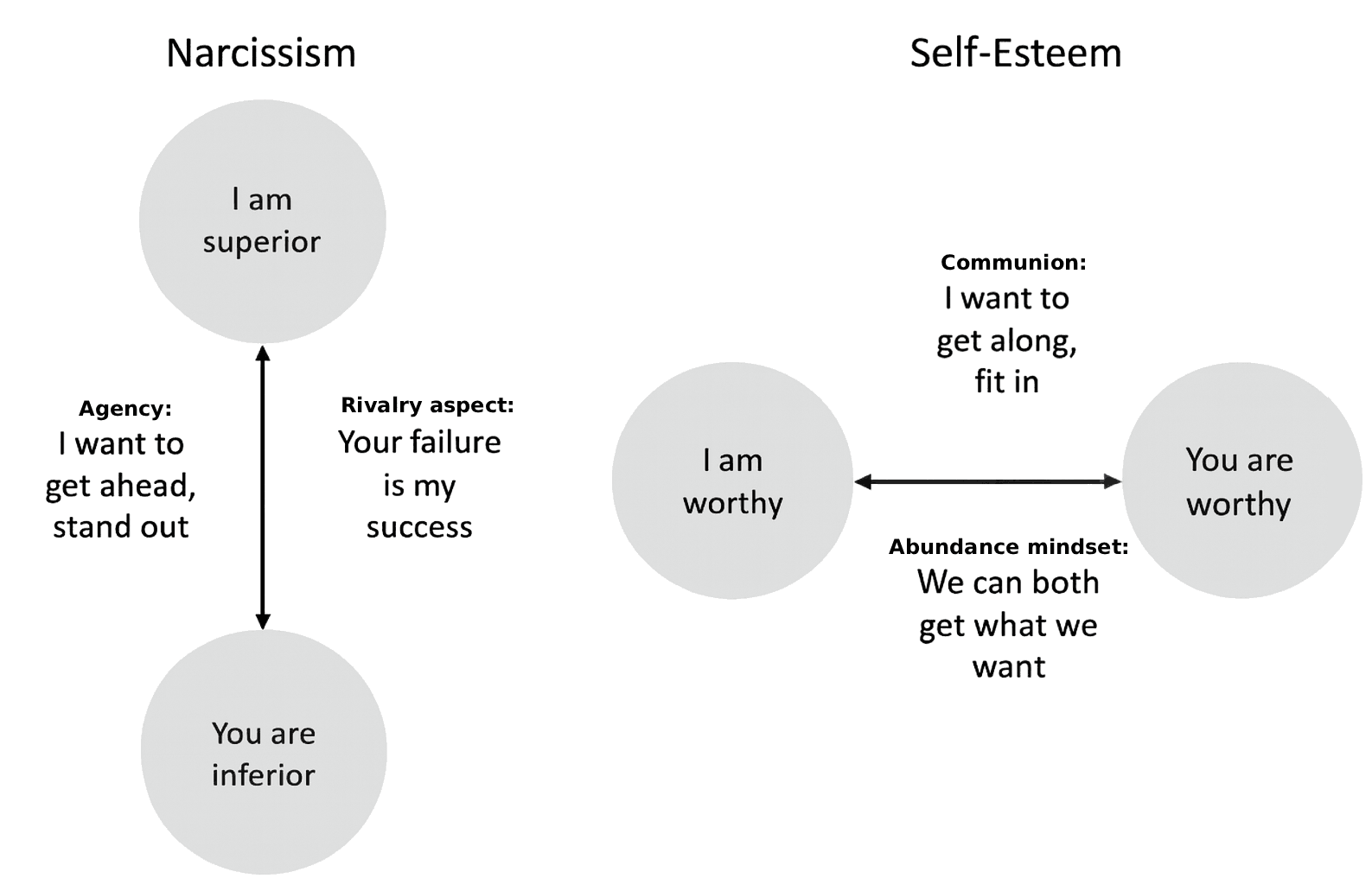
The belief system underlying narcissism and self-esteem, adapted from Brummelman, 2018
| Narcissistic Self-Esteem | Non-narcissistic Self-Esteem |
|---|---|
| Based on superiority; “God complex” | Worthy, not necessarily superior |
| Agentic traits (competence, intelligence) | Both agentic and communal traits |
| Inflated self-view, | Realistic self-view |
| Look down on others | Respect others; sees intrinsic worth |
| Craves others’ admiration; may suffer without it | Independent, secure in self-worth |
| May lead to rage and aggression | More forgiving (Locke, 2009) |
Based on Brummelman’s chapter ‘What Separates Narcissism from Self-esteem? A Social-Cognitive Perspective, providing an overview of the research literature on narcissism and self-esteem
While some authors refer to non-narcissistic self-esteem as ‘healthy’ self-esteem, it may not always and necessarily be ‘better’. Instead, narcissistic grandiosity may provide a significant advantage in certain contexts.
For example, narcissistic grandiosity may pass for unmitigated confidence and be more attractive in certain dating contexts; or it can better galvanize followers to pursue challenging goals (think of Steve Jobs’ ‘reality distortion field’).
And remember that by hierometer theory, narcissistic self-esteem focuses on status, rather than inclusion. That means that narcissistic self-esteem is higher agency, and may be more effective for self-advancement and goal achievement.
To integrate high-status grandiosity with psychological resilience, see the TPM framework:
Narcissism vs. The Dark Triad
Narcissism has been conceptualized as part of a ‘dark triad’ also including Machiavellianism and psychopathy (Paulhus & Williams, 2002).
The unifying features are antagonism, low empathy, and a disposition toward using others.
And, potentially, unrestricted sociosexuality with predisposition for short-term mating (Jonason et al., 2011).
| Trait | Brief Description — Pros & Cons |
|---|---|
| Narcissism | Grandiose, arrogant, and ego-focused. ✅ Confidence, charisma, leadership attainment ❌ Neediness for admiration and recognition, hypersensitvity |
| Machiavellianism | Strategic, long-term minded, pragmatic, ends-oriented mindset. ✅ Strategy, political skills, leadership emergence ❌ Over-cynicism, poor intimacy in relationships |
| Psychopathy | Impulsivity, low empathy, low anxiety, fearlessness, and boldness. ✅Fearlessness, boldness, high stress tolerance ❌ Impulsivity and irresponsibility undermine long-term achievement; substance addiction |
Table based on The Dark Triad of Personality (Lyons, 2019), and other research
An ideal mix for maximum performance would be: narcissists’ grandiosity, confidence and social charm, strategic predisposition of Machiavellians, and the ability to be selectively fearless and cold.
Add an honorable man’s approach, and you get to TPM’s transformation.
Adaptive vs. Maladaptive Narcissism
❗ Read it: This section is crucial for leveraging narcissism’s positives, without the negatives ❗
The NARQ model subdivides narcissism into two main modes:
- Admiration enhances the self = assertive self-enhancement, high-agency, and approach-oriented
- Rivalry tears others down= antagonistic self-protection with competitor devaluation, derogation, and envy
This is important for life success because admiration largely accounts for mental and social power, while rivalry undermines both (Back et al., 2014).
It’s admiration that delivers positive outcomes like early status, respect, and attraction. And it’s rivalry that squanders it over the long run (‘chocolate cake model’, see below).
| Admiration | Rivalry |
|---|---|
| Assertive self-enhancement (seeking admiration and status) | Antagonistic self-protection (defending grandiosity, blocking threats) |
| Dominance and prestige; charming; self-promotion | Dominance and derogation of others |
| Positive affect, confidence | Negative affect (envy, anger); lower self-esteem |
| Good first impressions, leadership emergence. | Conflict; toxic relationships; negative association with communion |
Facets of Narcissism
Facets of narcissism have also been associated with adaptive and maladaptive outcomes (Watson & Biderman, 1993; Watson & Morris, 1991).
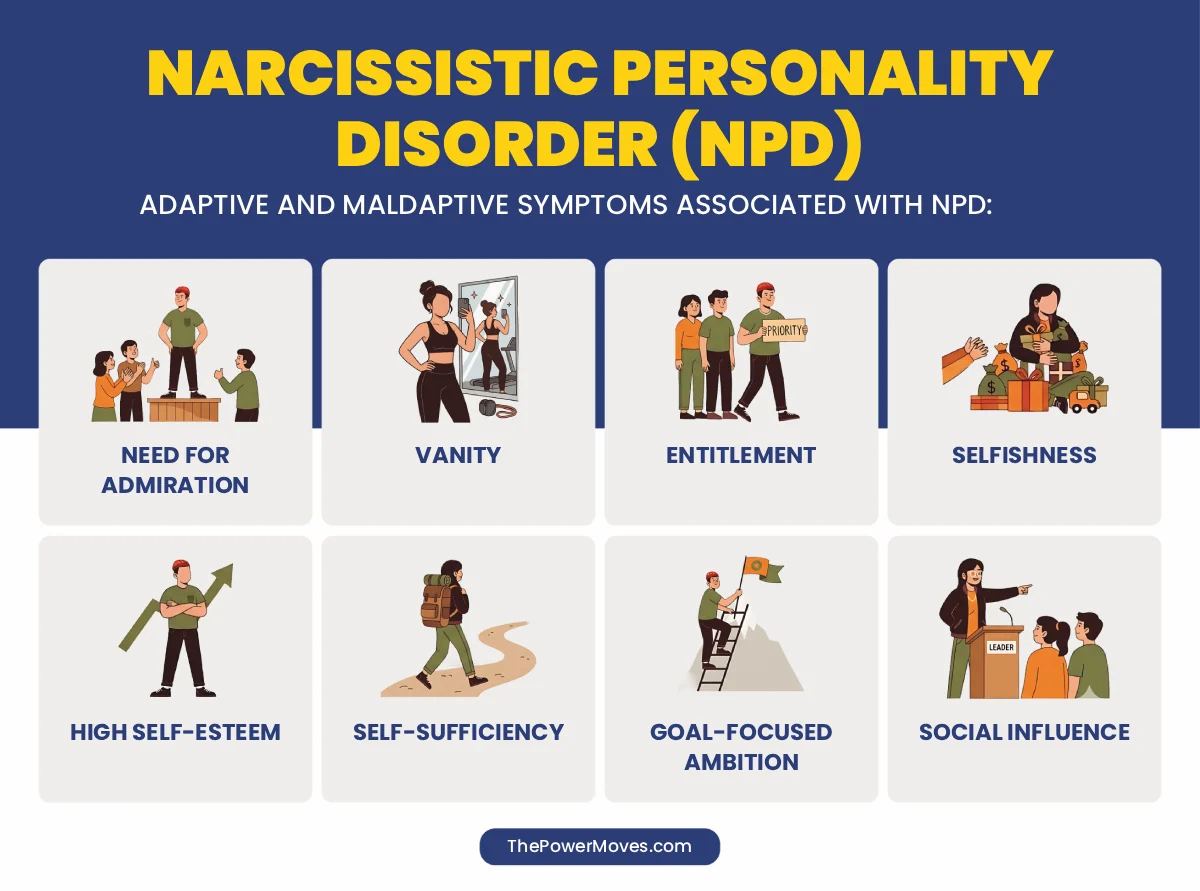
Categorizations differ by source, but authority and self-sufficiency are always considered adaptive, and entitlement and exploitativeness always maladaptive. Superiority and vanity are categorized as adaptive or neutral, and exhibitionism as neutral or maladaptive.
| Sub-facet | Explanation |
|---|---|
| Self-Sufficiency | Belief in one’s competence and independence; not relying on others to succeed. ✅ Independent and confident. ❌Avoids seeking help. |
| Authority | Belief in one’s leadership skills, power, and persuasiveness. ✅ Leads, drives initiatives. ❌ Can come off domineering. |
| Superiority | Feels above others and ‘better’. ✅ High ambition, confidence. ❌ Arrogance, poor self-assessments, alienation. |
| Vanity | Excessive concern with appearance and attractiveness ✅ Improves impressions. ❌ Shallow, validation-seeking, fragile looks-based ego |
| Exhibitionism | Excessive need to be the center of attention. ✅ Charisma in groups. ❌ Obnoxious, insecure when ignored, poor 1:1 relationships |
| Entitlement | The expectation of special treatment, above the rules. ✅ Win exceptions or appear higher power. ❌Conflicts, chronic anger and frustration, repels quality men |
| Exploitativeness | Willingness to manipulate or use others; disregarding others’ well-being ✅ Rapid short-term gain. ❌ Loss of trust, drive quality people away, isolation |
Even the ‘maladaptive’ facets can help achieve goals, at least in the short term.
But even when excluding moral considerations, they come with significant costs. Research shows that Entitlement and exploitativeness are associated with poorer mental power and relationship difficulties (including lower self-esteem, higher neuroticism and envy, and lower theory of mind).
Let’s dig deeper into the risks of narcissism.
Strategic Liabilities
Narcissism has incredible upsides and potential, but comes with important risks, especially when associated with rivalry, vulnerability, and unhealthier facets (exploitativeness and entitlement).
Some of the major liabilities include:
1. Limited Growth and Stagnation
Several issues may compound to limit narcissists’ growth over time:
- Competence-proving may cost in competence-building: while some focus on learning goals, narcissists focus on proving competence. Paralleling a fixed mindset, failure-avoidance may compound this issue (Elliot & Thrash, 2001; Gerhardt & Le, 2013)
- Admiration over feedback: rational learners would analyze critical feedback for self-development, but narcissists push back with self-protective behaviors (e.g., Kernis & Sun, 1994)
- Little ownership: Narcissists are less likely to learn from mistakes because they blame others (Campbell et al., 2004)
2. Poorer decision-making
Narcissists overvalue their expertise and ignore expert advice; it’s not a good recipe for optimal decision-making (O’Reilly and Hall, 2021).
Narcissists’ overconfidence can also cost financially.
A myopic focus on reward and over-optimistic expectations swelled narcissists’ losses in gambling experiments (Campbell et al., 2004; Lakey et al., 2008).
3. Poorer Strategy & Results
The need for superiority often harms effective social strategy.
For example, says Wallace in the Handbook of Narcissism and NPD:
Narcissists report Machiavellian willingness to manipulate others (e.g., Paulhus & Williams, 2002), but their perpetual grandstanding regardless of context suggests that they lack the craftiness to maximize self-benefits.
Narcissists may also lack calibration:
Narcissists’ self-enhancement prospects are limited by inflexibility (…) admiration-eliciting behaviors in one context could induce the opposite in another, so admiration-seekers should calibrate to the environment. Narcissists apparently lack this wisdom. They employ the same unsubtle, exhibitionistic style of self-promotion regardless of the situation (Campbell et al., 2000; Collins & Stukas, 2008).
4. Escapism From Reality (Geek Culture & Collective Narcissism)
Faced with challenges, narcissists may escape into alternative realities instead of persevering. This is the Great Fantasy Migration hypothesis, and there is some evidence to back it up.
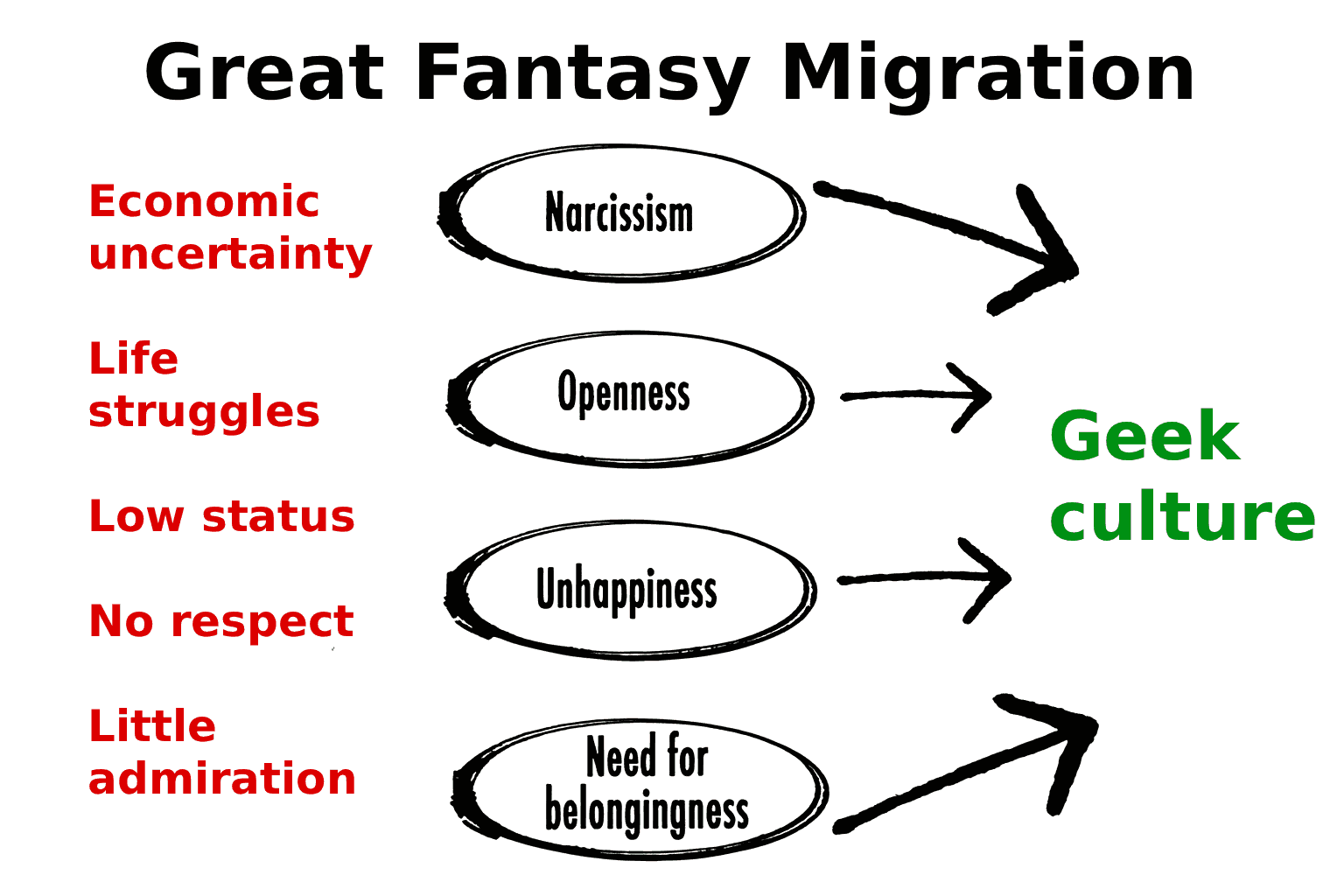
For example, narcissists engage in more fantasies of great feats and heroism, and are over-represented in geek culture and cosplay (Itamar and Shahar, 2014; McCain et al., 2015; W. Andrews and McCann, 2022).
A different but overlapping escapism from individual reality is tribalism.
Good empirical support now exists for collective narcissism, largely concerning vulnerable narcissists (de Zavala, 2019).
This is how the originator of the concept summarizes the available research in The Handbook of Trait Narcissism:
the reviewed research suggests that collective narcissists engage in intergroup hostility to protect their vulnerable self-worth invested in in-group’s exaggerated greatness.
Such as: individuals with disappointing personal lives feed their need for grandiosity through the group, rather than the self.
5. Souring Friendships & Social Networks
Narcissism is beneficial in the ’emerging zone’, but increasingly detrimental as acquaintance increases in the ‘enduring zone’ (Campbell and Campbell, 2009).
As early favorable impressions fade, narcissists are seen as arrogant, hostile, and braggarts (Paulhus, 1998).
⚠️ Even early impression can be unfavorable if rivalry is activated and empathy is required.
In debating experiments that likely triggered rivalry, coders rated narcissists negatively (e.g., as acting irritable, hostile, bragging, and ignoring their partner).
Previous studies with more intimate and interactive contexts also showed lower popularity (see Küfner et al., 2013, for an overview).
6. Poorer long-term relationships
Narcissists’ relationships may start more exciting, but plummet fast instead of growing.
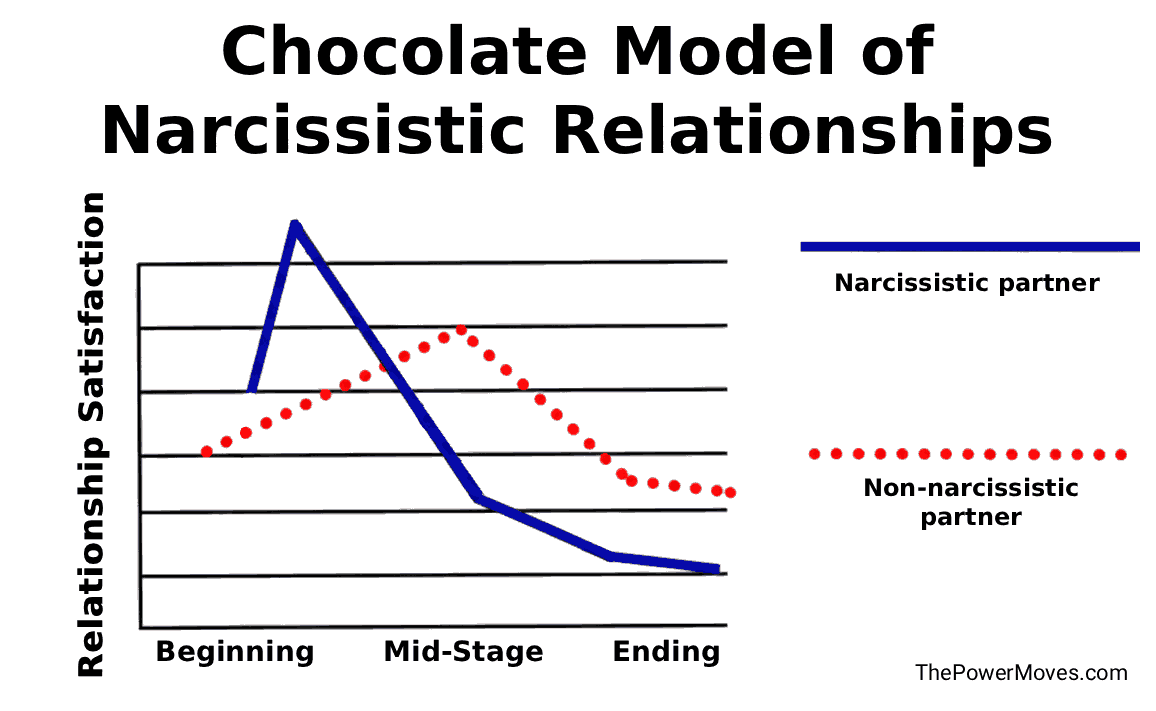
The chocolate cake model of narcissistic relationships (Chart revised by Buffalmano, 2025)
A 2014 German study may explain this common trend: narcissists switch from admiration to rivalry over time. First, they search for admiration with self-enhancement or value-adding approaches. And once the partner is secured, they switch to rivalry. The authors hypothesize that putting the partner down serves the same goal of self-enhancement.
Partners indeed described the narcissist as game-playing, deceptive, and manipulative, and they feel less valued (Campbell et al., 2002; unpublished data as cited by Morf et al., 2011).
TIP: keep rivalry at bay, pick supportive partners, or consider atypical relationships
It’s possible to have good relationships with or as a narcissist. If you’re not the type for relationships though, consider the alternatives. Don’t decide out of social pressure: it may cost everyone.
7. Contingent Self-Esteem: Makes You Needy For Positive Results
The mask model of grandiose outer shell but low implicit self-esteem has fallen in disfavor, but narcissists’ self-esteem may still be contingent on positive outcomes and feeling superior.
Studies showed that when grandiose narcissists have low intellectual self-esteem, their well-being was lower than people low in grandiose narcissism.
Maladaptive facets of Entitlement / Exploitativeness also showed unstable self-esteem when facing interpersonal threats (Zeigler-Hill & Besser, 2013).
8. Psychological Fragility When Faced With Uncontrollable Obstacles
Strength without resilience and adaptability makes systems vulnerable.
Indeed, there is some evidence to suggest that the higher the delusional sense of invincibility, the higher the risk and severity of PTSD and generalized anxiety disorder.
Besser, the author, hypothesizes that narcissists’ inflated and inflexible sense of control sets them up for failure when events are uncontrollable.
Effective Narcissism™: 7 Traits to Cultivate
Effective Narcissism™ describes the high-functioning expression of narcissistic traits that reliably produce agentic, life-relevant outcomes (e.g., status, mating, influence, and resource acquisition), while reducing the self-defeating costs associated with maladaptive narcissistic expressions.
Effective Narcissism vs. Healthy & Adaptive Narcissism
Effective Narcissism™ is TPM’s applied synthesis of leading empirical handbooks, peer-reviewed research, and Lucio Buffalmano’s long-term analysis of power dynamics.
Related constructs appear as healthy narcissism (popular discourse), emphasizing assertiveness and prosociality, and adaptive narcissism (academia), typically treating entitlement and exploitativeness as uniformly maladaptive. TPM departs from the moral frame: in specific, strategically constrained contexts, entitlement and exploitativeness may yield instrumental advantages—even when they operate outside of traditional morality (George-Levi S., 2025; Brunnel et al., 2013, Study 4).
Effective Narcissism is the goal; Strategic Narcissism™ is the work. It is the process of cultivating the traits that fuel power while consciously avoiding the toxic ones.
There is no one-size-fits-all to ‘maximize narcissism’ because it depends on the individual’s starting point.
But at a high level, we can say:
- Narcissists must reduce toxic traits while keeping or increasing the empowering ones
- Non-narcissists must develop the empowering traits, while avoiding the toxic ones
Here are the most effective, research-backed behaviors and mindsets of successful narcissists:
1. Be High Agency
High agency includes:
- High sense of control: believe you can influence your lives and outcomes
- Bias for action, solution-oriented
High agency does not necessarily require competitiveness or narcissism—but it’s a defining trait of successful narcissists. Narcissists’ inflated self-views may also combine with high agency into unmitigated self-confidence.
Lastly, research shows narcissists don’t care about communion, giving undivided focus on agency:
| Agency | Communion |
|---|---|
| Get ahead | Get along |
| Goals | Relationships |
| Power | Warmth |
| Assertive | Kind |
| Independence | Interdependence |
You can have both achievements and relationships—but high agency with an internal locus of control is a must.
2. Pursue Your Goals & Focus On Yourself (Approach-Orientation)
Grandiose are approach-oriented and sensitive to rewards, whereas vulnerable narcissists are avoidance-oriented and sensitive to threats (Foster & Trimm, 2008).
Approach orientation is associated with positive emotionality and boosts life effectiveness.
Writes narcissist researcher Keith Campbell with a dating example:
Grandiose narcissists (…) might ask ten people on a date to get one to say “yes.” (…)
Playing the numbers game when failure costs are low is a winning strategy—we’ve long espoused it here at TPM.
👉🏼 Approach orientation + self-focus addresses help fix rivalry
Self-focus sidesteps the other-focus that fuels rivalry. Mindset: ‘the competition doesn’t even exist‘.
3. Be High Self-Esteem
High self-esteem is the main driver of narcissists’ mental health and power.
Self-esteem is in part genetic (Raevuori et al., 2007; Luo et al., 2013). But, like most traits, there is much you can do to increase it
See this video for a complete guide on increasing self-esteem and confidence, or consider Confidence University.
Narcissists’ Tactic: Positively-Biased Attributions
Narcissists attribute successes to ability and failure to task difficulties while non-narcissists and vulnerable narcissists do the opposite (Stucke, 2003; Krusemark et al., 2015).
One may argue that this is a cheap trick that distorts reality. We agree, but… It works.
While you address self-esteem at its root, this tactic can help.
4. Be Self-Sufficient & Independent
High self-sufficiency is both empowering and attractive.
It doesn’t mean you have to be alone. It means you can be.
🙋♂️Lucio’s Take: Strong men walk alone

Lucio:
I take this aspect to an extreme and take pride in self-sufficiency.
I believe strong men walk alone, while weak men seek refuge in groups (there is also some evidence for this). The ultimate measure of a man’s power is the ability to carve his own path, on his own.
5. Approach, Talk, & Lead In Groups: Strategic Extraversion
Extraversion with confidence and social power fuels narcissists upward.
You don’t need to become an extrovert if you’re not; you only need to momentarily act like an extrovert.
Think of it like ‘switching on’ when it matters. After performance time, you’re back doing whatever you want.
This study attributed narcissists’ initial success to:
- Fancy appearances (e.g., fashionable dress and stylish hair)
- Charming facial expression (i.e., looked more self-assured and friendly)
- Self-assured body language (e.g., straight posture, confident walk, smooth movements)
6. Calibrate Strategically: The Advanced Game
Despite popular ‘power laws‘, the name of the advanced game is balance and calibration.
For example:
- Use narcissism publicly more than privately
- Add warmth to the dominance: lead with confidence, while also building intimacy
- Display value with nonverbals first, then double down verbally when they recognize it (think: confirm their reality instead of forcing it)
- Calibrate work self-promotion based on culture & visibility: self-promote more in individualistic cultures and for low-visibility work
Check this foundational article on being both dominant and warm.
7. Conquer With ‘Honorable Narcissim™’
Honorable Narcissism™ builds on Effective Narcissim by placing strategic honor™, power-aware smart cooperation™, and a preference for win–win as the baseline
Writes Keith Campbell on combining narcissists’ success with win-win:
You demand power, status, leadership, material, and respect. That’s great, and it often works.
However, in turn, you should give back (…) that general trade-off is important ethically to conceptualize (…). Are you bringing more to the system than you’re taking? Are you causing less suffering than you’re creating? These questions can be tough to answer (…) but they’re the ones that we need to consider.
We agree, and that’s exactly our approach: win, with win-win. Or, at least, without being a value taker.
Strategic Takeaways
How does narcissism affect success—both short-term and long-term?
Narcissism tends to boost success early on because agentic traits like confidence, leadership, and self-promotion help people stand out, take initiative, and position themselves for opportunities.
More maladaptive forms of narcissism however grow and become more visible over time, and become a liability. Entitlement, hypersensitivity to criticism, and neediness for admiration and superiority can undermine teamwork, learning, and stable relationships.
The overall pattern supported by research is clear: the adaptive sides of narcissism help with early advancement, while the antagonistic sides often erode long-term success if left unchecked.
Can I intentionally adjust my narcissistic traits—up or down?
Yes. Non-narcissistic individuals can learn to amplify the adaptive traits linked to achievement, such as assertiveness, charisma, ambition, and confident goal pursuit. These are skills and dispositions that can be intentionally developed without sliding into toxicity. Narcissistic individuals can also reduce, or at least strategically avoid acting on, the more harmful facets such as rivalry, entitlement, or overreacting to criticism.
Is narcissism always a weakness in relationships?
No. Narcissism often increases early attraction because confidence, status, and leadership signals are appealing in dating and narcissists are described as ‘exciting’.
Problems tend to appear later, when charm and confidence failed to build intimacy and give way to devaluation and competitiveness.
But research shows that with the right tools, like perspective taking, affirmations, and supportive partners, narcissists can improve their behavior and relationships.
Next Steps: A Winning, Honorable Narcissist
Narcissism is not a binary ‘good’ or ‘bad’, but a high-octane fuel.
As we have seen, the science is clear: the Adaptive traits (Authority, Self-Sufficiency, Approach-Orientation) are correlated with leadership, resilience, and happiness. They’re fuel for power and achievement.
However, the Maladaptive traits (Rivalry, negative Entitlement, Neediness) are the brakes. They are the reason why so many high-potential men crash over the distance—or find themselves isolated at the top.
Now that you understand the mechanism of the narcissistic mind, you can delve deeper into the how.
In our follow-up guide, we detail how to nuke toxic traits and harness the adaptive ones:
- How to be an effective narcissist
- Power University: The complete, integrated system for mastering high-agency, Machiavellianism, and strategic dominance.