

Masculine body language conveys confidence and earn you instant respect, attraction, and influence—without saying a word.
At The Power Moves, we’ve taught thousands of men the mechanics behind masculine presence—and how to wield it strategically to achieve goals.
This guide avoids the ungendered pop-psych fluff and teaches you how powerful men actually move.
Let’s get into it.

Contents
Why Masculine Body Language Matters
People judge you in seconds—and much of that judgment comes from how you move, stand, and look, not what you say.
Masculinity is one of the foundations of a high-value man who attains status, respect, and attraction.
Conversely, researchers say that men incur heavy social costs for adopting feminine body language.
And your nonverbal communication conveys masculine power before you even speak.
If you get this right, you gain:
- Respect from men
- Attraction from women
- Influence and status in any group
🙋♂️Lucio’s Take: Prioritize power, and masculinity will follow

Lucio:
Masculinity matters, and if you’re lacking it, you must focus on it.
But remember it’s a means to an end—a simple truth that sometimes goes missing in male self-development.
‘Masculinity as a goal’ can be overdone and look try-hard. The second risk is blind spots: to be effective, masculinity requires calibration, and effective strategies.
🧠 Think of it this way: you’re already a man, you don’t need to learn how to be one.
Focus on social and mental empowerment, and masculine body language will naturally follow.
How to Have Masculine Body Language
Here are the basics of masculine body language:
1. Stand Like a Leader
Posture is the foundation of good body language, and masculinity is no exception.
- Straight spine
- Shoulders back
- Chest open
- Feet shoulder-width or wider

Hands on hips is a typically high-power posture, but can be too much in professional settings and when you want to prioritize rapport and connection
2. Take Up Space
Including:
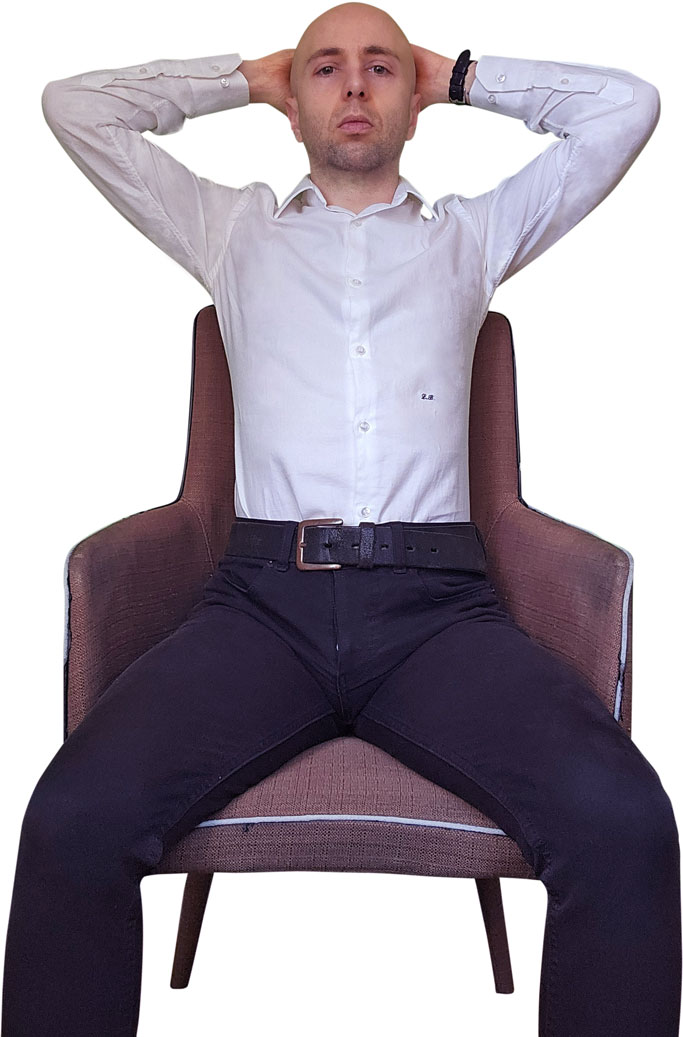
- Elbows on armrests or one elbow against a bar
- Legs apart or in ‘legs four position’ (below)

This body language pose is a good balance of natural spreading out for comfort, without overdoing it. It fits well in informal socialization
Spreading out is the most stereotypical advice when it comes to both masculine and dominant body language, and it’s valid.
However, never forget:
👉🏼 Balance & calibration: don’t overdo it
An over-manspread is juvenile and try-hard in many settings, and unprofessional at work.


3. Walk Like You Belong
Your walk displays your inner beliefs.
Men who walk like they own the place get treated like they do.
Key masculine cues:
- Shoulder swag, The APA Handbook calls it ”walking in 3D rather than 2D”
- Steady brisk pace, but not rushed
- Longer stride length
- Arms swing to pace your walk
- Eyes straight on or scanning without fear—not glued to your phone
💪🏼 Power move: stand your ground, don’t jump out of people’s way. If on collision course, expect others to take their half-step out of the way
4. Facial Expressions: Keep It Cool 🗿
- Hold eye contact a second longer than average.
In public, look ahead in the distance, out of focus, and through people - Blink less frequently
- Chin parallel to the floor
- Use a relaxed, slight, tight-lipped smile to build intrigue
- Eyes open for intensity, lower eyelids for seductivity

A slight, tight-lipped smile displays masculine confidence. With lower eyelids, it’s seductive; with open eyes, it’s intense
Avoid:
- ❌ Looking away too fast, especially if downward (submissive)
- ❌ Smiling too often or too broadly (approval-seeking)
- ❌ Wide open eyes (nervous energy)
💪🏼 Power move: stare to enforce boundaries after a power move, without a single word.
5. Pick A Central Spot
Body language isn’t just what you do—it’s also where you stand.
- Claim central or forward-facing spots in groups
- Stand in visible spots in bars and clubs
- Look towards the center/main action 👇🏼 (unless purposefully ignoring as a power move)


💪🏼 Power move: Stand slightly off-center to someone facing you to frame him as chasing you, while you act like a leader who remains open to the full group

I’m the one in the middle, and with the most obviously open body language
6. Start Slightly More Masculine
First impressions are critical: err on the side of power—it’s the strategic optimum.
You can always mellow and tone it down later, and it’s easier to ‘come down’, than ‘go up’.
Starting too low in masculinity is costlier, and you face a bigger uphill struggle in changing impressions.
In Dating:
- Hold your frame even when she tests it
- More eye contact, fewer smiles
- Lean back first, lean in after investment
In Socialization:
- Be the first to move
- Be the first to take space
- Use long pauses to signal confidence and comfort with silence
At Work:
- Speak early in meetings, with calm tone and open gestures
- Take the seat with the most visibility (or strategically close to your boss)
- Keep your chin up and hands above the table

7. Speak Like A Man
Albeit not strictly ‘body language’, paralanguage is a fundamental part of nonverbal communication.
A masculine voice is:
- Lower pitch (Klofstad, 2012)
- Higher volume than average (Schmid Mast & Sczesny, 2010)
And avoid:
- ❌ Vocal fry
- ❌ Upspeak, or going up as if it were a question mark
- ❌ Tentative language and excessive backchanneling (Leaper & Robnett, 2011)
For more see:
- Low power speaking: stop doing these
- High power speaking: speak like a confident man
8. Avoid Generic & Ungendered Pop-Psychology
Generic, untailored advice is the bane of self-help.
For example, this advice is valid only if well-calibrated, and generally not associated with high masculinity:
- ⚠️ Mirror others: men mirror less, women mirror more, and androgynous men mirror most (M. LaFrance and Ickes, 1981)
- ⚠️ Be expressive: masculine men are less expressive and androgynous men most expressive (Narus and Fischer, 1982)
- ⚠️ Ask questions: men use more statements, women ask more questions (M. LaFrance and Carmen, 1980)
Power-unaware generic advice is equally common.
Popular ones for confidence and body language include:
- ⚠️ Look people in the eyes, high-status and dominant men look less at others when they speak (Exline, Ellyson, & Long, 1975)
- ⚠️ Speak less than necessary, a valid ‘law’ from pop literature on power, but counterproductive during group formation, in bars or clubs, and among younger men
Of course, saying not to do any of the above would also be a useless generalization.
Masculine effectiveness is about when to do what, and how to do it (keep reading).
Masculine vs Feminine Body Language
While individuals vary, consistent gendered patterns have been observed.
Some differences are genetic, and some come down to cutlure and socialization. The latter is even more important for status, and likely also for respect, and attraction.
A simple principle here:
⚖️ Avoid feminine body language
Men pay a price for behavior deemed as ‘feminine’.
For a quick overview on feminine vs masculine body language:
| Aspect | MASCULINE | FEMININE |
|---|---|---|
| Posture | Broader stance (feet shoulder-width, chest out). | Constricted stance, legs and feet closer together. |
| Gestures | Fewer, but larger and more expansive. | More frequent, smaller gestures |
| Facial Expressions | Less expressive, suppressing more emotions | More expressive |
| Touch | Less casual touch, but may use it for dominance; purposeful handshake | Lighter, friendly touches; ‘resting hand handshake’, no ‘pumps’ and little tension |
| Proximity | Larger personal space (especially with strangers) | Willing to stand or sit closer to during conversation, reflecting affiliative behavior |
| Smile | Fewer smiles in neutral situations | Smile more often (even when listening) |
| Voice | More monotone | Wider vocal pitch range and vocal variety |
Of course, these are general trends, not rules. Exceptions and nuances apply.
But don’t get lost in over-relativism: many nuances follow predictable and foundational power principles.
For example, women adopt more male-typical scripts at work, and especially in high-power roles and male-dominated industries.
It’s exactly what you’d expect when higher masculinity is the group norm, expected, and necessary for advancing.
Masculine Optimum Balance
Masculine body language follows the principle of optimum balance, achieving maximum benefits within the two extremes of too feminine, and try-hard machismo.
Where exactly that optimum falls comes down to calibration for social context, calibration for goal achievement, and advanced fluidity.

Optimal masculine body language for most situations will fall close to that central position
1. Calibrating to Context
Remember that masculinity, like almost anything else, is all about calibration.
Calibration reads the room’s power dynamics, allowing you to dominate or put others at ease as necessary, without looking weak.
As a principle and guideline:
⚖️ Be on the upper range of masculine body language that is appropriate for the context
We advise the upper because ‘higher masculinity than average’ is good, and because the costs of ‘not masculine enough’ outweigh the costs of ‘being too masculine’.
2. Calibrating to Goal Achievement
Advanced calibration considers the context, in light of one’s goals.
Once you reach all your goals, you don’t even need to care of how you come across.
This is why some wealthy older men dress poorly: they don’t need to prove anything to anyone.
However, only smart calibration, smart action, and caring what others think will get you there.
Some tips:
- Be more masculine than your dates, for attraction
- Be more masculin than the average, for status
- Tone it down at the office, to prevent competitive higher ups to dislike you (you’ll ‘do you’ once you overtake them)
3. Advanced Calibration: Strategic Fluidity
Finally, advanced players are never stuck with any ‘mode’.
Instead, they span the full gamut depending on what best achieves their goals, given the context.
For example, leaning towards femininity puts nervous women at ease during first approach. And moments of strategic vulnerability can help bonding during relationship formation.
Some seducer types even lean on feminine body language.
See for example Russell Brand:
Russell Brand: (moves with feminine body language)
🙋🏼♂️ Lucio’s take: I don’t necessarily advise copying Russell (I wouldn’t want to be him, for one). It’s the concept of adaptive fluidity you want to adapt, not any specifc move or style.
Next Level: The WINNING Man
Men who understand and control their nonverbal communication rise faster.
They attract more interest, build better alliances, and command more respect.
However, the top men aren’t merely able to strike masculine poses.
They’re advanced strategists, fluid players, and mentally unbeatable.
We teach how in our flagship training program:
- Power University, the full blueprint for empowered men who achieve their life goals


