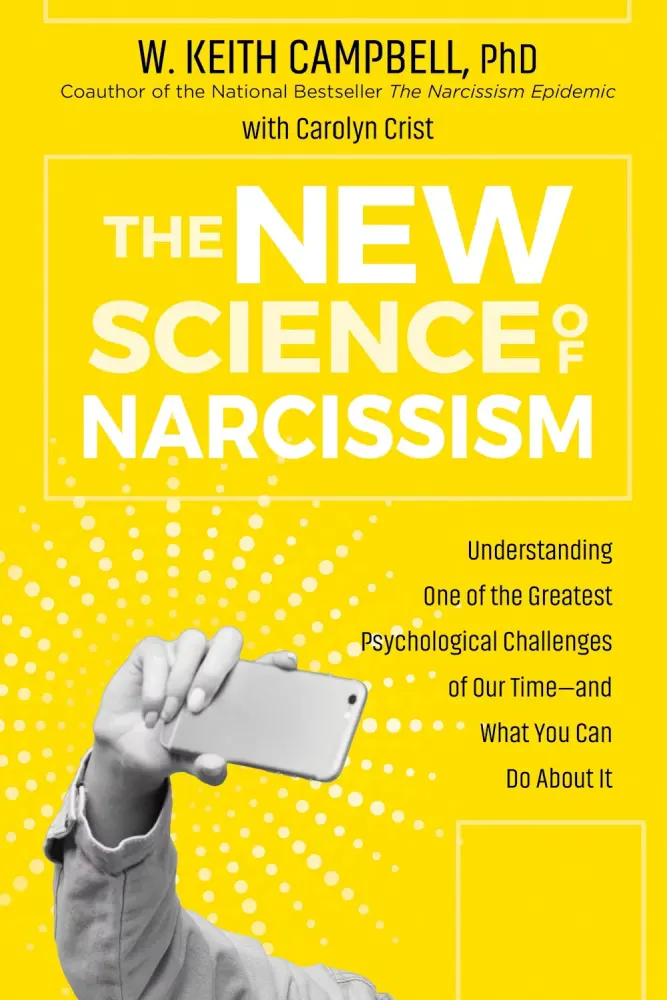
The New Science of Narcissism (2020) offers a clear, research-based overview of narcissism as a spectrum trait, explaining what characterizes it, and how it shows up in everyday life.
Contents
- FULL SUMMARY
- Chapter 1: Defining Narcissism
- Chapter 2: Measuring Narcissism
- Chapter 3: Basic Traits and the Narcissism Recipe
- Chapter 4: Narcissists’ Goals and Motives
- Chapter 5: Narcissistic Personality Disorder
- Chapter 6: Narcissism’s Cousins: The Four Triads
- Chapter 7: Relationships and Narcissism
- Chapter 8: Leadership and Narcissism
- Chapter 9: Social Media and Narcissism
- Chapter 10: Geek Culture and the Great Fantasy Migration
- Chapter 11: Using Narcissism Strategically
- Chapter 12-13-14: Reducing Narcissism
- SHARPEST INSIGHTS
- Humanity Needs New Systems For Leadership Emergence
- Selfless Leaders Are Remarkably Rare: 2.000 Years Gap
- Chaos vs. Stability
- Life Follows The Law of Balance
- Everyone Wants Status, Not Just Narcissists
- Narcissism May Undermine Growth
- Love Bombing: A Pop-Psychology Myth?
- Grandiose = Predator, Vulnerables = Prey
- QUOTES
- 🙋🏼♂️ Lucio’s Analysis
- REVIEW
FULL SUMMARY
About the Author:
W. Keith Campbell is a leading social psychologist and professor at the University of Georgia, best known for his pioneering research on narcissism. Campbell has published over 120 peer-reviewed papers, several books, and has been the editor of the first handbook on narcissism, The Handbook of Narcissism and Narcissistic Personality Disorder and authored a chapter in The Handbook of Trait Narcissism (🙋🏼♂️ Lucio’s note: I very much appreciate top researchers who also contribute to handbooks that provide an empirically grounded overview of the field).
Chapter 1: Defining Narcissism
At its core, narcissism is about self-importance, antagonism, and a sense of entitlement. Narcissists believe they matter more than other people and deserve to be treated that way.
Narcissism spans a spectrum: grandiose (ambitious, charming, high self-esteem) and vulnerable (insecure, depressed, low self-esteem), sharing a core of entitlement but differing in traits.
Some people have a mix of both, like Kaynie Waste, who is both grandiose and thin-skinned, reactive to criticism.
Elliot Rodger’s case exemplifies vulnerable narcissism with grandiose elements.
- Psychotherapists don’t often see grandiose narcissists because they don’t struggle socially or in life
- Trifurcated Model of Narcissism bridges vulnerability and grandiosity: connects grandiose and vulnerable narcissism as two related but separate traits. Both share a core of disagreeableness, self-importance, and a sense of entitlement, but they differ. With grandiose narcissism, you see confidence, boldness, and self-esteem, but with vulnerable narcissism, you see low confidence, anxiety, and low self-esteem.
- The mask model is incorrect, and grandiose narcissists don’t have a weak core: Under this interpretation, however, it would mean that when President Donald Trump goes home at night and looks in the mirror, he sees Woody Allen staring back at him. This is a neat idea, but like many neat ideas, it doesn’t hold up to scrutiny.
Models For Understanding Narcissism
| Model | Description | Example |
| Nomological network (trait model) | Narcissism is a stable trait that exists in a network with other traits. | Narcissism is linked with psychological entitlement. |
| Self-regulation model | Narcissism is a trait but needs to be actively maintained by meeting goals. | Narcissism leads to forming friendships, which in turn leads to self-esteem. |
| Evolutionary model | Narcissism is a trait, but needs to be actively maintained by meeting goals. | Narcissism predicts short-term mating success. |
| Cultural model | Narcissism is created, modified, and spread by cultural forces. | Narcissism was formed and spread by the broader focus on individualism. |
Chapter 2: Measuring Narcissism
Narcissism scales include NPI (grandiose, 40 items) and HSNS (vulnerable, 10 items).
The author invites to testing yourself, but with self-awareness: interpret the scales as indicator to measure traits, not disorders.
Rigor vs. Pop Science
Campbell also calls into question some pop-culture personality tests:
I’m sure you’ve taken a personality quiz or two—who doesn’t love those? Under the Myers-Briggs Type Indicator, you may be an ENTJ or an ISFT. Many variations exist, and chances are, many of them have little or no grounding in scientific evidence, especially if they are related to pop culture.
(…) Quiz takers often encounter what psychologists call the Barnum Effect, who apocryphally said, “There’s a sucker born every minute.” The Barnum Effect works by giving vague, ambiguous feedback that applies to everyone.
As well as some definitions, for example referring to the Six Pillars of Self-Esteem:
This massively popular work expanded the definition of self-esteem (…) yet it also captures many variables that today’s psychologists would place beyond self-esteem, such as mindfulness and self-efficacy.
Chapter 3: Basic Traits and the Narcissism Recipe
| Trait Level | Name | Description | Comment |
| Meta-trait | Big One | E + O + A + C – N | The “positive” poles of the Big Five |
| Meta-trait | Big Two | A + C – N E + O | Stability (also Alpha) Plasticity (also Beta) |
| Trait | Big Five | E, O, A, C, N | All-around most useful but has trade-offs of precision and generality |
| Aspect | Medium Ten | Extraversion split into enthusiasm & assertiveness | Useful for more specific questions |
| Facet | Thirty Facets | E split into activity, assertiveness, excitement-seeking, gregariousness, positive emotion, warmth | Useful for building complex profiles |
levels of personality traits
The author describes personality with the analogy of a recipe.
Personality traits are stable descriptors; Big Five (OCEAN: openness, conscientiousness, extraversion, agreeableness, neuroticism) form the foundation:
The Big Five traits are the ingredients that cover almost all other personality traits. At the same time, a personality recipe loses precision when using the Big Five traits; it’s a recipe that lists meat as an ingredient but doesn’t specify steak, pork, or chicken. The recipe is simple and straightforward, but vague
Narcissism’s “recipe”:
- Low agreeableness (antagonism) is the ‘key ingredient’. Antagonism has been called entitled self-importance or darkness.
It includes:- sense of entitlement
- lack of empathy
- manipulativeness
- superiority.
- High extraversion for grandiose, which includes:
- Sociability
- Boldness
- Drive
With extraversion, a much higher functioning individual compensates for the antagonism with likeability or success. If someone who is powerful or attractive is also energetic and likable, he can also be somewhat mean and get away with it. This extraversion is also what allows narcissism to spread across social media and upward into positions of power.
For vulnerabile narcissism the second ingredient is neuroticism, which includes insecurity, anxiety, depression, and hypersensitivity.
a vulnerable narcissist is essentially someone who is self-important, self-centered, and entitled but also insecure, depressed, and self-conscious. Vulnerable narcissists are sometimes thought of as thin-skinned: they expect special treatment and are hypersensitive to criticism and “perceived slights,” or situations that most of us wouldn’t make a big deal out of
Extraversion Facets
Most importantly, extraversion splits into enthusiasm and assertiveness. People are drawn to enthusiasm, or a high-positive-energy personality such as personal development coach Tony Robbins.
People are moved by assertiveness, or the idea of pushing themselves, goals, or an agenda. Sometimes we respect assertiveness, and sometimes we push back against it. Narcissism correlates with both aspects of extraversion but especially the assertiveness side.
Chapter 4: Narcissists’ Goals and Motives
Grandiose narcissists pursue approach (rewards) over avoidance (threats) goals, favoring extrinsic (status) over intrinsic (growth).
Self-regulation maintains an inflated ego via self-serving bias.
Vulnerable narcissists do the opposite.

Grandiose are approach-oriented (BAS), Vulnerabe approach-avoidant (BIS). Note: I removed ‘self-serving bias’ from the vulnerable as it may apply to grandiose too and replaced ‘aggression’ with ‘passive aggression’. Based on Campbell, 2020
Narcissists’ Pursuits: Sex, Status, & Stuff
Narcissists’ core aim is to boost their ego. Their external goals—public praise, power, status, and sexual success—are tools to make themselves feel important. I summarize them as the “three S’s”: sex, status, and stuff.
- Sex is about feeling desirable and powerful, not intimacy. Narcissists want to be seen as attractive, often pursue short-term partners, and may choose “trophy” spouses. Even turning others down can serve the same purpose—it signals that they are the desirable one.
- Status is about social rank. Narcissists want admiration, dominance, and top positions—whether as leaders or trendsetters. The focus is the prestige and influence that come with the role, not the responsibility.
- Stuff refers to owning high-value items—luxury cars, designer brands, fashionable pieces. They want things that make them look impressive. It’s not about appreciating quality or craftsmanship, but about boosting their image.
Sex relates to social power, not intimacy. Because sex is about the self for narcissists, rejecting sexual requests from others can also be a goal. In this case, sex itself isn’t the goal, but the fact that the narcissist is desirable.
🙋♂️Lucio’s Take: Women play the rejection game more than men

Lucio:
The author is correct.
I’d add that you see the game of spurning someone’s advances far more from narcissistic women, than men.
Since from an evolutionary point of view men gain from an added sexual partner, it’s rarer for men to turn down sex, but more common in women.
I list this as a game women play, sometimes a dating red flag, and would caution men to avoid considering women who play this game for a relationship.
Grandiose Pursue Their Goals, Vulnerable Withdraw In Fear
Grandiose actively seek the rewards they crave.
Vulnerable narcissists don’t: they fear failure and withdraw up in their own world.
In the social world, however, it is easier. The research shows that grandiose narcissistic motivation is related to learning through rewards to their ego.
On the other hand, vulnerable narcissists are particularly avoidance-oriented and often suspicious, fearful, and mistrustful. The world is seen as predatory. The vulnerable narcissist protects the self from that and fights for the recognition that is owed. Most of this fighting is mental and emotional because vulnerable narcissists are often too fearful to confront people directly. In the research, these narcissists report being angry but not particularly aggressive.
Vulnerable narcissists may want to read the following:
Chapter 5: Narcissistic Personality Disorder
NPD is extreme, inflexible narcissism causing impairment (prevalence ~1-6%).
However, it’s only diagnosed as a personality disorder if it leads to impairment. Such as, the personality disorder is not based on levels: one could be a full-blown dark narcissist, but if he functions well in life, it’s not a personality disorder.
Says tha author:
these traits should only be diagnosed as narcissistic personality disorder if they lead to significant impairment. In the end, if someone has enough status and power and can get away with a large amount of narcissism, it may not be clinically impairing, even if it is extreme.
- Impulsivity differentiates NPD from antisocial: One good differentiator between NPD and antisocial personality disorder (or psychopathic personality disorder) is impulsivity, or the need to act on impulsive thoughts and feelings. Narcissism is not typically associated with impulsivity, but antisocial personality disorder is. In the “real world,” impulsivity might mean stealing somebody’s watch or cheating on a spouse. In extreme cases, people who are antagonistic and highly impulsive often end up in and out of jail.
- Hypomania has confidence, but not attention-seeking: the grandiose phase of mania can create the confidence, energy, and grandiosity of narcissism, but they’re typically not driven by antagonism and attention-seeking. Someone with hypomania may want to achieve a lofty goal like building the tallest structure in the world but not want to put his name on it. Plus, manic episodes tend to be cyclical
Chapter 6: Narcissism’s Cousins: The Four Triads

Triads group related traits:
- Dark Triad (narcissism, Machiavellianism, psychopathy): antagonistic core
- Vulnerable Dark Triad (narcissism, borderline, Factor 2 psychopathy): instability.
- Light Triad (Kantianism, humanism, faith in humanity): prosocial opposite.
- Energized Triad (narcissism, hypomania, extraversion): bold energy.
The light triad may help combat narcissism.
What’s Most Effective Depends On Context
Flat organizations are becoming more popular (…) Narcissistic leadership thrives in a hierarchy, so when organizational power becomes hidden in a network rather than formalized in a hierarchy, researchers aren’t quite sure how narcissism will work.
Based on the current research, my guess is that narcissists may gain some centrality in organizational networks, yet they will eventually be pushed aside or isolated due to company culture. Classic Machiavellians might be able to navigate a web of social power, so it likely depends on the network and those who are employed.
Wannabe Machiavellians
Machiavellians are often callous and highly manipulative, believing that the importance of their aims justifies even immoral means. In real life, though, Machiavellians of this level are hard to find. Many wannabe Machiavellians think they are highly manipulative and clever, but they actually look and act like impulsive psychopaths.
Learn better:
Chapter 7: Relationships and Narcissism
A narcissist wants a relationship with someone who can boost self-esteem through high status, physical attraction, or money. Essentially, the narcissist’s partner is a tool for inflating the narcissist’s ego.
| Strategy | Examples |
| Effective adornment | Hair and makeup |
| Flashy and neat dress | Stylish Colorful |
| Charming facial expression | Self-assured Upbeat |
| Self-assured body movement | Straight posture Dominant behaviors |
Grandiose Narcissists Got Game
Many people wait for their soul mate to show up at a bar and pick them up, using the perfect conversation starter and saying everything they want to hear. Well, someone just might do that—if that person is a narcissist.
But are built for short-term:
Narcissists love the honeymoon period that’s filled with excitement, passion, and confidence, but we all know it doesn’t last forever. (…) Over time, however, that feeling wears off (…) replaced with familiarity and comfortable conversation.
And that’s when narcissists may begin to act out, or start angling for the door.
Vulnerable Narcissists Are Needy
vulnerable narcissism, in particular, is associated with insecure attachment styles, and vulnerable narcissists tend to need a partner who reassures them, makes them feel accepted, or ensures that they are connected in the relationship. This experience of being with a partner who is needy is not pleasant, especially as it develops into a long-term relationship.
In the short-term, providing this comfort can make partners feel good about themselves because they’re helping someone, stabilizing that person, and reinforcing their own idea that they matter. In the long-term, however, this pressure becomes exhausting because the partner exists to establish someone else’s self-esteem, and this builds as both partners realize they don’t like being in a relationship with the other person anymore.
From Nice to Abusive: Admiration & Rivarly

Chocolate cake model of narcissistic relationship: start higher, end lower
Researchers split narcissistic behavior in relationships into two sides: admiration (the charming, confident, attention-seeking side) and rivalry (the competitive, critical, antagonistic side).
A 2014 German study suggested that narcissists switch motives over time.
Early in dating, they seek admiration from a new partner. But once they feel they’ve “secured” that person, the boost fades. Then they shift to rivalry—putting their partner down or competing with them to maintain their own sense of worth. Other studies show the same pattern.
Overall, the admiration side is appealing at the start and becomes neutral later, but it never turns negative. It goes from positive → neutral. The rivalry side starts slightly negative and becomes more damaging over time.
Chapter 8: Leadership and Narcissism
Narcissism and leadership go together like picnics and ants. Leadership is a goal for narcissists because it means status, power, and attention. It means wealth, and it even means sex. Especially for men, leadership is a great way to gain the affection of—or simply to exploit—others for sex.
Talking about Trump, Campbell even says that he expects leaders to be narcissists.
This is only true for grandiose narcissists, though.
The neuroticism of vulnerables impairs leadership emergence and performance.
🙋♂️Lucio’s Take: Is Trump not embezzling funds?
Lucio:
The author mentions ‘The Dangerous Case of Donald Trump‘ and says he has little doubt that Trump is narcissistic, but doesn’t believe it represents a clinical level of impairment.
He cites as examples that ‘he has not overreacted to threats or promoted himself over others to the extent that I thought was possible, has not been caught having affairs or stealing funds from the government.’
I wouldn’t even consider affairs as a level of impairment and wouldn’t necessarily disagree with him (besides the expected and known leadership issues with high narcissists that I still personally find deplorable).
But stealing funds is debatable since one can leverage the presidency to make money. Think of launching crypto coins, receiving expensive gifts, or mis-spending on narcissistic pursuits like military parades, larger ballrooms, or cracking down on enemies.
Grandiose and Vulnerable Together Make For Poor Leaders
Leaders who exhibit both types of narcissism may not do well either. Bob Hogan, a well-known personality psychologist and industrial psychologist, has said that this is the worst combination he sees when working with high-level executives. People who are highly narcissistic but also neurotic and vulnerable take slights easily and are immune to criticism. They go off the handle. They throw things. People who are power hungry but also have thin skins are a problem.
Narcissistic Leaders Need Tough Followers
Research actually shows that certain followers benefit from having a narcissistic leader.
A consultant friend of the author calls his approach “feed the eagle, starve the pigeons,” and actively seeks out narcissistic leadership for that reason.
Employees with high confidence and strong self-esteem may excel under these leaders where they work hard, close sales, and boost performance.
In contrast, people with low self-esteem, insecurity, or impostor-syndrome tendencies struggle. They often feel intimidated, mistreated, or exposed.
So for narcissistic leaders to be effective, they need followers who are tough, resilient, and able to handle—and even perform better under—their demanding style.
In Stable Organizations Avoid Narcissists, But In Uncertain Times…
Context strongly shapes when narcissistic leaders become effective.
During stable, prosperous times, organizations don’t need them—people prefer steady, competent, good-natured leaders who simply keep things running.
But in periods of chaos or uncertainty—economic instability, social confusion, or a general sense that life is out of control—people are drawn to narcissistic leaders who project certainty, strength, and clear direction, even if they can’t actually deliver it.
The danger is that these conditions are exactly what allow destructive figures to rise—such as Hitler during Germany’s post–WWI collapse—or charismatic extremists like Jim Jones, who filled spiritual or emotional voids by building cult-like power.
Energy Clash Model: narcissism vs. system resistance

Campbell, 2020
The Energy Clash Model explains what happens when a grandiose narcissistic leader enters an organization. The system reacts to their disruptive style in three stages:
1. Perturbation (Shock Phase)
The organization becomes unstable.
People don’t know what the new leader will do.
The leader announces bold changes, and employees feel nervous but generally supportive.
2. Conflict (Pushback Phase)
As the leader starts reorganizing teams and pushing new directions, those who lose power or feel threatened push back.
Opposition forms, leading to internal battles, resistance, or departures.
3. Resolution (Integration or Rejection)
Eventually, the system settles.
Either the leader’s vision becomes the new norm (integration, e.g., Home Depot’s CEO case),
or the organization rejects the leader and removes them (rejection, e.g., Time Inc.’s CEO Jack Griffin).
The model also fits political leadership, such as Donald Trump’s presidency: a brief honeymoon, immediate instability, prolonged conflict between supporters and opponents, and eventual resolution.
Dominance vs. Prestige
Two main pathways explain why certain people rise as leaders: dominance and prestige.
Dominance (the narcissistic path)
Leaders rise through force, confidence, intimidation, and aggression.
Dominance in dating and relationships can come across as bullying or abuse and can translate into physical, emotional, or mental domination. In the research world, narcissistic abuse in relationships comes from the core feature of antagonism, regardless of grandiosity or vulnerability.
A classic example is General George Patton: charismatic, bold, and visually commanding—but ultimately self-focused.
His decisions prioritized image over soldier safety (e.g., forcing removal of improvised armor because it “looked weak”).
Dominance can get people to the top, but it often destabilizes teams and derails careers over time.
Prestige (the prosocial path)
Leaders rise because followers respect their competence, ethics, and care for the group.
Example: General Omar Bradley, who focused on logistics, survival, and troop welfare.
Prestige-based leaders are more agreeable, emotionally stable, less aggressive, and seen as wise.
This is the model of “servant leadership”—think Martin Luther King Jr., Gandhi, Mother Teresa.
How pride reveals the difference
Research by Jessica Tracy shows two forms of pride:
- Dominance-pride: aggressive, “I’m better than you,” ego-driven (fits narcissism).
- Prestige-pride: authentic pride—joy, self-efficacy, non-threatening confidence.
The leadership challenge
Organizations need confident people who want to lead and who care about followers.
But the people most eager to lead tend to be disproportionately grandiose narcissists.
We’re “fishing for tuna with shark bait”: the selection process attracts the wrong personalities.
The solution is to design systems that look beyond raw emergence cues and reward the qualities of prestige-based leadership.

| Personality Trait | Prestige Score | Dominance Score |
| Narcissism | 0.15 | 0.56 |
| Aggression | -0.38 | 0.55 |
| Neuroticism | -0.39 | 0.13 |
| Extraversion | 0.59 | 0.20 |
| Agreeableness | 0.27 | -0.61 |
| Ethics | 0.26 | -0.41 |
| Intellectual ability | 0.16 | -0.06 |
Chapter 9: Social Media and Narcissism
New smartphones, for instance, with new filters and high-resolution, front-focused cameras, have evolved for the narcissist’s modern habitat.
Social media amplifies narcissism via self-promotion/audience. Selfies correlate with grandiosity. Cause-effect unclear; networks built strategically. Studies: meta-analyses link narcissism to activity; selfies/nose jobs. Practical takeaways: Curate profiles mindfully; recognize platforms reward narcissistic behaviors.
Humblebragging
In this example, you are on the plane and may ask a flight attendant to take the photo. Then you share the picture on various social media accounts. You might be a little sophisticated in your self-enhancement and realize that openly bragging might make you look obnoxious, so you try a classic humblebrag by writing a caption that is more socially acceptable. In this case, #greatdayforflying and #blessed seem right. You show a little gratitude and people like you even more.
Also read:
Chapter 10: Geek Culture and the Great Fantasy Migration
For those who don’t have real-world ways of expressing their superiority, success, and status, virtual worlds could offer a better way to do this.
Geek culture (anime, furries) allows narcissistic fantasy escape.
Chapter 11: Using Narcissism Strategically
| When Narcissism Helps | When Narcissism Hurts |
| Initial meetings with people | Long-term relationships |
| Public performance | Ethical performance |
| Context where risk pays off (bull markets) | Context where risk hurts (bear markets) |
| Short-term romantic relationships | Long-term romantic relationships |
| Charismatic leadership | Ethical leadership |
| Social media connections | Meaningful friendships |
The five rule for effective narcissism:
1. Use it briefly.
Narcissism works best at the start—first impressions, interviews, or quick introductions. A little confidence or bragging can help early on, but overstaying it turns people off.
2. Use it publicly, not privately.
Narcissists shine in front of an audience—they perform better under attention. Confidence helps on stage, in meetings, or in high-visibility situations. Just switch it off at home or with close relationships, and treat support staff respectfully.
3. Be bold—but controlled.
Narcissistic boldness can drive success: taking risks, putting yourself out there, trying new things. The key is balancing bold action with accountability and knowing when to stop—especially when others’ needs genuinely matter more than your ego.
4. Build a broad network.
Narcissists are good at forming wide social networks that help in careers. The healthy version: reach out, connect, ask, offer help, and exchange favors. Breadth matters for opportunities; just avoid slipping into exploitative behavior and also make quality friends and connections.
5. Advocate for your worth—rationally.
Antagonistic people often earn more because they ask. The adaptive approach: confidently request what you’re truly worth and provide a clear, evidence-based case for it. You’re not “bragging”—you’re giving your boss the business argument they need to support you.
Being A Good Narcissist: The Rule of Positive Bottom-Line Value
I couldn’t agree more, and this may as well be The Power Moves’ ultimate goal: succeed for the self, while adding value to the world.
I’m so glad Campbell wrote this in his book, and I hope he is OK with us using his words for this concept:
You demand power, status, leadership, material, and respect. That’s great, and it often works. However, in turn, you should give back more than you take. If you build networks and are a friendly person, you will help the world with that narcissism. If you demand a fair wage at your job so you can support your kid, everybody wins. If you lead a company and make millions of dollars and also build a great product and employ a large number of people, that’s the way it should work.
In those cases, the ego needs are being offset by a general benefit to society itself. No matter the situation, small costs and small benefits will occur, and large costs and large benefits will occur, but that general trade-off is important ethically to conceptualize, especially when thinking about your own narcissism. Are you bringing more to the system than you’re taking? Are you causing less suffering than you’re creating? These questions can be tough to answer in our lives. They’re hard to answer in the lab, too, but they’re the ones that we need to consider.
Chapter 12-13-14: Reducing Narcissism
Make then want to change, and be a good parent, but don’t stress about it: parents have limited control.
Chapter 13: Reducing Your Own Narcissism

Potential solutions for narcissism, (Campbell, 2020)
Some solutions:
- Awe for grandiosity
- Avoid spending time with attractive others for commitment
- Self-compassion for fragility/thin skin
- Open to love and engage in the community for big-picture changes: If you invest yourself in the community, you will become a community-focused person—with the personality traits of a community-focused person. At the individual level, changing narcissism is about opening up to love. At the social level, it’s about connecting to the community more broadly.
Chapter 14: Psychotherapy for Narcissism
Different therapies are available, but the data is sparse. Focus on a good therapist first and foremost, and try out a few.
Chapter 15: Future Science Around Narcissism
Genetics has huge potential, including the birth of genetically modified babies.
Psychedelics and virtual reality may also help.
Epilogue: Are We Improving Or Not?
Campbell is very optimistic about the future:
Fortunately, I believe we’re beginning to shift to a moment where narcissistic leaders aren’t able to rely on their dishonesty and manipulative nature because society as a whole is beginning to see through the façade.
On social media, for instance, content is already shifting away from promotion and brand-building to entertainment and information sharing. The most successful businesses and solopreneurs are teaching others and providing true value through learning, and brand is becoming secondary.
In addition, we’re seeing a boom in podcasts and long-form content. Although studies show that our attention spans continue to shrink, we’re spending more time on longer videos, audios, and articles that we think are worth our time.
I’m also an optimist, but I’m not as optimistic.
I still see endless conmen gurus, narcissistic leaders and influencers, and I gotta wonder about the quality of some of those long-form podcasts.
Let’s hope AI can raise the average :).
SHARPEST INSIGHTS
These are the insights that struck us the most.
We use the authors’ quotes and research, but the titles and interpretations are our own—and may not reflect the authors’ intent.
Credit for the insight goes to them; blame for the interpretation is on us.
Humanity Needs New Systems For Leadership Emergence
Groups need people who want to lead, are confident in leading, and care about followers. However, those who want to lead may come from a pool overrepresented by grandiose narcissists. As I see it, we’re fishing for tuna by using shark bait, and we wonder why we keep getting sharks. In the end, the key to getting the right people into leadership positions is creating systems that look at qualities beyond these emergent leadership qualities.
Selfless Leaders Are Remarkably Rare: 2.000 Years Gap
To put this in perspective, when George Washington gave up the presidency of the United States, it was such a remarkable act that Washington was compared to Roman leader Lucius Quinctius Cincinnatus, who was the most recent prior example of a leader to take rule when needed in war and then step aside. Washington was even carved in marble as Cincinnatus, showing the bond between these two generals who relinquished power. Selfless leaders are remarkably rare in history.
Chaos vs. Stability
Plasticity drives change, and change means the destabilization and even destruction of older realities. When Silicon Valley folks talk about moving fast and breaking things or dump five hundred electric scooters in a town to see what happens, that is the work of high plasticity.
On the other hand, stability solidifies and slows change. People high on the stability scale do this by getting along with others, following rules and tradition, and remaining calm. For example, Elon Musk represents someone very high in plasticity, so high that the SEC and some shareholders want him surrounded by stabilizing individuals. Many entrepreneurs get the boot after they are successful in building an organization because entrepreneurs thrive on plasticity, yet big structures need stability in the form of rules, manualized policies, and laid-out systems.
Life Follows The Law of Balance
Humans evolved so that “average” and “normal” would be the desirable qualities. People want to be a little taller than average, but not too tall. The most attractive faces are symmetrical and a little different from average, but not too unique. For instance, we want a medium-sized mouth and eyes that aren’t too close or too far apart. We want a slightly wider smile than average or eyes that are a little larger, but we don’t want lips like a largemouth bass or guppy eyes.
This same truth applies to personality (…) Thanks to the praised idea of individualism, those in the Western world want to be slightly outside of normal—a little above average on extraversion, openness, agreeableness, and conscientiousness and a little below average on neuroticism. The extremes of personality can lead to problems, even for what we see as “positive” personality traits. (…). Even extremely low neuroticism can be a problem. Humans get anxious because it protects them from danger. People with extremely low neuroticism can become overly risk-taking, sometimes with the result being an early grave..
And extremes
Also read:
Everyone Wants Status, Not Just Narcissists
As a highly social species, we are motivated to secure or increase our place in the community and the dominance hierarchy. Often, social psychologists talk about these as the needs for belongingness or connection and power or status. As modern humans, we have a highly complicated self that we build and defend. We worry about image and self-esteem but also feel lonelier than ever before.
Narcissists’ goals and motives are grounded in the same systems as everyone else. That is, no narcissism-related motive or goal is solely exhibited by this small group of people;
Learn more:
Narcissism May Undermine Growth
On a manageable everyday level, basic self-enhancing ego distortions may lead us to believe that we’re slightly more attractive than we are or that our professors are to blame for a bad grade.
At the same time, this self-enhancement has negative costs. Feeling good about appearance replaces improving attractiveness. Blaming others for failure prevents studying harder for the next exam. For narcissists, this self-enhancement delusion works well emotionally but doesn’t lead to self-improvement. Storytelling continues to build their importance as long as others—and reality—will tolerate it.
Love Bombing: A Pop-Psychology Myth?
At the time of writing, virtually all articles and books on ‘narcissistic relationships’ list ‘love bombing’.
AI models follow suit, also listing it as a common technique or phase.
I never thought that added up logically.
High-effort and high-cost courtships tend to disempower the pursuer, and be more associated with lower mate value men.
Exceptions always apply but, in principle, high-value men are less likely to pursue high-cost courtships by virtue of their greater optionality.
Plus, since narcissists tend to be more attuned to power dynamics, it didn’t add up that they’d give all their power away.
From personal experience, I had also never witnessed it.
On this topic, Campbell writes:
I’m often asked about “love bombing” and whether narcissists have a tendency to overload you with affection and then ghost you once they’re bored.
Although research shows that narcissists tend to be more positive and attractive during the initial phase of a relationship, researchers haven’t found any good evidence to back up the idea of love bombs in particular. There’s a possibility that this behavior could be related to vulnerable narcissism and the tendency to seek love and attention through a sense of neediness and entitlement.
Campbell’s hypothesis makes more sense and may clarify this conundrum.
However, vulnerable narcissists may also be less likely to ‘discard’ a partner because they’re needy, lower mate value, and wouldn’t trust themselves to find a new one.
So maybe pop psychology just mixes the two: discarding from grandiose, and love bombing from vulnerables.
All in all, I still remain unconvinced by ‘love bombing’.
Grandiose = Predator, Vulnerables = Prey
The author says that predators are approach-oriented, like grandiose—who are also sometimes seen as predatory.
Vulnerable narcissists instead act more like prey, trying to evade threats.
For instance, grandiose narcissists focus on looking good, so they constantly hunt for opportunities to shine. Vulnerable narcissists focus on not looking bad, so they scan the environment for potential ego threats. The result in both cases is a life filled with course correction. Narcissists constantly search for short-term opportunities to look good or avoid feeling bad.
(…)
These two motives are even easy to spot across different species. Predators, such as hawks or lions, have eyes that face forward and stalk with an intense focus on the goal. When these predators commit to an action, they go for it full on (…) Their motivation is considered an approach tactic.
Prey animals are different. Their eyes sit on the sides of their head, so they have a large field of vision. They are often skittish, mistaking a passing shadow or breaking branch for a potential predator. Their motivation is considered an avoidance tactic.
Narcissists Date Effectively With Approach-Orientation
Grandiose narcissists, in particular, are approach-oriented and sometimes seen as predatory. For example, a grandiose narcissist might ask ten people on a date to get one to say “yes.”
Campbell is exactly right.
The number one reason why some men rack up the lion’s share of total lifetime partners is that they seek more women, approach more, and make the law of the large numbers work for them.
QUOTES
On narcissism as a blessing:
Finally, and I have to say this cracks me up every time I read it, the DSM notes that “many highly successful individuals display personality traits that might be considered narcissistic.”
On communal narcissists ‘gaslighting quality‘ for their private relationship:
This type of narcissism is also particularly tricky because leaders who are pillars of the community may fall into this category. Although they are devoted to the community and are generally positive in public interactions, their antagonism and self-focused nature hurts their private relationships, which can make it tough for spouses, children, and other relatives to grapple with the reality of their loved one’s personality.
On the appeal of geek culture for those seeking an escape:
A middle manager who works in a cubicle farm by day can run a guild in World of Warcraft by night. Those who struggled with athletics as a kid might be a legend in fantasy sports. The girl who got cut from the cheerleading squad can dress as a Klingon princess at a convention, and the men will line up.
🙋🏼♂️ Lucio’s Analysis
NPI Issues: Two Examples
The author raises some concerns about some NPI items.
I completely agreed with him, and had some on my own.
Consider this forced-choice pair:
- I can easily influence or manipulate others.
- I dislike it when I notice myself manipulating someone.
In my case, influencing or manipulating others is easy, mainly because I study social strategies and understand those dynamics well. That reflects competence, not a tendency or desire to take advantage of people.
The second statement also doesn’t resonate: I avoid manipulating decent, trustworthy, or honorable individuals. But I don’t feel the same restraint toward people who act in bad faith. So selecting that alternative would misrepresent me.
However, on the NPI, choosing the first response automatically counts as greater exploitativeness.
That’s where the measure may conflate ability with intent: the respondent answers based on skill, while the scale interprets it as an exploitative mindset or moral stance.
The NPI’s Entitlement Item Could Also Be Clearer
This also felt unbiguos:
- I will never be satisfied until I get everything I deserve.
- I like to do things for other people
I’m happy if I can help others, but I’m very high agency, so it shouldn’t come at a loss of my time and my priorities.
And I initially read the first option as expressing drive and effort toward one’s goals—essentially high agency rather than high entitlement.
This could have been just me, but I think it’s possible that at least some other high agency folks would choose the first, without necessarily being highly entitled.
Are Sex, Status, & Stuff Fleeting Compared to Family?
The author writes:
However, chasing sex, status, and stuff in the interest of building one’s ego presents a couple of major problems. The first is the fading goal problem. Reaching a goal that is relatively stable, such as having a loving family, can provide a long-lasting source of self-esteem and satisfaction. Fleeting goals such as sex, status, and stuff do not create sources of stable self-esteem.
I’d like to add some caveats to this:
- Enduring family benefits only apply in successful marriages and families. Men who lost their shirts in costly divorces and can barely see their children may not see it the same way
- Success in sex, status, and stuff may be enduring: Maybe some people constantly need more. But I found that the success I’ve had dating made me feel more accomplished in my pursuits for life. Without necessarily needing new ones
REVIEW
The New Science of Narcissism is an excellent, well-referenced scientific book with a self-development angle that remains fully accessible to the general public.
It delivers a simple yet thorough overview of narcissism, and also doubles as a solid introduction to personality psychology for anyone who wants a clear, research-based foundation.
The only note I have, which is also very subjective, is that while I appreciated the pop-culture examples and references, I didn’t get most of them (and I had to wonder: how does Campbell even manage to be a father, professor, top researcher… And still view all those series? 😮)
I loved it, I’m grateful to Campbell for his extraordinary work, and I can highly recommend it.
Get it on Amazon, or check the best books on narcissism.